
SaaS SEO in the UK: How to Lower CAC with Organic
For UK SaaS companies facing rising paid acquisition costs, SEO offers a compounding, lower-cost channel — but SaaS SEO is its own discipline. This guide covers how UK SaaS brands build topical authority, match content to a long buying journey, and turn organic into pipeline. Drawn from real client work, with no ranking guarantees.
- SaaS buying journeys are long and research-heavy — content must serve every stage, not just the bottom.
- Topical authority (depth across a theme) beats scattered, thin content for SaaS.
- Organic compounds into a lower customer acquisition cost over time, unlike paid.
- Measure SaaS SEO against pipeline and demo requests, not vanity traffic.
Where UK buyers are searching for software
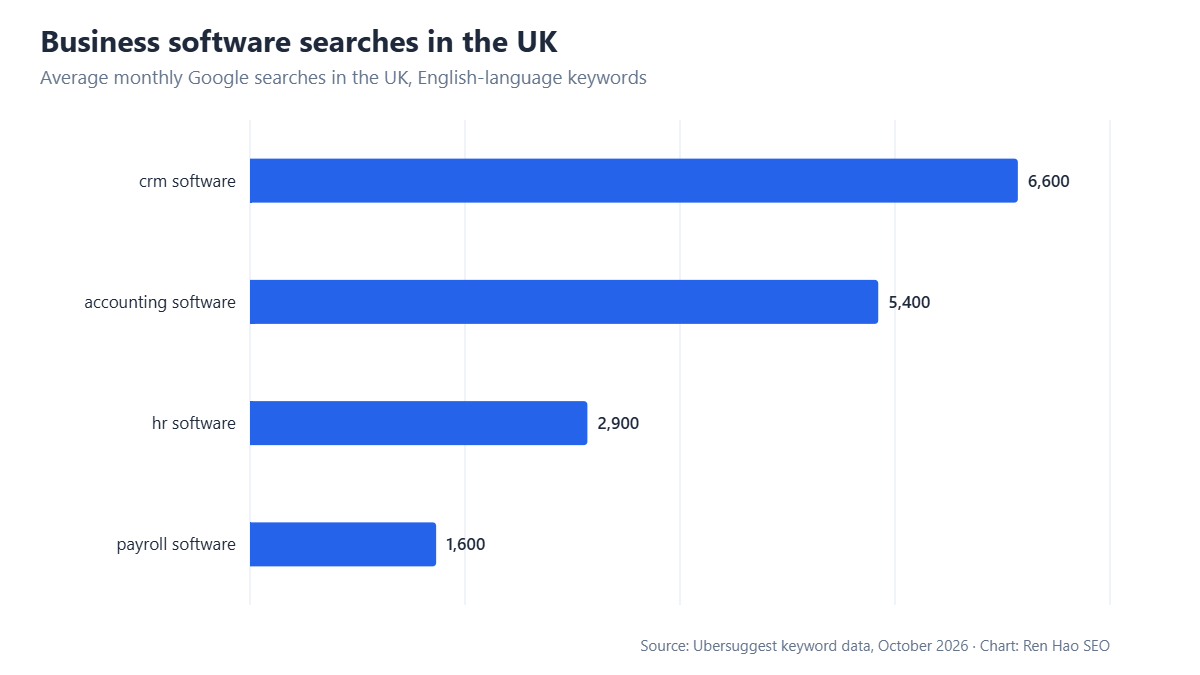
UK buyers search for software by category in large numbers. Ubersuggest data for October 2026 shows about 6,600 searches a month in the UK for “crm software”, 5,400 for “accounting software”, 2,900 for “hr software” and 1,600 for “payroll software”. Each search is a buyer building a shortlist.
Demand and competition differ from city to city. Our city-by-city SEO comparison for the UK helps you decide where to focus first.
Planning to bring in outside help? Use our guide to choosing an SEO agency in the UK to run the selection on your terms.
Volume and difficulty do not move together. “Accounting software” has a keyword difficulty of 68, while “crm software”, with more searches, scores 15 in this dataset. Check the difficulty of your own category before assuming the head term is out of reach, and where it is high, the sub-categories and UK-specific questions around it are where a scale-up establishes itself first.
We cover the wider context in SEO for UK SaaS Scale-Ups: From Seed to Series C, which is worth reading alongside this article.
Why SaaS SEO is different
SaaS buyers move through a long, research-heavy journey — from problem awareness to solution research to vendor comparison to decision. Each stage has different search intent, and content that only targets bottom-funnel terms misses most of the opportunity. UK SaaS SEO has to serve the whole journey, building trust at each stage.
The highest-value terms are also fiercely contested, often by well-funded global competitors. Ranking for a keyword is worthless unless it attracts the right buyer and converts to a demo — which is why SaaS SEO must be measured against pipeline, not traffic.
Building topical authority
The winning SaaS SEO strategy is topical authority: comprehensive, expert depth across the themes closest to your product and your buyers’ decisions, rather than thin content scattered across unrelated topics. Google rewards genuine expertise, and buyers trust depth. This is the single biggest lever for UK SaaS brands.
It starts with mapping your buyers’ real search journey, then building clusters of content that cover each theme thoroughly and link together logically. Our SaaS SEO service is built around this.
How organic lowers CAC
Paid acquisition cost rises with competition and stops the moment you pause spend. Organic does the opposite: as topical authority compounds, the cost per acquisition falls and the channel keeps working. For UK SaaS companies under margin pressure, this shift from paid-dependence to a compounding organic channel is transformative — as one of our case studies shows (320% organic growth in 8 months).
Don't forget AI search
Increasingly, UK SaaS buyers research using AI tools — ChatGPT, Perplexity and Google AI Overviews. Being cited in those answers is becoming as important as ranking in traditional results. Topical authority and genuine expertise help here too. See our AI search guide and AI SEO service.
The SaaS buying journey and how SEO maps to it
B2B SaaS has one of the longest and most research-heavy buying journeys in business, and SEO succeeds or fails on how well it maps to that journey. A typical UK SaaS buyer moves through several stages: problem awareness (realising they have a problem worth solving), solution research (understanding the categories of solution available), vendor comparison (evaluating specific providers), and decision (final selection, often by a buying committee). Each stage has different search intent, and content that targets only the bottom of the funnel — “best [product] for [use case]” — misses the much larger pool of buyers earlier in their journey.
Effective SaaS SEO builds content for every stage, earning trust early and staying present through to the decision. This is why topical authority — comprehensive depth across the themes your buyers care about — beats scattered, bottom-funnel-only content. See our SaaS SEO service for how we build this in practice.
Building topical authority: the core SaaS SEO strategy
Topical authority is the single most powerful lever in SaaS SEO. Rather than publishing thin content across many unrelated topics, you build comprehensive, genuinely expert depth around the themes closest to your product and your buyers’ decisions. Google rewards demonstrated expertise, and buyers trust depth — so a cluster of interlinked, authoritative content on a core theme consistently outperforms a scattering of shallow posts.
The method is systematic: map your buyers’ real search journey, identify the core themes, then build content clusters that cover each theme thoroughly and link together logically. A ‘pillar’ page covers the theme broadly; supporting pages go deep on subtopics; internal links tie them into a coherent, authoritative whole. Done well, this both ranks and converts, and it compounds over time. Google Search Central documents how Google evaluates helpful, expert content if you want the primary source.
How SaaS SEO lowers customer acquisition cost (CAC)
For UK SaaS companies under pressure from rising paid acquisition costs, the strategic prize of SEO is a lower, compounding CAC. Paid CAC tends to rise as competition for keywords increases, and it stops delivering the moment you pause spend. Organic behaves differently: as topical authority compounds, more qualified buyers find you without per-click cost, and the channel keeps working. Over 12–24 months, this can transform unit economics — shifting a business from paid-dependence to a durable, lower-cost organic engine.
One of our UK SaaS clients grew organic traffic 320% in eight months and turned organic into their biggest pipeline source — the full story is in our SaaS case study. As always, results vary by starting point and competition, and we set realistic expectations in line with the Business Protection from Misleading Marketing Regulations 2008.
Product-led SEO and programmatic content
Many of the most successful SaaS SEO strategies are product-led: turning the product itself, or the data and use cases around it, into content that ranks. This can include free tools, templates, integration pages, comparison pages and use-case pages — content that captures high-intent search while showcasing the product. Done at scale, this becomes programmatic SEO: systematically generating many high-quality, genuinely useful pages from structured data (for example, an integration page for each supported tool).
The caution is quality: programmatic pages must be genuinely useful, not thin auto-generated filler, or Google will ignore them. The principle is the same as everywhere in SaaS SEO — depth and genuine value win.
SaaS SEO and AI search
- Increasingly, UK SaaS buyers research using AI tools — ChatGPT, Perplexity and Google’s AI Overviews — and being cited in those answers is becoming as important as ranking in traditional results. The good news is that the foundations overlap: genuine topical authority, clear and well-structured content, and demonstrable expertise help you get cited by AI just as they help you rank. Google's announcements on AI in Search is the place to track how Google’s AI search features are evolving.
- For SaaS specifically, this means structuring content so AI systems can extract clear answers — concise definitions, comparison tables, FAQs and well-organised explanations. See our AI search guide and AI SEO service for how we approach it.
Technical SEO for SaaS sites
SaaS sites have specific technical SEO needs. Many are built as JavaScript-heavy single-page applications, which can create crawling and indexing challenges if not handled correctly — Google must be able to render and index your content. Site architecture matters enormously for distributing authority across content clusters. And because SaaS competes globally, Core Web Vitals and performance are table stakes. Our technical SEO service covers these, guided by Google's Core Web Vitals guidance.
The practical priority order for a SaaS site is usually: ensure content is crawlable and indexable, then fix performance and Core Web Vitals, then optimise architecture and internal linking to concentrate authority where it matters. Get these right and your topical-authority content can actually rank.
Measuring SaaS SEO success
Because SaaS SEO serves a long buying journey, measuring it well means looking beyond traffic to pipeline. The metrics that matter are organic-sourced trials, demos and qualified pipeline, tracked over 6–18 months as the strategy compounds. Traffic and rankings are leading indicators, useful only insofar as they translate into qualified buyers entering the funnel. Attribution in a multi-touch B2B journey is genuinely hard, so we focus on the trend in organic-sourced pipeline rather than chasing perfect last-click attribution.
If you want to see what this could look like for your UK SaaS business, start with a free audit, or explore our SaaS SEO and B2B SEO pages.
Competing with global SaaS players from the UK
A defining challenge for UK SaaS companies is that they often compete for the same keywords as well-funded global players with large content teams and strong domains. Trying to out-publish a global competitor head-on is usually a losing game. The winning strategy is sharper: concentrate authority on the themes where you can genuinely win — your specific niche, your strongest use cases, underserved subtopics, and where relevant, the UK market context that global players overlook. Depth and focus beat breadth when you are the smaller player.
the UK context can be a genuine advantage here. Global SaaS content is often generic; content that speaks to the UK regulatory requirements, local integrations, the UK pricing and tax considerations, or the UK customer needs can win local buyers that global competitors do not serve well. Combined with genuine topical depth on your core themes, this lets a focused UK SaaS company carve out strong organic positions despite the global competition. See our SaaS SEO and B2B SEO pages for how we build this focus.
Content strategy across the SaaS funnel
A complete SaaS SEO content strategy serves the whole funnel deliberately. Top-of-funnel content targets the problems your buyers are trying to solve, capturing them early and building awareness and trust — educational guides, problem-framing content, industry insights. Middle-of-funnel content addresses solution categories and approaches, helping buyers understand their options. Bottom-of-funnel content targets high-intent commercial queries — comparisons, alternatives, use-case and integration pages — where buyers are close to a decision. Each stage needs different content, and neglecting any stage leaves money on the table.
The art is in the linking and the balance. Bottom-funnel pages convert but have limited search volume; top-funnel content has volume but converts slowly. Internal linking ties them together, channelling the authority and traffic from high-volume educational content toward the commercial pages that convert. This is topical authority in action — and it is why a scattered, bottom-funnel-only approach underperforms a deliberate full-funnel content strategy.
Retention, expansion and the role of SEO content
SEO content’s value to a SaaS business does not end at acquisition. The same authoritative content that attracts new buyers also supports onboarding, retention and expansion — help content, best-practice guides and use-case content that ranks in search also serves existing customers, reducing support load and increasing product adoption. For SaaS, where retention and expansion drive long-term value, this dual role makes content investment especially efficient: one well-built content asset can attract a prospect, convert them, and then help retain and expand them.
This is why the most sophisticated UK SaaS SEO strategies treat content as a long-term asset serving the whole customer lifecycle, not just a top-of-funnel acquisition tactic. It also reinforces topical authority and E-E-A-T, compounding the SEO benefit. To explore how this fits your SaaS business, start with a free audit.
Frequently asked questions about SaaS SEO in the UK
How is SaaS SEO different from regular SEO? SaaS SEO must serve a long, research-heavy B2B buying journey across multiple stages, build topical authority rather than chase scattered keywords, and be measured against pipeline and demos rather than raw traffic. The competitive terms are often contested by well-funded global players, so focus and depth matter more than breadth.
How long does SaaS SEO take to show results? Because SaaS buying cycles are long and the terms competitive, meaningful pipeline impact typically builds over 6–18 months and compounds from there. It is a longer game than local SEO, but the compounding payoff — a lower, durable customer acquisition cost — is substantial.
Does SEO actually lower CAC for SaaS? Yes, over time. As organic authority compounds, more qualified buyers find you without per-click cost, lowering blended acquisition cost — unlike paid, which stops the moment you stop spending. One UK SaaS client we worked with grew organic traffic 320% in eight months; see the case study.
What is topical authority and why does it matter for SaaS? It is comprehensive, genuinely expert depth across the themes closest to your product and your buyers’ decisions, rather than thin content scattered across unrelated topics. It is the single biggest lever in SaaS SEO because Google rewards demonstrated expertise and buyers trust depth.
Can a UK SaaS compete with global competitors in search? Yes, by being focused rather than trying to out-publish them everywhere — concentrating authority on your specific niche and strongest use cases, and leveraging the UK-market relevance that global players overlook. See our SaaS SEO page.
What makes a UK buyer choose you over a US vendor
Most of your competitors for these searches are American. They seldom answer the questions a UK buyer has to settle before signing, and that is your opening:
- Pricing in pounds, stated excluding VAT, so it matches how UK procurement compares quotes.
- How the product meets UK requirements in your category: Making Tax Digital compatibility for accounting, HMRC payroll reporting, UK employment law for HR.
- Where data is hosted and how you comply with UK GDPR, with a data processing agreement a buyer can download.
- For public-sector buyers, whether you are listed on the G-Cloud framework.
A clear page for each of these gives buyers, and the AI assistants they consult, a reason to name you. Our SaaS SEO service builds them into the comparison stage of your funnel.
Build the UK reference position one sub-category at a time
UK SaaS head terms are often held by well-funded incumbents, and a scale-up rarely wins them directly. The route that works is to become the clear reference for the UK-specific questions and sub-categories around the head term, where difficulty is lower and buyers are closer to a decision, and let the head-term ranking follow the authority that builds.
- 1Map the UK-specific questions in your categoryMaking Tax Digital, PAYE and pensions auto-enrolment, VAT schemes, UK GDPR, IR35: each creates searches a US-written page cannot answer. List the ones your buyers ask in sales calls.
- 2Answer each on its own page under a named expertGBP pricing including VAT treatment, the HMRC or ICO source linked, and your own product’s handling of the rule explained plainly.
- 3Win the sub-category before the category“Payroll software for UK charities” or “CRM for UK estate agents” is winnable in months; “payroll software” may take years. Build the specific pages first and link them to a category hub that gains authority from them.
- 4Add UK proof as it arrivesNamed UK customers by sector, results in UK terms, and recognition from UK trade bodies. This is what makes the category hub credible when it starts to compete for the head term.
Scale-ups that follow this order tend to find the head term becomes reachable once the surrounding sub-categories are held, because by then the site is plainly the UK reference for the topic.
Avoiding the most common SaaS SEO mistakes
Across UK SaaS companies we have worked with and audited, a recognisable set of mistakes recurs, and avoiding them is half the battle. The most common is a bottom-funnel-only obsession: pouring all content effort into a handful of high-intent commercial keywords while ignoring the much larger pool of buyers researching earlier in their journey. This caps growth, because you compete fiercely for a small volume of terms and miss the chance to build trust before the decision. The second common mistake is scattered, shallow content — publishing across many unrelated topics in pursuit of traffic, which fails to build the topical authority that actually drives sustainable rankings. The third is neglecting the technical foundations specific to SaaS, particularly JavaScript rendering and site architecture, so that even good content cannot rank.
The fourth mistake is impatience — judging SEO on a 3-month horizon when SaaS buying cycles and competitive terms demand 6–18 months to compound — and the fifth is measuring the wrong things, celebrating traffic and rankings while losing sight of whether organic is actually generating qualified pipeline. Each of these is avoidable with a disciplined, data-driven approach: build full-funnel topical authority rather than chasing scattered keywords, fix the SaaS-specific technical foundations first, commit to a realistic timeline, and measure against pipeline rather than vanity metrics.
The UK SaaS companies that get these right turn organic search into their most efficient, compounding acquisition channel — as one of our clients did, growing organic traffic 320% and making it their largest pipeline source (see the case study). As always, results depend on your starting point and market, and we set realistic expectations in line with the Business Protection from Misleading Marketing Regulations 2008.
A practical SaaS SEO roadmap, stage by stage
Bringing the strategy together, here is the sequence a serious UK SaaS SEO programme typically follows, in the order that builds durable results. It begins with foundations and research: a technical audit to ensure the site (often a JavaScript-heavy application) can be crawled, rendered and indexed, alongside deep research into the buyer journey, the competitive landscape and the core themes where you can genuinely win authority. Trying to produce content before this groundwork is laid wastes effort on a foundation that cannot support it. With foundations solid, the programme moves to building topical authority: developing comprehensive content clusters around your core themes, structured across the full funnel from problem-awareness through to commercial comparison, and tied together with deliberate internal linking that channels authority to the pages that convert.
As authority compounds, the programme broadens — expanding into adjacent themes, building product-led and programmatic content where it adds genuine value, earning relevant authority through white-hat links and digital PR, and optimising for AI search visibility alongside traditional rankings. Throughout, measurement focuses on organic-sourced trials, demos and qualified pipeline over a 6–18 month horizon, rather than vanity traffic, so investment can be steered toward what actually generates revenue. This is not a linear, set-and-forget plan but an iterative, data-driven cycle: build, measure, learn and refine, with each cycle compounding on the authority built before it.
UK SaaS companies that follow this disciplined sequence — foundations first, then full-funnel topical authority, then expansion and optimisation, all measured against pipeline — turn organic search into their most efficient and durable growth channel. To map this roadmap to your specific SaaS business, explore our SaaS SEO service and start with a free audit.
Search volumes and keyword difficulty scores are from Ubersuggest (October 2026).
Written by the Ren Hao SEO team and reviewed by Ren Hao, founder and lead SEO strategist. Ren Hao SEO is a data-driven international SEO agency serving UK businesses, with 100+ SEO audits and £1M+ in client sales value generated. We publish openly because an informed audience makes better decisions — and under the Business Protection from Misleading Marketing Regulations 2008, we never guarantee rankings.