
London vs Other Cities SEO in the UK: How Local Search Differs
the UK is a large, diverse country, and its commercial geography is far from uniform — and for local SEO that matters. Competition, buyer intent and industry mix differ sharply between London, Manchester and the country’s other commercial centres. This guide explains how local search differs across the UK and how businesses in each area can win, drawn from real client work, with honest, data-grounded guidance.
- The London and Manchester are the UK’s most competitive SEO markets — finance, professional services, retail and aesthetics.
- Regional cities (Birmingham, Leeds, Glasgow) are less saturated, so disciplined local SEO can win visibility efficiently.
- Buyer intent differs: London search is high-value B2B and commercial; regional search is proximity-driven and local.
- Strategy must reflect each region’s competition and intent — not a single generic the UK template.
Where demand for SEO sits across UK cities
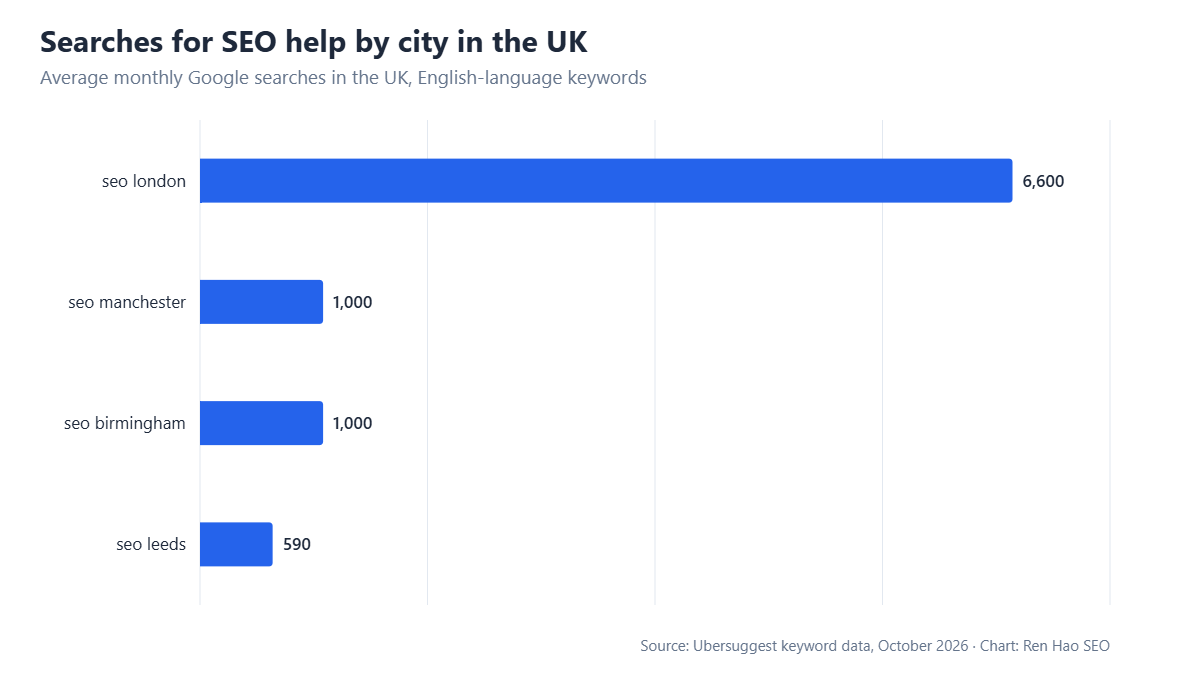
Searches for SEO help are a fair measure of how hard each city’s businesses are competing online. Each month Google sees roughly 6,600 searches for “seo london”, 1,000 for “seo manchester”, 1,000 for “seo birmingham” and 590 for “seo leeds” (Ubersuggest, October 2026). London’s lead is expected; what matters for planning is that Manchester and Birmingham are level, and that Leeds, Glasgow and the other regional centres sit well below them. Outside London, a well-run local campaign still has room to become the obvious name in its category.
If you are comparing providers, how to choose an SEO agency in the UK gives you a selection process and the checks to run before you sign.
For the wider commercial argument, see our case for SEO in the UK.
Property search behaves differently in London than in Manchester, with portals dominating the head terms in both. Our UK real estate SEO service explains where independent agents can still win.
The North is where the gap between London and the regions is widest and the window is still open. Our follow-up on SEO in Manchester and the North beyond London works through the borough-level structure, sector opportunities and trust signals that win there.
For a closer look at this topic, see London Fintech SEO: Ranking in a Regulated Financial Hub.
Property illustrates that regional openness perfectly: portal dominance is absolute in the capital’s listing queries, but vendor-side and area demand across regional markets rewards local depth. Our playbook on UK property SEO alongside Rightmove and Zoopla maps the winnable territory.
What each UK city rewards
You know which of these places your customers come from. Use the notes below to match your effort to what each market responds to.
- ✓Finance, legal, technology and professional services compete at borough level, against firms with strong domains. Depth, evidence and relevance for the specific boroughs you serve decide who is found.
- ✓Digital, media and professional services are well established, and local buyers respond to northern case studies and references over London ones.
- ✓Manufacturing, B2B and professional services lead. Search demand for SEO equals Manchester’s, with many categories still open to a well-evidenced local specialist.
- ✓A legal and financial services hub with a strong SME base. Sector-specific pages and local proof do more than broad regional content.
- ✓Scotland’s largest city, where services, retail and hospitality lead and buyers look for Scottish proof and references.
Decide whether to compete in London at all
For many UK businesses the right first move is not to fight for London rankings. London searches carry the highest competition, the strongest incumbent domains and the most expensive paid clicks in the country, while a regional city with a fifth of the demand can be won in a fraction of the time. The question to answer first is whether your business needs London, or whether London is simply where the biggest numbers are.
Work it through in this order:
- 1Map your revenue by cityIf most of your customers are in the North West or the Midlands, that is your first market whatever the national figures say. If London is your biggest market, plan for a longer, better-funded campaign.
- 2Choose the boroughs, not the capitalBusinesses that do need London win it borough by borough: a page for the areas you genuinely serve, with local projects, reviews and references, outperforms one city-wide page.
- 3Own one regional city before the secondManchester, Birmingham, Leeds or Glasgow: a complete location page, a maintained Google Business Profile, local links and sector content. Regional buyers respond to local case studies over London ones.
- 4Carry the proof into the next cityReviews and case studies from each new city are what make the next page credible. A templated page with the city name changed is what Google and buyers both ignore.
- 5Review enquiries by city each quarterLet the numbers, not the map, decide where the budget goes next.
Our local SEO service in the UK and UK city pages are built on this approach.
Why you cannot copy strategy across regions
The biggest mistake is assuming a strategy that works in one part of the UK will work everywhere. Competition, industry mix and local search behaviour differ markedly between the high-value major cities and the proximity-driven regional cities, so keyword priorities, content angles and local signals must be tailored to each. A data-driven approach — starting from each area’s actual search data and competitors — consistently beats a copied template.
This is why we build dedicated strategies for each UK region rather than a single generic page. See our local SEO pages for each region, or our broader local SEO the UK guide and Google Business Profile guide.
Market size and economic structure
the UK’s major cities and regional cities differ sharply in competition and intent, but their economic structures differ in ways that shape SEO strategy. London is the country’s financial capital, with a dense concentration of banking, insurance, professional services and property businesses, plus the largest technology and startup cluster. Manchester has a more diverse economic base — strong in retail and eCommerce, hospitality and events, education, healthcare and a fast-growing tech scene — and famously distinct inner-district identities that shape local search behaviour. the Office for National Statistics (ONS) publishes the underlying economic data if you want the primary source.
These differences matter because they determine which keywords are most contested, what content resonates, and how buyers search. A strategy calibrated for London’s finance-heavy, brand-dominated landscape will not automatically work in Manchester’s diverse, neighbourhood-conscious market.
Competition and cost: a head-to-head
Both cities sit at the higher end of the UK SEO costs because both are genuinely competitive, but the nature of the competition differs. In London, competition is concentrated and intense in a few high-value verticals — finance, legal, property, professional services — where established brands have spent years building authority. Breaking in requires significant, sustained investment and genuine authority-building. In Manchester, competition is broader: many sectors are contested at once, and local relevance and reviews often decide who wins, especially in retail, hospitality and services.
For budgeting, this means a competitive London finance or legal campaign typically sits toward the top of the UK ranges, while Manchester campaigns vary more by sector. Our SEO pricing guide covers the GBP ranges in detail, and our city pages for London and Manchester explain how we approach each.
Search behaviour: how the major cities and regional centres buyers differ
The clearest practical difference is in how locals search. London’s sheer size means searchers frequently qualify by region or neighbourhood — “Birmingham”, “Leeds East”, “Yorkville” — because proximity matters across such a large metropolitan area. Region- and neighbourhood-level targeting consistently outperforms generic city-wide pages in London. Melburnians, meanwhile, search with strong neighbourhood and lifestyle intent tied to each area’s distinct identity — a cafe “in Yorkville”, a dentist “in Scarborough” — and content tuned to those identities performs best.
The lesson is the same in both cities but expressed differently: hyper-local relevance beats generic city-wide content. The specifics of how you achieve it differ by city, which is why we never copy a strategy between them.
Why you cannot copy a strategy between cities
The single most common mistake businesses make when expanding from one city to another is assuming what worked in the first will work in the second. It rarely does. Different competition, different industry mix, different search behaviour and different local signals mean that keyword priorities, content angles and local tactics all need recalibrating. A data-driven approach — starting from each city’s actual search data and competitor landscape — consistently beats a copied template.
This applies across the UK, not just the major cities and regional centres. Birmingham, Leeds and Glasgow each have their own dynamics, covered on our local SEO pages and in our complete local SEO guide.
Expanding from one city to the other: a practical playbook
- 1Start with data, not assumptionsResearch the new city’s actual search demand, competition and buyer behaviour before committing to keywords or content.
- 2Build genuine local relevanceA real Google Business Profile, local citations and city-specific content — not a thin copy of your existing pages.
- 3Respect the local competitive realityBudget and timeline should reflect the new city’s competition, which may be very different from your home market.
- 4Measure each market separatelyTrack enquiries and revenue by city so you can see what is actually working where, and reallocate accordingly.
Industry deep-dive: which sectors are hardest in each city
Drilling into specific sectors reveals how different the two markets really are. In London, the hardest, most expensive SEO battles are in financial services, law, and property — sectors where established firms have spent years and large budgets building authority, and where a single client can be worth a great deal, so competition for every keyword is intense. Professional services and technology are also highly competitive. In Manchester, the toughest sectors include retail and eCommerce, hospitality, and professional services, reflecting the city’s diverse, consumer-facing economy; competition is spread across more sectors rather than concentrated in a few.
For a business choosing where and how to compete, this matters. A financial services firm faces a steeper, costlier climb in London than almost anywhere else in the UK; a hospitality or retail brand faces its hardest competition in Manchester. Knowing your sector’s competitive intensity in each city lets you set realistic budgets and timelines — and sometimes reveals that a less obvious city or a sharper local focus offers better returns. Our city pages for London and Manchester go deeper on each market.
Practical strategy differences
These market differences translate into concrete strategic choices. In London, given the size of the metropolitan area and the strength of regional identities, a winning strategy usually leans hard into region- and neighbourhood-level targeting — building genuine relevance for Birmingham, Leeds, Glasgow and the wider regionals rather than competing only for the broadest, most contested city-wide terms. In Manchester, the strategy leans into the city’s distinct neighbourhood identities and sector diversity — content and profiles tuned to specific neighbourhoods and the particular way Melburnians search for each type of business.
In both cities, the data-driven principle holds: start from the actual search demand and competitive landscape, not assumptions, and build genuine local relevance rather than thin, templated pages. The specifics differ, which is precisely why a strategy cannot be lifted wholesale from one city to the other. For the broader national picture and how the other cities compare, see our complete local SEO guide and local SEO pages.
Choosing where to focus your SEO investment
For UK businesses operating in or expanding across multiple cities, one of the most valuable strategic decisions is where to concentrate SEO investment. The instinct is often to chase the biggest markets — the major cities and regional centres — but the smartest decision depends on your sector’s competition, your margins, and where your best opportunities actually lie. Sometimes the highest return comes not from fighting the most expensive London terms head-on, but from dominating a less-contested market, a specific region, or a sharper niche where your authority can win faster and more cheaply.
This is fundamentally a data question: where is the winnable demand, at what cost, for what return? A data-driven analysis of search demand, competition and your unit economics across cities reveals the answer, which is rarely ‘spend everything on the biggest city’. We help UK businesses make this allocation deliberately — start with a free audit to map your best opportunities across markets.
Frequently asked questions about the major cities and regional centres SEO
Is SEO more competitive in London or Manchester? London is generally the UK’s most competitive SEO market overall, especially in finance, law, property and professional services, where established brands dominate. Manchester is also highly competitive but across a broader range of sectors — retail, hospitality, services and tech — rather than concentrated in a few.
Is SEO more expensive in London or Manchester? Both sit at the higher end of the UK SEO costs because both are genuinely competitive. The specific cost depends far more on your sector and its competition than on the city alone — a competitive London finance campaign and a competitive Manchester retail campaign can both sit near the top of the UK ranges. See our SEO pricing guide.
Can I use the same SEO strategy in both cities? No — competition, industry mix and local search behaviour differ enough that a strategy should be recalibrated for each city using local data, not copied wholesale. London rewards strong region- and neighbourhood-level targeting across a vast metro area; Manchester rewards tuning to its distinct neighbourhood identities and diverse sectors.
Should I focus my SEO on London or Manchester first? It depends on where your best, most winnable opportunities are — which is a data question about demand, competition and your margins in each market, not simply ‘the bigger city’. Sometimes a sharper focus on one city, a specific region, or even a less-contested city delivers a better return than splitting effort. A free audit maps this across markets.
Do you provide SEO outside the major cities and regional centres? Yes — we serve businesses across all major cities and regions, including Birmingham, Leeds and Glasgow.
Operating an SEO campaign across both cities at once
Many growing UK businesses do not have to choose between the major cities and regional centres — they operate in both, and need an SEO strategy that wins in each simultaneously. Doing this well requires treating the two markets as genuinely distinct campaigns under one coherent strategy, rather than a single campaign stretched across both. In practice this means separate keyword research and competitive analysis for each city, recognising that the high-value, winnable terms differ; city-specific landing pages and local profiles built with genuine local relevance rather than duplicated templates; and measurement that tracks enquiries and revenue by city, so you can see what is working where and reallocate effort to the better-performing market. The shared elements — your core site authority, your brand content, your technical foundations — lift both cities at once, while the local layer is tailored to each.
The most common failure mode is treating the second city as an afterthought: bolting a thin ‘Manchester’ page onto a London-focused site, or vice versa, and expecting it to rank. It rarely does, because it lacks the genuine local relevance and authority that local ranking demands. The alternative failure is over-investing equally in both when the data shows one city offers far better returns for your sector. A data-driven approach sidesteps both: it allocates effort to each city in proportion to the winnable opportunity there, builds genuine local relevance in each, and measures results separately so the allocation can be refined over time. This same discipline extends naturally if you later expand to Birmingham, Leeds or other markets — each treated as its own market within a coherent national strategy. To map your multi-city opportunity, start with a free audit.
What both cities teach us about the UK SEO generally
The contrast between the major cities and regional centres is instructive far beyond these two areas, because it illustrates principles that apply to SEO across all of the UK. The first principle is that local context is decisive: the same business, the same service, the same keywords behave differently in different UK markets because competition, search behaviour and local identity vary. Generic, context-free SEO underperforms everywhere; data-driven, locally-tuned SEO wins. The second principle is that competition intensity should shape strategy and budget: a highly contested market demands more investment and a sharper focus (often on regions, neighbourhoods or niches) than a less-contested one, and pretending otherwise leads to under-funded campaigns that never break through.
The third principle is that hyper-local relevance beats generic breadth. In both cities, and across the UK, businesses win local search by being genuinely, specifically relevant to the areas and audiences they serve — not by publishing thin, broad content that tries to cover everything. This is why we build genuinely unique city and location pages rather than templated ones, and why we start every campaign from each market’s actual search data. Whether you operate in one the UK city or many, these principles hold: understand the local context, match investment to competition, and build genuine relevance. For the broader national picture, see our complete local SEO guide and the full set of UK city pages.
From single-city focus to national SEO leadership
For ambitious UK businesses, mastering SEO in one competitive city is often the first step toward national organic leadership — and the way you build in your home city shapes how readily you can expand. A business that builds genuine authority, excellent technical foundations and a strong content asset while winning in London or Manchester creates a platform that makes expansion to other markets faster and cheaper, because the core site authority lifts every new market it enters. Conversely, a business that wins its home city through thin or risky tactics has nothing durable to build on when it tries to expand. The lesson is that how you win matters as much as whether you win: genuine, compounding authority travels and scales, while shortcuts do not.
A national SEO strategy, then, is best understood as a coherent whole — strong central site authority and brand content lifting every market, with locally-tuned relevance built for each city in turn — rather than a series of disconnected local campaigns. The city you start with becomes the proving ground for the approach you will scale: data-driven market analysis, genuine local relevance, technical excellence and patient authority-building, applied city by city as the economics justify. This is how we help UK businesses move from single-city strength to national organic leadership across Birmingham, Leeds, Glasgow and beyond — each market treated seriously within one strategy. To map your path from your home city to national reach, start with a free audit.
Final thoughts: choosing your UK SEO battleground wisely
The comparison between the major cities and regional centres ultimately points to a broader strategic truth about SEO in the UK: success comes not from fighting the most obvious or prestigious battles, but from choosing your battlegrounds wisely based on where you can genuinely win. The instinct to compete for the biggest, broadest, most contested terms in the largest cities is understandable but frequently self-defeating, because those battles demand the most investment and the most patience while delivering the slowest returns against the most entrenched competitors.
The smarter strategy, revealed clearly by contrasting these two markets, is to bring data to the decision: understand the actual search demand, the real competition and your own economics in each market, region and niche, then concentrate your effort where the winnable opportunity is greatest — which is often a sharper regional or neighbourhood-level focus, a specific high-value niche, or even a less-contested segment, rather than the broadest city-wide terms in the most crowded markets.
This data-driven, opportunity-focused approach is the throughline of effective the UK SEO whether you operate in one city or many. It means building genuine local relevance rather than thin templated pages; matching your investment and timeline to the real competition you face; integrating local SEO with your wider site authority and conversion efforts; and measuring everything against genuine enquiries and revenue rather than vanity rankings. Applied across markets, it builds toward national organic strength one winnable battle at a time. the major cities and regional centres are the most distinct battlegrounds, but they are not the only ones, and the businesses that win nationally are those that choose where and how to compete with evidence rather than instinct. To map your own best opportunities — in London, Manchester, or across the UK’s other major-city markets — start with a free, data-driven audit and read our complete local SEO guide.
Search volumes are from Ubersuggest (October 2026).
Written by the Ren Hao SEO team and reviewed by Ren Hao, founder and lead SEO strategist. Ren Hao SEO is a data-driven international SEO agency serving UK businesses, with 100+ SEO audits and £1M+ in client sales value generated. We publish openly because an informed audience makes better decisions — and under the Business Protection from Misleading Marketing Regulations 2008, we never guarantee rankings.