
Legal SEO in Singapore: How Law Firms Win Search in 2026
SEO for Singapore law firms is one of the most competitive and demanding niches in search — high-value keywords, established competitors, strict trust requirements and regulatory constraints all at once. This data-driven guide covers exactly how law firms win Singapore search in 2026: balancing intense local competition, the ‘Your Money or Your Life’ trust bar, and compliant, genuinely helpful content. Drawn from real work in competitive professional-services markets, with no ranking guarantees.
- Legal is a ‘Your Money or Your Life’ niche — Google demands strong expertise and trust signals (E-E-A-T).
- Local intent is high and competition fierce, especially in capital cities; neighbourhood and practice-area targeting wins.
- Content must be genuinely helpful and compliant — never misleading, in line with the Consumer Protection (Fair Trading) Act.
- Practice-area depth plus local relevance, on sound technical foundations, is the winning combination.
What Singapore clients search for: demand by practice area
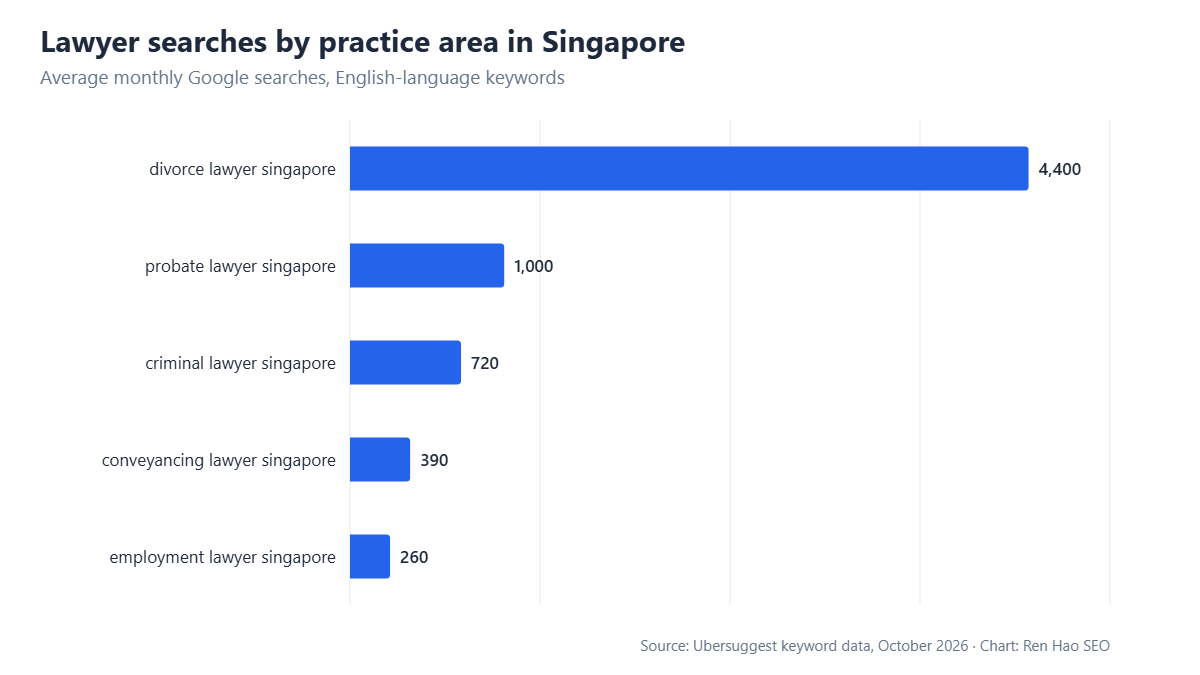
Demand for lawyers in Singapore is concentrated in a few personal practice areas. Ubersuggest data for October 2026 shows about 4,400 searches a month for “divorce lawyer singapore”, against 1,000 for “probate lawyer singapore”, 720 for “criminal lawyer singapore”, 390 for “conveyancing lawyer singapore” and 260 for “employment lawyer singapore”. Family law draws more searches than the other four combined.
Difficulty does not follow volume. The probate and conveyancing terms have keyword difficulty scores of 15 and 13, far lower than divorce at 37, so a firm with real depth in estates or property can reach page one sooner there than in the most crowded category. Corporate and commercial work shows little search demand of this kind because those clients arrive by referral and reputation, which calls for thought-leadership content more than practice-area landing pages.
If you want the practical next step on this point, our guide on Tuition & Enrichment SEO: Singapore’s Education Search Market goes into the detail.
The same regulated-industry logic applies to financial services — our Singapore fintech SEO guide covers the MAS-aware version of the playbook.
Why legal SEO is uniquely demanding in Singapore
Singapore law firms face a perfect storm of SEO challenges. The keywords are extremely valuable — a single client can be worth a great deal — so competition for terms like “commercial lawyer Singapore” or “family lawyer Singapore” is intense, with established firms that have invested heavily for years. At the same time, legal is a ‘Your Money or Your Life’ (YMYL) category, meaning Google applies its highest scrutiny to expertise, authoritativeness and trustworthiness, because poor legal information can seriously harm people. And law firms operate under professional and advertising rules, plus the Consumer Protection (Fair Trading) Act, that constrain what they can claim.
Winning in this environment requires more than generic SEO. It demands genuine demonstrable expertise, sharp local and practice-area targeting, compliant and genuinely helpful content, and sound technical foundations — all working together. This is why we approach legal SEO as a specialist discipline, detailed on our legal SEO service page, rather than applying a generic playbook.
E-E-A-T: the heart of legal SEO
Because legal is YMYL, E-E-A-T — Experience, Expertise, Authoritativeness and Trustworthiness — sits at the centre of any successful legal SEO strategy. Google wants to see that content is created or reviewed by genuinely qualified people, that the firm is a recognised, trusted authority, and that information is accurate and current. Practically, this means real author bylines with genuine credentials (the actual lawyers, with their qualifications and experience), content that demonstrates deep practice-area expertise, and the kind of authority — through quality content and earned links — that makes the wider web treat the firm as trustworthy.
This same emphasis now extends to AI search, where AI answer engines lean heavily on E-E-A-T when deciding which sources to cite for legal questions — a connection we explore in our AI search guide. For law firms, building genuine, demonstrable expertise is not optional; it is the foundation everything else rests on.
Local and practice-area targeting
Legal search is overwhelmingly local and practice-specific: people search for a particular type of lawyer in a particular place. This shapes the whole strategy. Rather than competing only for the broadest, most contested terms, successful firms build genuine relevance for specific combinations of practice area and location — family law in a particular region, commercial litigation in a specific city, conveyancing in a defined area. Dedicated, substantial practice-area pages, combined with strong local signals, consistently outperform thin, generic ‘we do everything everywhere’ content.
Local SEO fundamentals matter enormously here too — a complete Google Business Profile, genuine reviews and consistent citations — because much legal search carries strong local intent. Across Singapore’s competitive central districts and the heartlands, sharp region- and area-level targeting is often decisive, a theme covered in our CBD versus heartlands guide.
Compliant, genuinely helpful content
Legal content must walk a careful line: genuinely helpful and authoritative enough to satisfy Google and users, yet compliant with professional advertising rules and the Consumer Protection (Fair Trading) Act on claims. This rules out the misleading, outcome-guaranteeing language some firms are tempted by, and rewards content that genuinely educates — explaining processes, answering the questions clients actually ask, and demonstrating expertise without overpromising. Well-structured, genuinely useful content also performs best in AI search, where clear, accurate answers get cited.
The most effective legal content is built around the real questions and concerns of prospective clients at each stage — from early research (‘what are my rights if…’) through to firm selection. This full-funnel, genuinely helpful approach builds the topical authority and trust that both Google and clients reward, while staying firmly within compliance.
Technical foundations for law firm sites
None of the above can rank if the technical foundations are weak. Law firm sites must be fast, mobile-friendly, crawlable and well-structured, with appropriate schema (including LocalBusiness and, where relevant, attorney/legal-service markup) to help Google understand the firm, its lawyers and its practice areas. Clean site architecture — organising content logically by practice area and location, tied together with internal links — both helps users navigate and helps Google understand and rank the firm’s expertise.
These technical foundations are covered in our technical SEO checklist and delivered through our technical SEO service. Get them right, and the genuine expertise and local relevance built on top can actually rank.
Building practice-area authority that ranks and converts
The backbone of effective legal SEO is genuine practice-area depth. Rather than thin, generic pages that claim to cover everything, successful Singapore law firms build comprehensive, authoritative content around each practice area they genuinely want to win — family law, commercial litigation, property, wills and estates, and so on. Each practice area becomes a content cluster: a substantial pillar page covering the area, supported by deeper content answering the specific questions clients ask, all tied together with internal links. This depth demonstrates the expertise Google demands in a YMYL niche and genuinely helps prospective clients, building trust before they ever make contact.
Crucially, this content must be created or genuinely reviewed by qualified lawyers and attributed to them with real credentials — anonymous or generic legal content struggles to rank and to be cited by AI, because E-E-A-T is paramount in legal search. It must also stay strictly compliant: genuinely educational and helpful, never misleading or outcome-guaranteeing, in line with professional advertising rules and the Consumer Protection (Fair Trading) Act. Done well, this practice-area authority both ranks and converts, because the same depth that satisfies Google reassures prospective clients that the firm genuinely knows its field. This is the approach behind our legal SEO service.
Local SEO for Singapore law firms
- Because legal search carries strong local intent, local SEO is central to a law firm’s strategy, not an afterthought. A complete, optimised Google Business Profile is essential, as are genuine reviews (handled carefully given professional conduct considerations) and consistent citations across trusted Singapore and legal directories. For firms with multiple offices, each location needs its own properly-optimised profile and genuinely unique local content — not thin duplicated pages.
- In competitive capital-city markets, the local strategy sharpens further. Rather than competing only for the broadest, most contested city-wide terms, successful firms target specific combinations of practice area and location — building genuine relevance for the regions and neighbourhoods their clients actually come from. This region- and practice-level targeting, explored in our CBD versus heartlands guide and local SEO guide, consistently outperforms generic city-wide effort in the most competitive legal markets.
Compliance, trust and the Consumer Protection (Fair Trading) Act
Legal SEO operates within tighter constraints than most niches, and respecting them is both an ethical and a strategic necessity. Law firm marketing is governed by professional conduct and advertising rules that vary by jurisdiction, alongside the Consumer Protection (Fair Trading) Act’s prohibition on misleading or deceptive claims. This rules out the outcome-guaranteeing, superlative-laden language some firms are tempted by — “we always win”, “guaranteed result” — which is not only non-compliant but also undermines the genuine trust that wins clients. It rewards instead content that is accurate, genuinely helpful, and honest about how legal matters actually work.
Far from being a limitation, this compliance-first approach aligns perfectly with what Google and AI search reward in YMYL categories: accurate, trustworthy, expert content. The firms that win legal SEO are those that build genuine authority and trust through compliant, genuinely useful content — not those that cut corners with misleading claims or thin content. Trust is the currency of legal search, and it is earned through demonstrable expertise and honesty. This is why our approach to legal SEO puts compliance and genuine E-E-A-T at the centre rather than treating them as obstacles.
Measuring legal SEO success
Legal SEO should be measured against what matters to the firm: qualified enquiries and new client matters from organic search, tracked over time, rather than vanity rankings. A page-one ranking for a term that brings no qualified enquiries is worthless; a strong position for a high-intent, high-value practice-area-plus-location term may be transformative. Because legal matters are high-value and the buying decision considered, even modest improvements in qualified enquiry volume can deliver substantial return — but it takes time, as authority and trust build over months in a competitive YMYL niche.
As with all our work, we set realistic, evidence-grounded expectations rather than promising specific rankings or numbers — both because it is honest and because the Consumer Protection (Fair Trading) Act requires it. What we commit to is the disciplined, compliant, data-driven approach that genuine legal SEO success demands. To see what this could look like for your firm, start with a free Singapore SEO audit, and read our guide to choosing an SEO agency to find a partner who understands the specific demands of legal search.
Frequently asked questions about legal SEO in Singapore
How long does legal SEO take to work? In competitive Singapore legal markets, expect meaningful movement over 6–18 months as authority and trust build — faster in less-contested practice areas or regions, slower against entrenched capital-city competitors. There are no guaranteed timelines.
Do I need separate pages for each practice area and location? Yes — dedicated, substantial pages for each genuine practice area, and for each location you serve, consistently outperform thin generic content, provided each page is genuinely unique and useful rather than a duplicated template.
Can I write legal content myself or use AI? Content must demonstrate genuine expertise and accuracy (E-E-A-T) and stay compliant, so it should be created or genuinely reviewed by qualified lawyers. Anonymous or purely AI-generated legal content struggles to rank and risks inaccuracy and compliance problems in a YMYL niche.
Is legal SEO worth it given the competition? For most firms, yes — legal keywords are high-value, so even modest gains in qualified enquiries deliver strong returns. But it requires genuine investment and patience; thin or cheap effort rarely breaks through against established competitors. A free audit will assess your specific opportunity.
What about reviews for law firms? Genuine reviews help, but must be handled carefully given professional conduct rules — never fake or improperly incentivise them, and follow your jurisdiction’s guidance on testimonials, in line with the Consumer Protection (Fair Trading) Act.
Content strategy for a Singapore law firm
A law firm’s content strategy is the engine of its SEO, and the most effective approach is built around the real journey a prospective client takes — from first realising they may need legal help through to choosing a firm. Early-stage clients are often anxious and uninformed, searching broad questions: what their rights are, what a process involves, whether they even have a case. Content that genuinely and accurately answers these questions — without overpromising — builds trust and captures clients early, long before they are ready to choose a firm. Mid-journey, clients compare approaches and consider their options; later, they evaluate specific firms. A complete content strategy serves every stage, establishing the firm as a knowledgeable, trustworthy authority throughout.
Crucially for a YMYL niche, this content must demonstrate genuine expertise and stay strictly accurate and compliant. That means content created or genuinely reviewed by qualified lawyers, attributed to them with real credentials, and written to educate rather than to make claims that could mislead or breach professional and consumer-law rules. Tied together with strong internal linking — connecting educational content to relevant practice-area pages — this builds the topical authority that ranks while genuinely serving prospective clients. It is also exactly what AI search rewards, positioning the firm to be cited in AI Overviews for legal questions. This content-led approach sits at the heart of our legal SEO service.
Common legal SEO mistakes Singapore firms make
Across the legal sector, a recognisable set of SEO mistakes recurs, and avoiding them is half the battle. The most common is thin, generic content — a handful of short practice-area pages that claim broad expertise without demonstrating any, which fails to rank in a niche where genuine depth and E-E-A-T are decisive. The second is anonymous content with no genuine author credentials, which undermines the expertise signals Google demands for YMYL topics. The third is neglecting local SEO fundamentals — an incomplete Google Business Profile, inconsistent citations, no review process — despite legal search being heavily local.
More serious mistakes include non-compliant marketing language — outcome guarantees, misleading superlatives — that breaches professional rules and the Consumer Protection (Fair Trading) Act and erodes the very trust that wins clients, and engaging cheap or risky SEO providers whose tactics can trigger penalties that are especially damaging for a professional firm. The deepest mistake is impatience: abandoning SEO before the authority and trust that competitive legal markets require have had time to build. Each of these is avoidable with a disciplined, compliant, data-driven approach — genuine expert content, strong local foundations, white-hat methods, and the patience to let authority compound. A free audit will identify which of these are holding your firm back, and our guide to choosing an SEO agency helps you find a partner who understands the specific demands of legal search.
Publicity rules for Singapore law practices
Law firm marketing in Singapore is governed by the publicity provisions of the Legal Profession (Professional Conduct) Rules 2015, supported by the Law Society of Singapore’s practice directions on advertising and media publicity. The principle that matters for SEO is that publicity must not be misleading, which includes unverifiable claims and unjustified expectations of results, and must not be likely to diminish public confidence in the legal profession. That affects everyday content decisions: superlatives and success-rate claims, comparisons with other practices, how you describe a lawyer’s expertise, and how client testimonials and case outcomes are presented.
Treat the rules as part of the brief. Have a lawyer in the practice approve every practice-area page, attribute content to named practitioners with their admission details, and keep a record of the evidence behind any factual claim. The Law Society of Singapore publishes the current rules and practice directions on its website, and they should be checked before a campaign launches.
Where legal searches land, and how to position a firm’s content
For many informational legal queries in Singapore, the first results are official: Singapore Statutes Online for the legislation, the Singapore Courts website for procedure in the Family Justice Courts and State Courts, and government pages on legal aid. A firm will rarely outrank those for “what is” questions, and does not need to. The opportunity is the next question a client asks: what the process means for someone in their position, how long it tends to take, what it costs, and when to instruct a lawyer.
Write for that step. Link to the official source for the rule, then add what only a practitioner can: worked scenarios, typical timelines, fee structures and the documents to prepare. Because clients often search in Chinese, Malay or Tamil for family and estate matters, translated versions of the highest-demand pages are worth considering. Our legal SEO service builds practice-area clusters on this model.
Legal SEO and AI search: getting cited for legal questions
- AI search adds an important new dimension to legal SEO, because many people now research legal questions through AI Overviews and assistants like ChatGPT before contacting a firm. Being the source these AI systems cite for legal questions in your practice areas is becoming a valuable form of visibility — and, encouragingly, it rests on the same foundations as strong legal SEO. AI systems weight E-E-A-T heavily for YMYL topics like legal, so the genuine expertise, accurate information and clear, well-structured content that win traditional legal rankings also earn AI citations. A firm that publishes genuinely authoritative, clearly-structured, compliant content on its practice areas positions itself to be cited across traditional search, Google AI Overviews and AI assistants alike.
- The practical implications reinforce the content strategy already described: lead with clear answers to the legal questions clients actually ask, structure content with clear headings and summaries, demonstrate genuine expertise through real lawyer authorship, and keep everything accurate and compliant. None of this is separate from good legal SEO — it is the same genuine-authority, compliant-content approach, presented clearly enough for AI to extract and cite. For Singapore law firms, this means the investment in genuine expertise and quality content pays off across an expanding set of surfaces, which only strengthens the case for doing it properly. This integrated approach is central to our legal SEO service, and a free audit will assess your firm’s specific opportunity across both traditional and AI search.
Choosing an SEO partner for your law firm
Given how specialised and demanding legal SEO is, choosing the right partner matters enormously — and the wrong choice carries particular risks for a professional firm. Legal SEO requires a partner who genuinely understands the YMYL trust requirements, the professional and consumer-law constraints on marketing, the competitive dynamics of legal search, and how to build genuine authority through compliant, expert content. A generalist agency applying a one-size-fits-all playbook will struggle in this environment, and — more seriously — a cheap or low-quality provider using risky tactics can trigger penalties or produce non-compliant content that exposes the firm to professional and consumer-law risk. For a firm whose reputation is its core asset, that risk is unacceptable.
When evaluating a partner, probe their genuine understanding of legal SEO specifically: how they handle E-E-A-T and lawyer authorship, how they keep content compliant, how they approach the competitive local and practice-area landscape, and whether they set realistic expectations rather than guaranteeing rankings (which would breach the Consumer Protection (Fair Trading) Act). Insist on transparency, white-hat methods, and reporting tied to qualified enquiries rather than vanity rankings. Our guide to choosing an SEO agency in Singapore gives you the full framework, and our legal SEO service is built specifically around the demands of legal search. The best way to assess any partner — including us — is a free, no-obligation audit that lets you judge the quality and honesty of their thinking before committing.
Legal SEO is a long game worth playing
For Singapore law firms, the case for serious SEO ultimately comes down to this: legal keywords are among the most valuable in search, the buying decision is high-consideration and high-value, and buyers overwhelmingly research online before choosing a firm. Winning visibility at that moment — in traditional search, AI Overviews and AI assistants alike — is transformative for a firm’s flow of qualified enquiries. It is a long game, demanding genuine expertise, compliant content, strong local foundations, white-hat authority-building and the patience to let trust compound in a competitive YMYL niche. But for firms willing to invest properly, the return is substantial and durable, because the authority built is hard for competitors to displace. The starting point is always the same: an honest, data-driven assessment of where your firm stands and what is genuinely achievable, which a free audit provides, backed by the specialist approach in our legal SEO service.
The recommendations on this page align with Google’s own guidance: see Google's SEO Starter Guide and Google's helpful content documentation. Search volumes are from Ubersuggest (October 2026). For publicity rules, see the Law Society of Singapore.
Written by the Ren Hao SEO team and reviewed by Ren Hao, founder and lead SEO strategist. Ren Hao SEO is a data-driven international SEO agency serving Singapore businesses, with 100+ SEO audits and SGD $1.5M+ in client sales value generated. We publish openly because an informed audience makes better decisions — and under the Consumer Protection (Fair Trading) Act, we never guarantee rankings.