
ChatGPT & AI Assistants: How US Businesses Get Cited
More Americans than ever research products, services and providers using AI assistants like ChatGPT, Perplexity and Gemini before they buy. Being the business these tools cite and recommend is a powerful new form of visibility. This data-driven guide explains how AI assistants source their answers and how US businesses can become the trusted source they cite — built on genuine authority, not tricks. No hype, no guarantees.
- Americans increasingly research via ChatGPT, Perplexity and other AI assistants before buying.
- AI assistants cite sources they judge authoritative, accurate and clearly structured.
- Genuine E-E-A-T, clear answers and a strong web presence drive AI citations.
- This complements, not replaces, traditional SEO and Google AI Overview optimization.
AI assistant use in the US: what the data shows
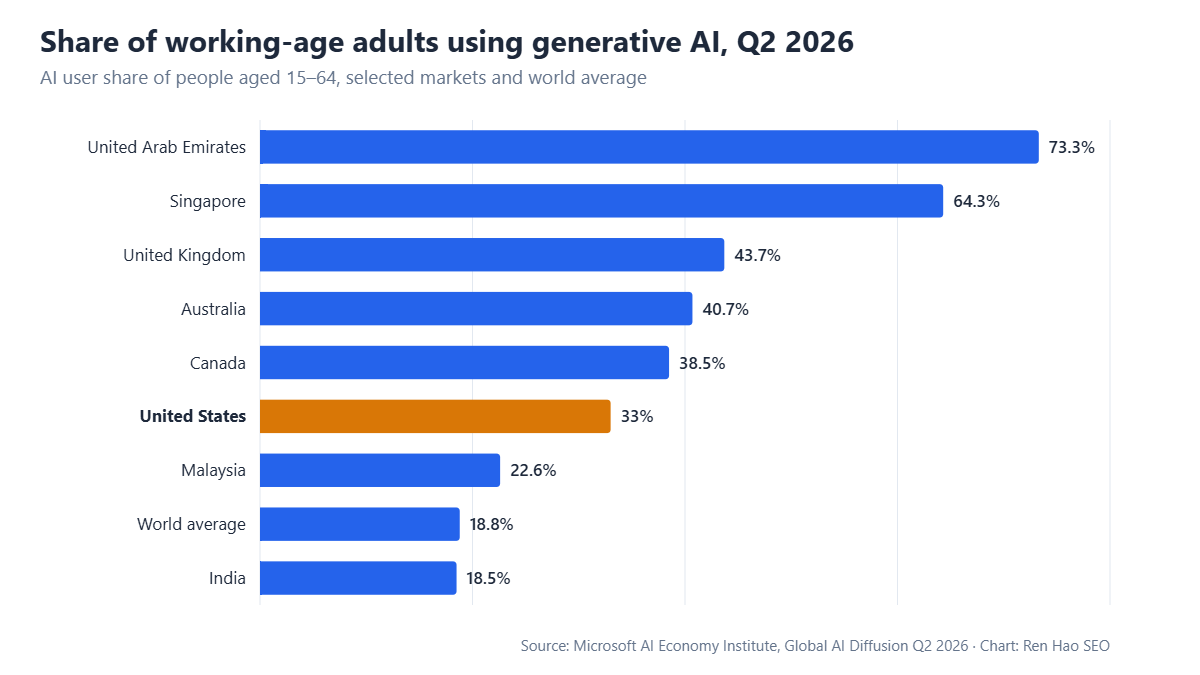
ChatGPT use in the US has more than doubled in three years. Pew Research Center found that 44% of US adults said they use ChatGPT in early 2026, up from 18% in 2023, and that the figure is 61% among adults under 30 and 55% among those aged 30 to 49. Microsoft’s AI Economy Institute, which measures use of any generative AI product, puts the US at 33.0% of working-age adults in the second quarter of 2026: well above the world average of 18.8%, but only 21st among the economies it tracks.
The US is also the most contested market for this topic. Ubersuggest shows about 390 searches a month for “chatgpt seo” with a keyword difficulty of 50, so the generic advice is already crowded. The advantage is in being the cited source within your own category and region.
How AI assistants are changing US research
AI assistants have rapidly become a research tool for many Americans. Rather than scanning a page of blue links, people increasingly ask ChatGPT, Perplexity or Gemini a question — “what’s the best CRM for a small US business?”, “how do I choose an SEO agency?” — and receive a synthesized answer that may name and cite specific sources or businesses. For businesses, this creates a decisive new moment in the buyer journey: being named, cited or recommended by an AI assistant shapes the buyer’s shortlist before any human comparison begins.
This matters most for research-heavy and considered purchases — B2B software, professional services, complex products — where the AI-assisted research stage is influential. Being absent from these answers means being invisible at a moment that increasingly shapes decisions, which is why forward-looking US businesses are learning to win it, alongside Google AI Overviews and traditional search.
How AI assistants source and cite answers
Different AI assistants work differently — some draw on training data, some search the live web, many do both — but the common thread is that they favor sources they judge authoritative, accurate and clearly structured. Tools that cite live sources (like Perplexity, and increasingly others) lean on much the same signals as search: relevance, authority and trust, with extra weight on content that clearly and directly answers the question. Building a strong, authoritative web presence makes your business more likely to be drawn upon and cited.
For ‘Your Money or Your Life’ topics the trust bar is highest, so genuine demonstrable expertise (E-E-A-T) matters even more — the same principle that governs legal SEO and other regulated sectors. Across all topics, thin, anonymous or gamed content is increasingly seen through; genuine authority is what earns citations.
How to become the source AI assistants cite
The practical path mirrors strong SEO with an emphasis on clarity and trust. Build genuine topical authority — comprehensive, expert content on the themes closest to your business and your buyers’ questions. Answer questions directly and clearly, leading with the answer. Structure content for extraction with clear headings, concise summaries and FAQs. Demonstrate real expertise through genuine author credentials and accurate, current information (compliant with FTC advertising rules). And build a strong, authoritative presence across the web — quality content and earned mentions — so AI systems encounter your business as a trusted, frequently-referenced source.
This is the same genuine-authority approach behind our AI SEO service, and it reinforces rather than competes with traditional SEO and Google AI Overview optimization. The businesses best positioned across all of these are those building genuine quality, not chasing AI-specific gimmicks.
Building the foundations AI citations rest on
As with every form of AI visibility, citations by AI assistants rest on solid foundations: a technically sound, crawlable site (see our technical SEO checklist), genuine depth and authority in your content, and demonstrable E-E-A-T. Weak foundations cannot be shortcut — an anonymous, thin or technically broken site is unlikely to be cited regardless of effort. Invest in the fundamentals first, then add the clarity and structure that make your authority easy for AI to extract and cite.
Measuring and adapting
Tracking AI-assistant visibility is an emerging discipline, but you can monitor it directly: ask the major AI assistants the questions your buyers ask about your category, and see whether and how your business appears. Review this over time to gauge progress and find gaps, while staying adaptable as these fast-moving tools evolve. We focus on the durable fundamentals that serve every form of search rather than chasing each change, and we set realistic, evidence-grounded expectations in line with the FTC Act (Section 5).
The different AI assistants and how they source answers
It helps to understand that AI assistants are not all the same, and how they source answers shapes how you earn citations. Some, like ChatGPT in its base form, draw heavily on training data — meaning a strong, authoritative, frequently-referenced web presence over time makes your business more likely to be part of what the model has learned. Others, like Perplexity and increasingly many assistants, search the live web and cite sources in real time — meaning the same signals that drive search visibility (relevance, authority, clear structure) drive citation. Many tools now blend both approaches, and increasingly integrate live retrieval to stay current.
For US businesses, the practical implication is that there is no single trick or submission process — you earn citations across all these tools by being a genuinely authoritative, accurate, well-structured and frequently-referenced source on your topic. This is the same genuine-authority foundation that drives traditional search and Google AI Overview visibility, which is why a single strong content and authority strategy serves all of them rather than requiring separate, tool-specific gimmicks.
Building authority that AI assistants recognize
Becoming a source AI assistants cite comes down to building genuine authority that is visible across the web. This means comprehensive, expert content on the themes closest to your business and your buyers’ questions — the same topical authority that drives strong SEO. It means demonstrable E-E-A-T: real author credentials, accurate information, and depth that establishes genuine expertise. And it means a strong presence beyond your own site — earned mentions, quality links, and references across reputable sources — so that AI systems repeatedly encounter your business as a trusted, relevant authority on your topic.
This is fundamentally about being genuinely authoritative rather than gaming a system. Thin, anonymous or manipulative content is increasingly seen through by AI systems, which are designed to favor reliable sources. The businesses that earn AI citations are those that have done the genuine work of becoming real authorities in their field — which is exactly the data-driven, white-hat approach behind our AI SEO service and our broader SEO services. There are no shortcuts, but the upside is durable: genuine authority earns visibility across search, AI Overviews and AI assistants simultaneously.
Content structure for AI assistant citation
Beyond authority, how you structure content affects how easily AI assistants can use and cite it. The principles mirror those for AI Overviews: lead with clear, direct answers; use question-based headings that match how people ask; provide concise summaries and FAQ sections that serve as clean, citable units; and implement accurate schema so the meaning of your content is explicit. Content that is clear, well-organized and genuinely answers questions is far more likely to be drawn upon than dense, meandering or vague content — for both AI and human readers.
For US businesses specifically, including genuinely Canada-relevant context — local considerations, US-dollar pricing where relevant, the US regulations and market specifics — can help you become the cited source for the US-specific questions that global competitors answer generically or not at all. This local relevance, combined with genuine authority and clear structure, is a real advantage in earning citations for US queries.
Integrating AI assistant optimization with your wider strategy
- Optimizing to be cited by AI assistants is not a standalone activity — it is a natural outcome of a strong, integrated SEO and content strategy. The genuine authority, clear content and strong web presence that earn AI citations are the same things that drive traditional rankings and Google AI Overview visibility. So rather than building a separate ‘AI assistant strategy’, the smart approach is to build genuine quality and authority once, structured clearly, and reap visibility across all these surfaces. This is more efficient, more durable, and more aligned with how search is actually evolving than chasing each new AI tool separately.
- It also rests on the same foundations as everything else: a technically sound site (see our technical SEO checklist), genuine content depth, and demonstrable E-E-A-T. Weak foundations cannot be shortcut for AI citation any more than for traditional ranking. For US businesses, the conclusion is reassuring: invest in genuine quality and authority, structure it clearly, and you are positioned to win across traditional search, AI Overviews and AI assistants alike. That integrated, substance-first approach is how our AI SEO service works, and a free audit is the place to start assessing your position.
Frequently asked questions about AI assistants and SEO
Can I submit my business to ChatGPT or pay to be recommended? Not for the recommendation itself — there is no submission process, and no payment places you among the sources an assistant cites. ChatGPT does now sell advertising: a business registered in the US is now among the more than 60 markets where a self-serve Ads Manager account can be opened (OpenAI’s Ads Manager availability page lists the current markets), but those ads are shown only to Free and Go users, are clearly labeled, and OpenAI states they do not influence the answers themselves. A paid slot and a citation are different things; the citation is still earned by being a genuinely authoritative, accurate, well-structured and frequently-referenced source on your topic, the same way you earn search visibility.
Which matters more — Google AI Overviews or AI assistants like ChatGPT? Both matter, and the good news is they share foundations. A single strong content and authority strategy, clearly structured, serves both alongside traditional search, so you do not have to choose.
How do I know if AI assistants are recommending my business? Ask the major assistants the questions your buyers ask about your category, and see whether and how your business appears. Review this over time to gauge progress — the discipline is emerging, but direct testing is informative.
Is this worth investing in for a US business? Increasingly, yes — especially for research-heavy and B2B purchases where Americans use AI assistants during their research. And because the foundations overlap with traditional SEO, the investment pays off across multiple surfaces. A free audit will assess your specific opportunity.
Do AI assistants favor US sources for US queries? They favor the most authoritative, relevant sources, and genuinely Canada-relevant content — local context, US dollars, the US regulations — can help you become the cited source for the US-specific questions that generic global content answers poorly.
What American buyers ask, and which sources assistants trust
American questions to assistants are usually local or regulatory underneath: the best provider in a metro, whether a contractor is licensed in a state, what a service costs in that region, how a rule applies in California versus Texas. Assistants that retrieve live results lean on pages that state those specifics, so name the states and metros you serve, the licenses you hold and the basis of your pricing in dollars. In several large metros a meaningful share of questions are asked in Spanish, and a Spanish answer is built from Spanish sources.
Assistants also draw on third-party evidence: Google Business Profile reviews, industry directories, and state licensing lookups. Our guide to the 2026 directory shake-up covers which listings still carry weight. Keeping your business name, address and credentials consistent across them gives assistants one set of facts to work from.
Rules to respect when you publish for AI visibility
Content written to be quoted is still advertising. Section 5 of the FTC Act prohibits deceptive claims, and the FTC’s rule on fake reviews and testimonials makes fabricated or undisclosed endorsements a direct liability, which matters when assistants summarize your reviews. State privacy laws, starting with the California Consumer Privacy Act, govern the customer data and case details you publish. Regulated professions add their own advertising rules, set state by state.
The practical test is simple: publish only what you could substantiate if asked. Claims that are specific, dated and sourced are also the ones assistants find easiest to reuse.
Common mistakes and misconceptions about AI assistant SEO
As businesses rush to adapt to AI assistants, a set of mistakes and misconceptions has emerged that are worth avoiding. The most common misconception is that there is a submission process, or that buying ChatGPT ads gets you recommended — there is not: ads are a separate, labeled slot, and OpenAI states they do not influence the answer itself; genuine citations are earned through authority, not bought or submitted. A related mistake is chasing AI-specific tricks or ‘hacks’ rather than building genuine authority, which AI systems are increasingly designed to see through. Another is treating AI assistant optimization as entirely separate from SEO, building parallel strategies, when in fact the foundations overlap almost entirely and a single strong strategy serves both.
Perhaps the most damaging mistake is neglecting fundamentals in favor of AI gimmicks: a thin, anonymous or technically broken site cannot earn AI citations any more than it can rank in search, regardless of how much ‘AI optimization’ is attempted. The businesses that succeed are those that build genuine quality — comprehensive, expert, accurate, clearly-structured content on a sound technical foundation, with demonstrable E-E-A-T — and present it clearly. This is harder than chasing shortcuts, but it is durable and it pays off across traditional search, Google AI Overviews and AI assistants simultaneously. Avoiding these mistakes comes down to the same principle that runs through all good SEO: invest in genuine authority and quality, structure it clearly, and measure and adapt — which is exactly the data-driven, substance-first approach we bring to every engagement. A free audit will assess your foundations and the highest-impact opportunities to build AI-ready authority.
Practical steps to improve your AI assistant visibility
- 1Build genuine topical authorityComprehensive, expert content on the themes closest to your business and buyers — the same depth that drives strong SEO. AI assistants favor authoritative sources.
- 2Answer real questions clearlyLead with direct answers to the questions your buyers actually ask, then elaborate. Clear, answer-led content is far easier for AI to use and cite.
- 3Strengthen E-E-A-TReal author credentials, accurate information and demonstrable expertise signal the trustworthiness AI assistants favor — especially for considered and YMYL topics.
- 4Add Canada-relevant contextLocal considerations, US-dollar pricing, the US regulations and market specifics help you become the cited source for the US-specific questions global content answers poorly.
- 5Build a strong web presenceQuality content and earned mentions across reputable sources so AI systems repeatedly encounter your business as a trusted, relevant authority.
- 6Structure for extractionClear headings, concise summaries, FAQs and accurate schema make your content easy for AI to parse, use and cite — see our technical SEO checklist.
Getting started with AI assistant visibility
For a US business ready to build visibility in AI assistants, the starting point — as with all AI search — is an honest assessment of your foundations and current standing. Check how the major AI assistants answer the questions your buyers ask about your category: are you named or cited, and how does your business appear relative to competitors? Assess your genuine authority and content depth on your core topics, your E-E-A-T signals, and your technical foundations. This baseline reveals whether your priority is building genuine authority and content (the usual case) or refining the structure and clarity of authority you already have.
From there, the work is the disciplined, durable approach this guide has described: build genuine topical authority, answer real questions clearly, demonstrate genuine expertise, add Canada-relevant context, build a strong web presence, and structure everything for extraction — all on a technically sound foundation. Measure your visibility across AI tools over time and adapt as they evolve, while resisting both complacency and the urge to chase every new feature. This is not a gamble on predicting the future; it is the disciplined pursuit of genuine quality and authority that serves every form of search, current and emerging.
The businesses that start now, while many competitors still ignore AI assistants, will establish authority that compounds and is hard to displace. That is the opportunity, and the substance-first approach behind our AI SEO service is built to seize it. A free, data-driven audit is the natural first step to assess where you stand and build your AI-ready visibility — across AI assistants, Google AI Overviews and traditional search alike.
Start building AI authority now
The clearest practical takeaway is one of timing: the authority that earns AI assistant citations is slow to build and hard to fake, so the businesses that start now will hold a durable advantage as these tools grow more capable and more widely used. Establishing genuine authority and clear, accurate content today positions you to be cited and recommended tomorrow, while competitors who wait find the position already claimed. For US businesses in research-heavy and considered-purchase categories especially, where AI-assisted research increasingly shapes shortlists, this early investment is among the highest-leverage available. The genuine-authority approach behind our AI SEO service is built to seize it, and a free, data-driven audit is the natural first step.
For primary sources, see Google’s official Search blog and Google Search Central — standard, quality-focused SEO is what Google confirms qualifies content for AI features. Usage figures are from Microsoft AI Economy Institute, Global AI Diffusion Q2 2026 and Pew Research Center (survey of US adults, February 2026); keyword volumes are from Ubersuggest (October 2026).
Written by the Ren Hao SEO team and reviewed by Ren Hao, founder and lead SEO strategist. Ren Hao SEO is a data-driven international SEO agency serving US businesses, with 100+ SEO audits and $1.5M+ in client sales value generated. We publish openly because an informed audience makes better decisions — and under the FTC Act (Section 5), we never guarantee rankings.