
Google Business Profile Optimization for US Businesses
For any US business that serves customers in a specific place, your Google Business Profile is the single most powerful local SEO asset you control — and the one most often left half-finished. This data-driven guide covers exactly how to claim, optimize and maintain your profile to win the local map pack and turn local searches into real inquiries, drawn from optimizing profiles across the US regions. No theory, no ranking guarantees — just what actually moves local visibility.
- Your Google Business Profile drives most of your local map-pack visibility — completeness and accuracy are decisive.
- Categories, accurate NAP, genuine reviews and regular activity are the highest-impact levers.
- Consistency between your profile and the rest of the web reinforces local trust.
- A profile is not set-and-forget: ongoing reviews, posts and updates sustain rankings.
Google Business Profile in the US: an asset your competitors already manage
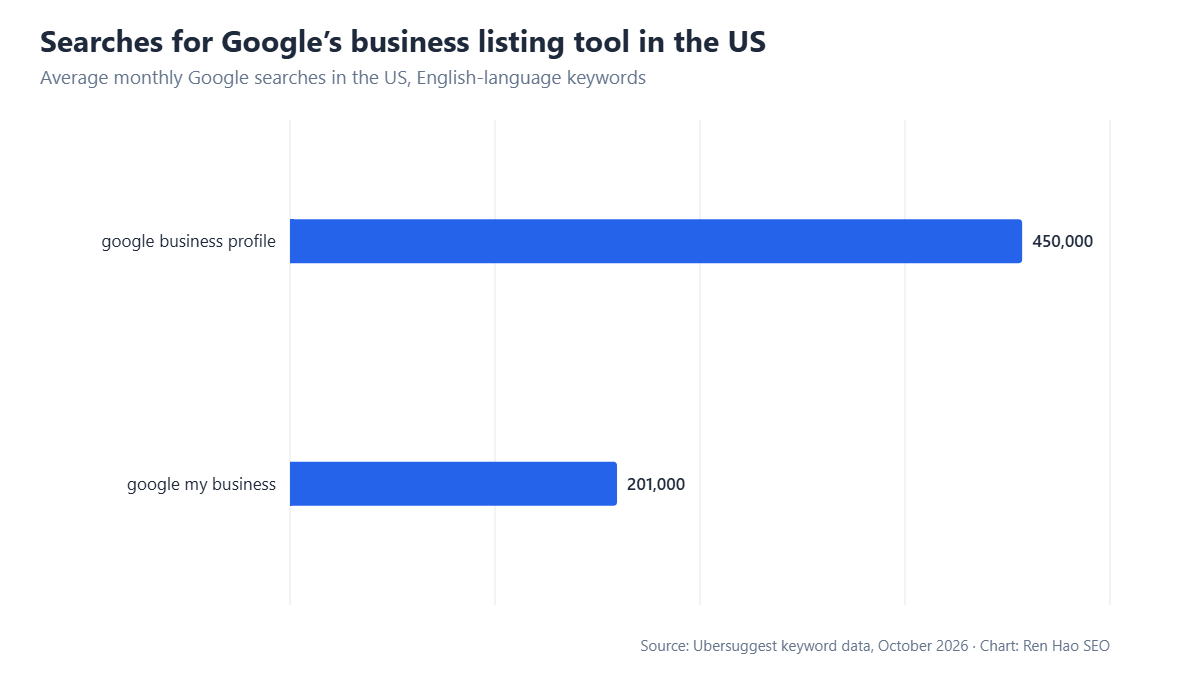
“Google business profile” is searched about 450,000 times a month in the US, with “google my business” adding another 201,000 (Ubersuggest, October 2026). The great majority are owners and managers heading to their dashboards, which means the listings competing with yours in any US metro are actively maintained. For home services, healthcare, restaurants and professional firms, the map pack is where most local decisions are made, and the listing has to carry the sale. The product was renamed from Google My Business in November 2021; your listing, reviews and history carried over unchanged.
If you are comparing providers, how to choose an SEO agency in the US gives you a selection process and the checks to run before you sign.
AI assistants lean on Business Profile data and reviews when they recommend a local business. How US businesses get cited by ChatGPT and AI assistants covers what else they check and how widespread assistant use has become.
Where you rank in Houston is decided by local signals, not by national authority alone. The Houston local SEO guide shows how we build those signals for businesses in the area.
We plan local campaigns at district level rather than city level. Local SEO in Los Angeles is the Los Angeles plan: the queries, the competitors and the location pages that matter there.
Many US clients combine this with Landing Page Optimization USA — both run off the same audit and the same reporting, so there is no duplicated work.
For contractors the profile feeds two layers at once — the pack and the Local Services strip above it share the same review and credential inputs. Our home-services playbook shows how the stack fits together and where each trade’s leads actually come from.
Directory listicles lost serious ground in 2026 — see our breakdown of the US local SEO shake-up for the evaluation-page playbook that inherits those positions.
For franchise systems, profile discipline has to scale across every location: our US multi-location SEO guide covers centralised ownership, category standards and per-location review engines.
Why Google Business Profile matters so much in the US
When a US consumer searches with local intent — “plumber near me”, “cafe Santa Monica”, “family lawyer Houston” — Google often shows the “map pack” of three local businesses above the regular results. For a local business, appearing here is frequently worth more than a page-one organic ranking, because these listings sit at the very top and carry high-intent, ready-to-act searchers. And the listing Google shows in that map pack is your Google Business Profile.
Google ranks local results on three factors — proximity, relevance and prominence — and your profile is the primary signal for relevance and a major one for prominence. A complete, accurate, active profile tells Google exactly what you do, where, and that you are a legitimate, trusted business. An incomplete or neglected one leaves you invisible to the local customers searching for exactly what you offer. This is why optimizing your profile is the fastest, highest-return local SEO win available — and why it sits at the center of our local SEO service and our complete local SEO guide.
Claiming and verifying your profile
The first step is to claim and verify your profile. An unclaimed or unverified profile cannot compete — Google needs to confirm you are the legitimate owner before it will rank and fully display your listing. Verification is usually by postcard, phone, email or video depending on your business type and location, and while it can take a few days, it is non-negotiable: every subsequent optimization depends on it.
If a profile already exists for your business (Google sometimes auto-generates them), claim that rather than creating a duplicate — duplicate listings confuse Google and split your local signals. If you find duplicates, resolve them properly rather than leaving competing profiles live.
Optimizing every field that matters
Once verified, completeness is your biggest lever — Google favors fully-completed profiles, and users trust them more. Work through every field deliberately: your business name (exactly as it appears in the real world, without keyword-stuffing, which violates Google’s guidelines); your primary category (one of the strongest relevance signals — choose the most specific accurate option); relevant secondary categories; your precise address or service areas; accurate hours including public holidays; phone and website; genuine photos; and a clear, accurate description.
Your primary category deserves special attention. It is one of the most powerful relevance signals in local search, so choosing “Family law attorney” rather than the generic “Lawyer”, or “Italian restaurant” rather than “Restaurant”, can materially affect which searches you appear for. Get this right before anything else.
NAP consistency: the foundation of local trust
Your name, address and phone number (NAP) on your Google Business Profile must match exactly how they appear everywhere else online — your website, directories, social profiles and citations. Inconsistency (an old address here, a different phone format there) confuses Google about which information is correct and directly suppresses local rankings. Consistency does the opposite, reinforcing that you are a legitimate, established business.
This is why profile optimization and citation building go hand in hand: the first step is always to audit and fix NAP inconsistencies across the web, then build out consistent citations on trusted US directories. A dozen accurate, consistent citations beat fifty inconsistent ones.
Reviews: the local ranking and conversion multiplier
Reviews do double duty: a steady stream of genuine, recent reviews signals prominence to Google (helping rankings) and powerfully influences conversion (most US buyers read reviews before choosing a local business). Establishing a genuine, repeatable process to ask satisfied customers for reviews — and responding to every review, positive or negative — is one of the highest-leverage things a local business can do.
Two firm rules. Never fake reviews or incentivise them in ways that breach FTC advertising rules or Google’s policies — the Federal Trade Commission has acted against misleading reviews, and the legal and reputational risk is severe. And respond to negative reviews calmly and constructively; how you handle criticism is itself a trust signal to prospective customers reading along.
Staying active: posts, Q&A and updates
A profile is not set-and-forget. Google favors active, maintained profiles, and regular activity signals a legitimate, operating business. Use Google Posts to share genuine updates, offers and news; monitor and answer the Q&A section (and seed it with genuinely useful answers to common questions); keep hours and information current, especially around public holidays; and add fresh, genuine photos over time. None of this needs to be onerous — a consistent, modest cadence beats sporadic bursts.
A step-by-step Google Business Profile optimization checklist
- 1Claim and verifyClaim your profile and complete Google’s verification. An unverified profile cannot fully rank or display — this is the non-negotiable first step.
- 2Set the right primary categoryChoose the most specific accurate primary category — it is one of the strongest relevance signals. Add relevant secondary categories too.
- 3Complete every fieldName (real-world, no keyword-stuffing), address or service areas, hours (including public holidays), phone, website, attributes and a clear description.
- 4Audit and fix NAP consistencyEnsure your name, address and phone match exactly everywhere online — inconsistency directly suppresses local rankings.
- 5Add genuine photosReal, quality photos of your premises, team and work build both ranking signals and customer trust.
- 6Establish a review processPolitely ask satisfied customers, make it easy, and respond to every review. Never fake or improperly incentivise reviews.
- 7Stay activeUse Google Posts, answer Q&A, and keep information current. Active profiles are favored and signal a legitimate business.
Common Google Business Profile mistakes US businesses make
Across the many US local businesses we have audited, the same profile mistakes recur — and each one quietly costs local visibility. The most common is simply leaving the profile incomplete: missing categories, no description, few photos, outdated hours. Google favors complete profiles, and an unfinished one cedes ground to competitors who have done the work. The second most common is NAP inconsistency — the business name, address or phone differing between the profile, the website and various directories — which confuses Google and suppresses rankings. The third is choosing too generic a primary category, missing the relevance boost a specific category provides.
Other frequent mistakes include neglecting reviews entirely (no process to generate them, no responses), letting the profile go stale (no posts, no updates, outdated information), and — more seriously — keyword-stuffing the business name or soliciting fake reviews, both of which violate Google’s guidelines and the FTC Act (Section 5) and risk suspension or penalties. The deepest mistake of all is treating the profile as set-and-forget: local search is competitive and dynamic, and the businesses that dominate are those that maintain their profile consistently rather than optimizing it once and walking away. Our local SEO service handles this ongoing maintenance, and a free audit will show which of these mistakes are costing you local visibility.
How Google Business Profile fits your wider local SEO
- Your Google Business Profile is the centerpiece of local SEO, but it does not work in isolation — it is reinforced by, and reinforces, the rest of your local presence. Consistent citations across trusted US directories validate the information on your profile and strengthen local trust. Genuine reviews drive both your profile’s prominence and your conversion. Location-relevant content on your website supports the relevance your profile signals. And your overall site authority — built through quality content and earned links — lifts your local rankings too, because prominence is a cross-cutting signal. A profile optimized in isolation, on a weak site with no citations or reviews, will underperform one that sits at the center of a coherent local strategy.
- This integration is why we never treat profile optimization as a standalone task. It is one dimension of the complete local SEO program described in our complete local SEO guide — alongside citations, reviews, local content and the technical and mobile foundations all rankings depend on. For multi-location US businesses, each location needs its own properly-optimized profile, consistent across the web, feeding authority back to the whole. And as local discovery increasingly happens through mobile, voice and AI assistants as well as the traditional map pack, a complete, accurate, active profile keeps paying off across every interface. To see how your profile and wider local SEO would come together, start with a free audit, or explore local expertise for your city across our the US location pages.
Frequently asked questions about Google Business Profile
Do I need a physical address to have a profile? Not necessarily — service-area businesses that travel to customers (plumbers, mobile services) can hide their address and set service areas instead. Storefront businesses customers visit should show their address. Choosing the right setup for your business type matters for how you rank and display.
How important are photos? Genuine, quality photos help both ranking and conversion — they signal an active, legitimate business and help customers choose you. Add real photos of your premises, team and work over time rather than stock imagery.
Should I respond to every review? Yes — responding to every review, positive and negative, signals an engaged, legitimate business and is itself a trust signal to prospective customers reading along. Handle negative reviews calmly and constructively rather than defensively.
Can I have more than one profile for my business? Only if you genuinely have multiple distinct locations — each gets its own profile. Creating duplicate profiles for a single location confuses Google and splits your signals; resolve any duplicates you find.
How does my profile relate to ranking on Google Maps? Google Maps and the local map pack draw on the same Google Business Profile data and local ranking factors. Optimizing your profile improves your visibility in both.
Google Business Profile for multi-location US businesses
Businesses with more than one location — a chain of clinics, multiple office branches, franchises — face a distinct set of Google Business Profile challenges, and getting the structure right is essential. Each genuine location needs its own separate, fully-optimized profile, with its own accurate name, address, phone, hours and locally-relevant information. Managing these consistently at scale is where many multi-location US businesses struggle: profiles drift out of sync, hours go stale at some branches, reviews accumulate unevenly, and NAP inconsistencies creep in across the growing web footprint. The result is uneven local visibility, with some locations ranking well and others invisible.
The solution is a systematic approach: a single source of truth for each location’s information, a consistent process for keeping every profile current, and a review-generation process that works across all locations rather than relying on individual branches. For larger operations, Google’s business management tools help manage profiles at scale, but the discipline matters more than the tooling. Each location should also have a corresponding, genuinely unique location page on your website — not thin duplicated templates — reinforcing the local relevance of each profile. This is exactly the approach we take to local SEO, detailed in our complete local SEO guide and delivered through our local SEO service. For multi-location businesses, getting this structure right is often the single biggest local SEO opportunity available.
Tracking what your Google Business Profile delivers
A well-optimized profile is not just about rankings — it is about the inquiries and customers it generates, and tracking these is what lets you judge and improve performance. Google Business Profile insights show how customers find and interact with your listing: the searches that surfaced you, the actions people took (calls, direction requests, website clicks), and how your profile performs over time. These are genuinely useful leading indicators, but the metrics that matter most are the business outcomes downstream: the calls, inquiries and customers that originated from local search.
Setting up proper tracking — call tracking, website analytics that capture local-search-driven inquiries, and a way to attribute new customers to their source — turns your profile from a set-and-forget listing into a measurable, optimizable channel. It also reveals what is working: which searches drive valuable actions, which photos and posts engage people, where the gaps are. This data-driven, measurement-led approach is how we treat every local SEO engagement: not chasing vanity visibility, but optimizing against the genuine local inquiries that grow your business. A free audit will assess your profile’s current performance and the highest-impact opportunities to improve it.
The role of reviews in your Google Business Profile strategy
Reviews deserve a deeper treatment, because they are among the most powerful — and most under-managed — elements of a Google Business Profile. They influence ranking (a steady stream of genuine, recent reviews signals prominence and activity to Google), they powerfully influence conversion (most the US consumers read reviews before choosing a local business, and star ratings shape the very first impression in the map pack), and they provide genuine feedback that helps you improve. A business with few, old or poorly-managed reviews cedes a major advantage to competitors who actively cultivate them — even if everything else about its profile is well optimized.
The key is a genuine, systematic, ongoing process rather than sporadic effort. Build review requests into your natural customer journey — after a completed job, a positive interaction, a delivered service — and make it as easy as possible for satisfied customers to leave a review, for example with a direct link. Respond to every review, thanking positive reviewers and addressing negative ones calmly and constructively, since prospective customers read these exchanges and judge you on them.
Above all, never fake reviews, buy them, or incentivise them in ways that breach FTC advertising rules or Google’s policies — the Federal Trade Commission has acted against misleading reviews, and the legal, reputational and ranking risks are severe. Genuine reviews, consistently cultivated and thoughtfully managed, are one of the highest-return investments a local US business can make, and they sit at the heart of the local SEO program in our complete local SEO guide.
Frequently asked questions about optimizing your profile (continued)
How often should I post or update my profile? A consistent, modest cadence beats sporadic bursts — regular genuine updates, posts about real news or offers, and keeping information current (especially around public holidays) signal an active, legitimate business. There is no need to post daily, but a neglected profile that has not been touched in months underperforms.
What should I do about a bad review? Respond calmly, professionally and constructively — acknowledge the concern, offer to resolve it offline, and avoid defensiveness. How you handle criticism is itself a trust signal to every prospective customer who reads it. You can request removal of reviews that genuinely violate Google’s policies, but you cannot remove a review simply for being negative.
Does my website matter if I have a great profile? Yes — your profile and website reinforce each other. A strong, relevant, technically sound website supports the relevance and authority your profile signals, and many customers visit your site after finding your profile. Neglecting either weakens the other.
Can I rank in areas where I do not have a physical office? Service-area businesses can set service areas and build genuine relevance for the areas they serve, but ranking strongly in an area is harder without genuine presence and relevance there. Thin, fake area pages do not work and risk penalties; genuine local relevance does. For a fuller treatment, see our local SEO guide and find local expertise across the US regions.
Treat the listing as your highest-converting landing page
In most US local categories, the profile receives more customer actions (calls, direction requests, messages, bookings) than the website does. Manage it with the same care you would give a paid landing page.
- 1Pick the primary category for the jobs you wantCategories decide which searches you appear for. “Roofing contractor” and “Roof repair service” are different audiences. Choose the one that matches your best-margin work and add the others as secondary.
- 2Use attributes and services to answer pre-call questionsVeteran-owned, wheelchair accessible, free estimates, emergency service, financing available: each attribute removes a reason to call a competitor instead.
- 3Turn on booking, quotes and messagingWhere Google offers them for your category, these let a customer act without leaving the listing. Answer messages within the hour during business hours.
- 4Build a review engineDecide who asks, when, and through which channel (a text with the direct review link right after service works best), and reply to every review by name within a day. Reviews with photos carry extra weight.
- 5Measure like a landing pageUse the profile’s performance report and UTM-tagged links to see calls, direction requests and website clicks by month. Adjust categories, photos and posts based on what moves those numbers.
Businesses that run the listing this way often find it outperforms paid local ads on cost per lead, because the customer has already chosen before the call.
Details US businesses should get right
These are the points where local knowledge shows. Each one is a small edit, and together they make the profile read like a business that belongs where it trades.
- ✓Set up service areas if you travel to customersHome services and mobile trades can hide the street address and list the cities or ZIP codes they actually serve, so the profile matches where you really work.
- ✓Include your suite or unit numberIn shared buildings and shopping centers, add your suite number and place the map pin on your own entrance.
- ✓Cover federal and local holidaysAdd special hours ahead of each holiday for every location you run.
If you would like these applied across every location you run, our local SEO service in the US handles the profile, the reviews process and the supporting pages together.
Getting started with your Google Business Profile
If this guide has convinced you to take your Google Business Profile seriously, the most productive way to begin is with an honest assessment of where it stands today against the fundamentals: is it claimed and verified; is every field complete and accurate; is your primary category as specific as it should be; is your name, address and phone consistent everywhere online; do you have a genuine, ongoing process for generating and responding to reviews; and is the profile active with current information? Answering these honestly reveals your biggest, fastest opportunities — which for most businesses is a short list rather than an overwhelming one, because the highest-impact fixes (completing the profile, fixing NAP consistency, starting a review process) are usually straightforward once identified.
From there, the work is consistency: maintaining the profile, generating reviews, keeping information current, and adding genuine local relevance over time, while measuring against the local inquiries that grow your business. For businesses that would rather have experts handle this systematically — or that face genuinely competitive local markets — a free audit will assess your profile and map your specific local opportunity, and you can find local expertise for your city across our the US location pages. Either way, a complete, accurate, active, well-managed Google Business Profile is the foundation of local search success in the US — and the single best place most local businesses can start.
Your profile as part of a complete local presence
A final perspective worth holding: your Google Business Profile is the most visible part of your local presence, but it works best as one element of a complete, coherent local strategy. The profile, your website’s location content, your citations, your reviews and your overall site authority all reinforce one another, and a weakness in any of them limits the others. In a market where local intent is high and the path from search to inquiry is short, getting this whole picture right is one of the most reliable, measurable growth levers a US local business has — and it rewards consistent, data-driven attention rather than one-off effort. A free audit will show you exactly where your profile and wider local presence stand and the highest-impact place to start.
For the primary source on local ranking, see Google’s documentation on how local results are ranked and Google Search Central. Search volumes are from Ubersuggest (October 2026).
Written by the Ren Hao SEO team and reviewed by Ren Hao, founder and lead SEO strategist. Ren Hao SEO is a data-driven international SEO agency serving US businesses, with 100+ SEO audits and $1.5M+ in client sales value generated. We publish openly because an informed audience makes better decisions — and under the FTC Act (Section 5), we never guarantee rankings.