
AI Overviews vs AI Mode: What the Difference Means for Your Traffic
Google now runs two AI answer experiences with confusingly similar names and meaningfully different mechanics. AI Overviews is a summary block inserted above classic results on eligible queries; AI Mode is a separate, fully conversational search tab where the entire session happens inside the AI experience. They retrieve differently, cite differently, and take different bites out of your traffic — which means they reward different optimisation moves. This guide defines both precisely, compares them dimension by dimension, and translates the differences into what to actually do.
- AI Overviews augments the classic SERP: a synthesized block above familiar results, triggered selectively by query type, with citations alongside a page users can still scroll.
- AI Mode replaces the SERP for the session: a conversational tab where follow-ups stay inside the experience and the classic result list never renders unless the user leaves.
- Both are built on query fan-out — the system issues multiple sub-queries and synthesizes from retrieved passages — but AI Mode fans out wider and sustains multi-turn context.
- Traffic impact differs in kind: Overviews redistributes clicks between cited and uncited sources on one SERP; AI Mode compresses the session into fewer, later, higher-intent outbound clicks.
- The optimisation overlap is large — retrievable, answer-first, evidenced passages win citations in both — but AI Mode additionally rewards covering a topic’s full question space, because the follow-ups are where its citations happen.
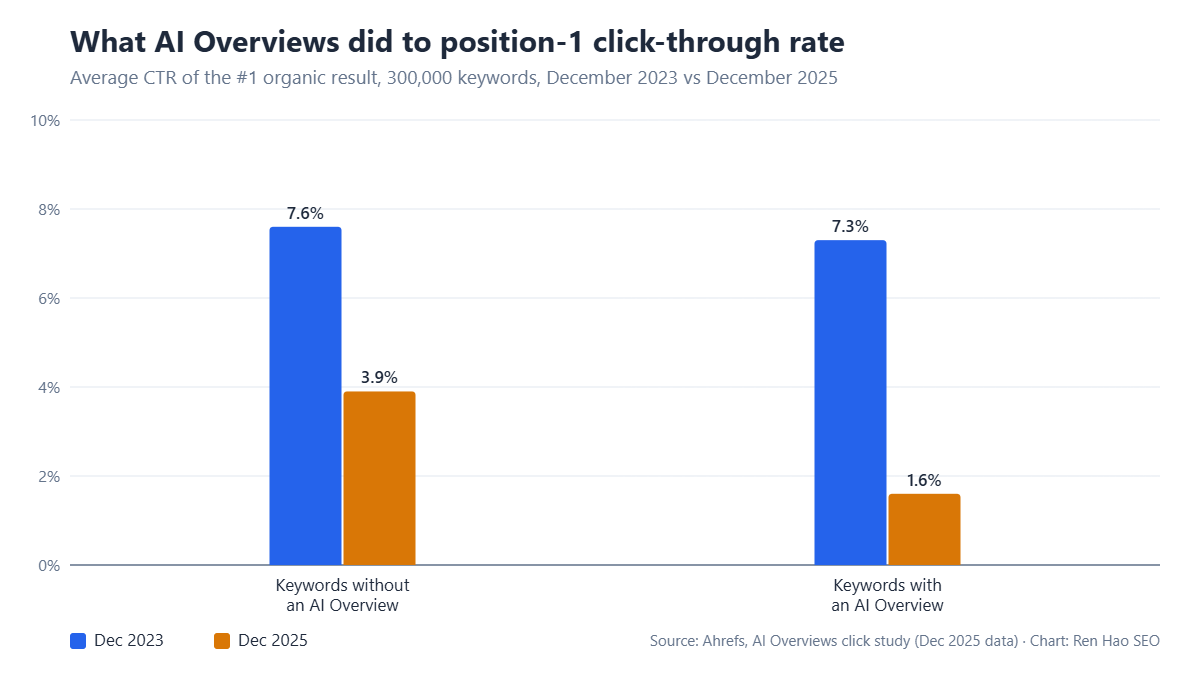
Definitions first: two products, one confusion
AI Overviews is the synthesized answer block that appears at the top of the standard Google results page for queries where the system judges synthesis helpful. The classic SERP remains beneath it: users can read the summary, click its citations, or scroll past to the familiar blue links. It is an augmentation of the page users already know, triggered selectively — heavily on informational and question-shaped queries, rarely on transactional, brand and local ones. AI Mode is a separate search experience — a dedicated tab — in which the entire interaction is conversational: the user asks, the system answers with citations, the user refines with follow-ups, and the classic result list never appears unless the user navigates away. One is a feature on the SERP; the other is a replacement for it, session by session. The naming invites conflation, and most published advice treats them as one phenomenon — a mistake, because the mechanics beneath them diverge exactly where traffic strategy is decided. We covered the citation mechanics of the first in how to get cited in AI Overviews; this piece is about where the second differs and what that changes.
For a closer look at this topic, see Entity SEO: Building a Brand That LLMs Recommend.
If you want the practical next step on this point, our guide on Content Pruning & Consolidation: When Less Content Ranks More goes into the detail.
The shared engine: query fan-out and passage retrieval
Under both experiences sits the same architectural idea. When a query arrives, the system does not retrieve one answer — it decomposes the request into multiple sub-queries (the fan-out), retrieves candidate passages for each from the search index, and synthesizes a response with citations pointing at the passages that supplied its claims. Three practical constants follow for publishers. First, the candidate pool is gated by conventional retrieval: passages come overwhelmingly from pages that rank well for the sub-queries, so classic SEO fundamentals remain the admission ticket. Second, the unit of competition is the passage, not the page: a tightly-structured section that answers one sub-question completely can be cited from a page that ranks fifth, over a rambling page that ranks first. Third, synthesis rewards verifiability — dated claims, named sources, evidence — because the systems are visibly tuned to cite sources they can defend. Everything in the extractability playbook — question-shaped headings, answer-first sections, one intent per passage — serves both experiences identically. The divergence starts with how wide the fan-out runs and what happens after the first answer.
Dimension by dimension: where they diverge
- 1Surface and session shapeOverviews: one block on one SERP; the session ends or continues on the classic page. AI Mode: a persistent conversation; the session’s second, third and fourth questions happen inside the experience, with context carried forward.
- 2Fan-out breadthOverviews fans out to cover the head query’s immediate facets. AI Mode fans out wider and repeatedly — every follow-up is a fresh retrieval round informed by the conversation — so the set of passages that can earn a citation across a session is far larger.
- 3Trigger scopeOverviews renders selectively, and Google is visibly conservative on transactional, YMYL and local queries. AI Mode answers whatever the user brings to it — the selectivity moves from Google’s trigger logic to the user’s choice of tab.
- 4Click economicsOverviews redistributes one SERP’s clicks: cited sources hold or gain qualified traffic, uncited mid-page listings absorb the loss. AI Mode compresses the whole session: fewer outbound clicks, issued later, after synthesis has done the comparison work — each click carrying more resolved intent.
- 5Measurement visibilityOverview presence and citations can be sampled per query with SERP tooling. AI Mode sessions are conversational and personalised — harder to sample, pushing measurement toward outcome proxies: branded demand, assisted conversions, and the quality of the clicks that do arrive.
What each does to your traffic — concretely
For a typical content-plus-commercial site, the two experiences bite different layers. AI Overviews primarily re-prices your informational rankings: on queries where it renders, page-one positions without citations lose the scanning clicks they used to collect, while citation slots retain prominence and deliver visitors who arrive better-informed. The commercial bottom of the funnel — brand, buy, price, near-me queries — remains largely classic, which is why Overview exposure maps to your informational keyword set almost exclusively. AI Mode’s effect is shaped differently: it absorbs entire research sessions. The user who would previously have visited four sites while comparing options now runs the comparison inside the conversation and clicks out once — to shortlist finalists, verify a claim, or transact. Raw sessions from that behaviour fall; the sessions that survive convert at higher rates because synthesis pre-qualified them. The strategic reading: Overviews is a fight for citation slots on a SERP you can see; AI Mode is a fight to be the source the conversation keeps returning to — and to be the destination when the resolved click finally happens. Neither threatens the transactional core directly; both make the informational middle earn its keep through citations rather than clicks.
Optimising for both without doing everything twice
The overlap is the good news: one content discipline serves both engines. Retrievable passage structure — the literal question as a heading, the complete answer in the opening sentences, evidence and nuance after — is the citation currency in Overviews and AI Mode alike. Verifiability — named authorship, dates, sourced claims, first-hand data — raises citation probability in both. Classic ranking strength gates both candidate pools. The AI Mode-specific addition is coverage of the question space: because its citations happen across a conversation’s follow-ups, the sources that win are the ones answering the second and fifth and ninth question in a topic, not just the head term. Practically, that means building topic clusters against the full fan-out — the comparisons, edge cases, pricing mechanics, failure modes and how-do-I-actually questions around your subject — rather than one flagship page per keyword. The measurement addition: alongside Overview citation sampling, watch the proxies AI Mode moves — branded search growth, direct and assisted conversions from informational entry points, and conversion rate of AI-referred sessions where referrer data exposes them. Sites doing this well report the same shape: flat-to-down raw informational clicks, up-and-right qualified demand — the trade the new surfaces impose, taken deliberately instead of suffered.
What to do this quarter
Sequence for a site starting from standard SEO maturity: first, map exposure — tag your money and traffic keywords for Overview presence and citation status; assume AI Mode touches every informational topic regardless of trigger sampling. Second, restructure the already-ranking pages: top-ten pages without citations are candidates losing purely on passage structure, and inverting their key sections is the cheapest citation win available. Third, extend coverage into the fan-out: for each core topic, build or upgrade the pages answering its follow-up question space, interlinked as a cluster. Fourth, re-weight reporting so the organisation judges the channel on qualified outcomes — citations, branded demand, conversion-weighted traffic — before the raw-click decline triggers a panic that cuts exactly the investment these surfaces reward. The sites that treat 2026 as a measurement upgrade rather than a traffic crisis are the ones compounding through it.
Product behaviour is drawn from Google’s published documentation and announcements on AI Overviews and AI Mode, and from our own SERP sampling panels across eight markets; click-redistribution patterns from our UK and US panel data. Product surfaces evolve quickly — mechanics described here reflect the sampling window and are re-verified continuously.