
AI Search vs Traditional SEO: What’s Changed?
AI search has prompted a lot of anxiety about whether traditional SEO still works. The honest answer is reassuring: AI search changes some things, but rests on the same fundamentals as traditional SEO. This guide explains what’s genuinely changed, what stays the same, and how to adapt without abandoning proven strategy — so you can respond sensibly rather than panic.
- What changed: AI synthesises answers and cites a few sources, reducing some informational click-through.
- Visibility now means being cited/recommended (inside the answer), not just ranking in a list.
- What stays the same: relevance, quality, authority, trust and technical SEO still decide everything.
- Adapt, don’t reinvent — extend sound SEO with awareness of how AI selects sources.
- Diversify from pure informational clicks toward consideration and commercial content.
What’s actually changed
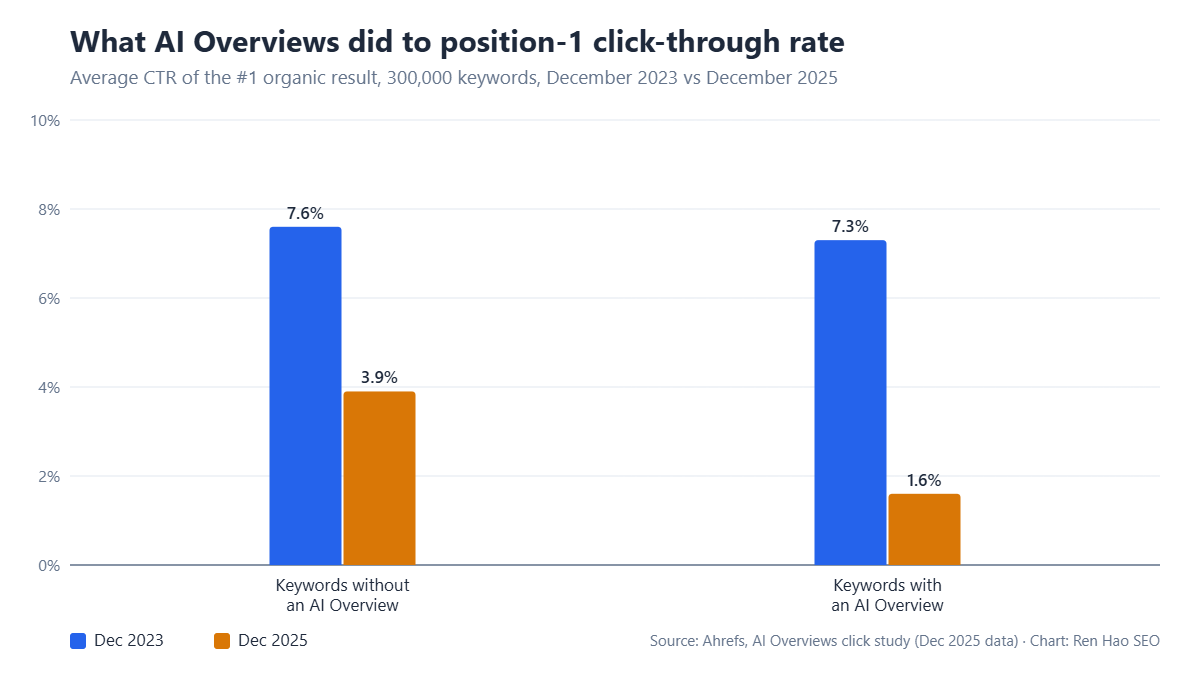
The biggest change is how results are presented. Traditional search shows a list of links you scan and click; AI search (AI Overviews, ChatGPT, Perplexity) synthesises an answer from multiple sources and cites a few, often without the user clicking through. For purely informational queries, this can reduce the click-through traffic that informational content used to earn.
Related reading: Crawlability: How Search Engines Navigate and Understand Your Website — it picks up where this section leaves off.
Since this comparison was written, Google has pushed AI Mode into the mainstream. Our practical guide to ranking inside Google AI Mode covers the retrieval mechanics and the passage structure that wins citations.
The other shift is what visibility means. In AI search, being cited or recommended — being inside the answer — matters alongside (or instead of) ranking in a list. This rewards being clearly the most authoritative, trustworthy, extractable source, with some patterns specific to how AI selects sources, as we cover in getting cited in AI Overviews.
What stays the same
Far more stays the same than changes, which is the reassuring part. AI engines are largely built on or alongside existing search infrastructure and draw on the same underlying signals: relevance, content quality, authority and trust. If your content can’t be crawled, indexed and understood, it can’t be retrieved by the AI’s search layer either — so technical SEO remains the price of entry.
Genuine topical authority, content that matches intent and is the best answer, strong E-E-A-T, original data, and a credible brand presence — these win in traditional search and AI search alike. The fundamentals haven’t been replaced; they’ve been extended to a new surface.
How to adapt sensibly
Don’t abandon proven SEO to chase AI — the two are deeply intertwined, and the content, authority and technical foundations that win traditional rankings are largely the same ones that earn AI citations. Instead, extend your strategy: keep doing sound SEO, and add awareness of how AI selects and synthesises sources. Lead with clear, extractable answers; publish original data that makes you a primary source; strengthen E-E-A-T; and build a credible presence across the web.
Also diversify sensibly: if you’ve relied heavily on top-of-funnel informational clicks (the most exposed to AI answers), shift some investment toward consideration and commercial content, where clicks and citations remain valuable. This is adaptation, not reinvention.
The bottom line
AI search rewards the same thing search always has: being genuinely the best, most trustworthy answer — now made retrievable and extractable for AI as well as humans. The brands investing in genuine authority and quality are building an advantage in both traditional and AI search at once, while shortcut-seekers chasing ‘AI hacks’ will find them as fragile as black-hat SEO always was.
The right response to AI search is calm, informed adaptation built on strong fundamentals — exactly the approach behind our AI Overview Optimization and ChatGPT Optimization services. A free SEO audit shows you where you stand across both.
What actually changes — and what doesn’t
AI search changes the surface, not the substance. The systems generating answers still depend on crawling, indexing, content quality and source credibility — the exact foundations traditional SEO builds. What changes is the payout structure: informational queries increasingly resolve on the results page, so the click prize migrates down-funnel to queries where the user must still evaluate, compare or buy. Brands also now earn value through citation and mention inside AI answers, not only via the blue link.
So the honest framing is evolution, not replacement: the same technical and authority work qualifies you for both surfaces, but the content strategy must rebalance toward depth, experience and commercial intent — the things a one-paragraph synthesis can’t substitute.
How to allocate effort across both
- 1Keep the foundation investedCrawlability, speed, schema and authority feed both traditional rankings and AI citations. This budget never moves.
- 2Shift content weight down-funnelComparisons, pricing, use-case and evaluation content keeps earning clicks in an AI-answer world.
- 3Make informational content citation-gradeWhere you do publish guides, lead with direct answers, original data and clear structure — the formats AI answers quote.
- 4Track AI visibility explicitlyMonitor your presence in AI Overviews and assistant answers for money queries alongside classic rank tracking.
- 5Defend your brand layerEnsure AI systems describe your brand accurately by keeping your entity footprint consistent and well-sourced.
The opportunity inside the disruption
Most competitors are still optimising for 2020’s results page. The brands that adapt earliest — building citation-worthy assets, deep commercial content and genuine authority — are taking outsized share of the new surfaces while rivals watch informational traffic erode. Search disruption has always rewarded the fast adapter; this cycle is no different, only quicker.
Auditing your AI-search exposure
- 1Classify your traffic by absorbabilityTag top organic pages as informational, comparison or transactional. The informational tier is where AI answers will bite first — quantify your exposure.
- 2Check your current citation shareTrigger the AI Overviews for your money terms and ask assistants your buying questions. Present, absent, or misdescribed — that’s your baseline.
- 3Find the defensible gapsWhere do you hold first-hand data, genuine expertise or proof competitors can’t match? Those assets earn citations and survive synthesis.
- 4Rebalance the roadmapShift the next quarter’s content weight toward comparison and transactional intent, and upgrade the informational pages worth defending to citation-grade.
Reading the early signals in your own data
The AI transition shows up in analytics before it shows up in revenue — if you look. Watch impressions holding steady while clicks decline on informational queries (answers absorbing the click), branded search growing while generic informational falls (citation working), and assistant referrals appearing in your traffic sources. Segment reporting into informational versus commercial intent so erosion in one doesn’t hide growth in the other.
Teams that monitor these lines quarterly adapt a year ahead of teams reading annual summaries. In a shifting surface, your own search data is the most local, least lagged signal you have.
For primary sources, see Google’s official Search blog for AI Overviews announcements, and Google Search Central — Google has confirmed that standard, quality-focused SEO is what qualifies content for AI features.
Written by the Ren Hao SEO team and reviewed by Ren Hao, founder and lead SEO strategist. Our guidance comes from real client work — over 100 SEO audits and $1,500,000+ in client sales value generated with white-hat, data-driven methods — not recycled theory.