
How to Measure AI-Referred Traffic in GA4 (Step by Step)
AI assistants are sending you traffic that GA4 files under generic referrals — and AI Overviews clicks that it cannot separate at all. Here is the exact setup we deploy for clients: segments, referrer patterns, the honest limits, and the reporting that makes AI visibility a number instead of a vibe.
- AI referrals land in GA4 as generic referral traffic unless you isolate them: a custom channel group with source patterns for the major assistants takes minutes and changes reporting permanently.
- The measurable set is assistants that pass referrers — ChatGPT, Perplexity, Copilot, Gemini and peers; in-answer exposure without clicks remains invisible to analytics by design.
- AI Overviews clicks are not separable from classic organic in GA4 or Search Console; the honest method is trend inference, not a fake precision metric.
- Report by landing page and cluster, not site-wide: citation wins are page-level events, and the segment only becomes actionable when it says which content earns them.
- AI-referred visitors typically show distinct engagement economics — measure their conversion value before deciding how much AI visibility is worth chasing.
The direct answer: GA4 can measure AI-referred traffic today — but only the portion that arrives with a referrer, and only if you build the segmentation yourself. Out of the box, a session from ChatGPT or Perplexity files under Referral alongside every forum and newsletter, AI Overviews clicks blend invisibly into google/organic, and your reports say nothing about the channel reshaping discovery. The setup below is the one we deploy in client properties: a custom channel group for assistant referrals, honest handling of the Overviews measurement gap, and value-per-visit reporting that turns AI visibility from anecdote into budget-grade data.
What is measurable, what is not: the honest map
Three layers of AI-driven discovery, three different measurement realities. Assistant referrals — a user clicks a cited source in ChatGPT, Perplexity, Copilot or Gemini — arrive with referrer headers and are fully measurable once segmented. AI Overviews clicks arrive as standard Google organic with no distinguishing parameter in GA4 or Search Console; they are inferable from trends but not separable as a line item. In-answer exposure — your content shaping an answer the user never clicks beyond — is structurally invisible to site analytics and lives instead in citation monitoring and brand-demand signals.
A closely related read: The-Ultimate-Guide-to-On-Page-SEO-in-2025-Step-By-Step-Guide.
Related reading: AI Overviews vs AI Mode: What the Difference Means for Your Traffic — it picks up where this section leaves off.
Holding this map prevents the two standard failures: dashboards that claim precision the data cannot support (an “AI Overviews traffic” number is a fiction in GA4), and the opposite error of treating the whole channel as unmeasurable and skipping the referral layer that is sitting in your data right now, mislabeled.
The referral layer is growing fast enough to matter: across client properties we audit, assistant-referred sessions have moved in two years from rounding error to a visible single-digit share of non-branded discovery for content-heavy sites — concentrated, revealingly, on exactly the pages that win citations.
Step-by-step: the GA4 build
Step 1 — create the channel group. In Admin → Data display → Channel groups, duplicate the default group and add a new channel — call it AI Referral — positioned above Referral in the evaluation order so it claims matching sessions first. Custom channel groups are the supported mechanism for exactly this kind of source taxonomy, per Google's channel group documentation.
Step 2 — register the referrer patterns. Define the channel by source matching a regex of the assistants that pass referrers: chatgpt.com, chat.openai.com, perplexity.ai, copilot.microsoft.com, gemini.google.com, claude.ai, you.com and any regional assistants your market uses. Step 3 — backstop with an exploration segment using the same pattern, which works retroactively on existing data while the channel group applies from creation forward — the segment is how you recover your history.
Step 4 — wire the dimensions. Build one exploration reporting the AI segment by landing page and one by your content-cluster dimension (a custom dimension if you maintain cluster tagging). Step 5 — instrument value: compare key events, engagement rate and conversion value per session across AI Referral, Organic Search and Direct. Step 6 — baseline and annotate: record the pre-segment baseline, annotate assistant-market changes, and put the review on a monthly calendar. The whole build is an afternoon; the discipline is the part that compounds.
The AI Overviews gap: inference without fiction
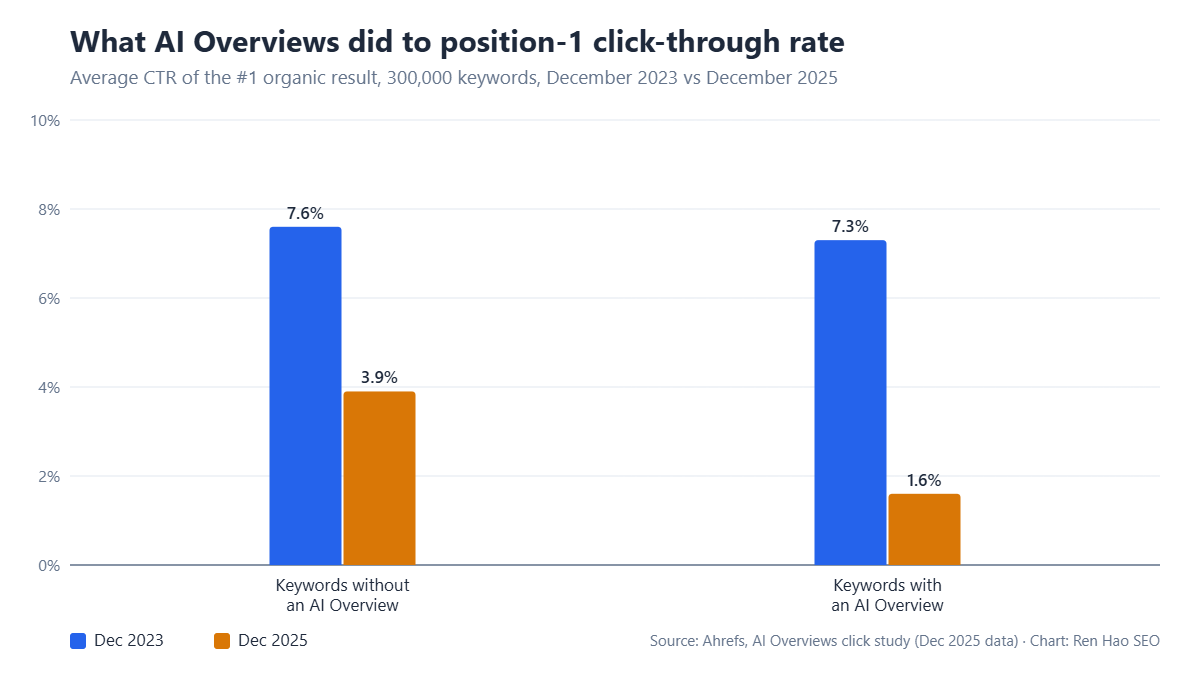
Google does not expose AI Overviews interaction in GA4, and Search Console reports Overviews impressions and clicks blended into ordinary web search totals. Any dashboard claiming an exact Overviews traffic split is manufacturing precision. What the data does support is inference: track position-adjusted CTR for your key query clusters over time — a falling CTR at stable rankings on informational queries is the Overviews absorption signature — and pair it with the blended organic trend for the affected clusters.
This inference layer matters because it prices the strategic question correctly. Overviews absorb clicks on queries where the answer suffices; they redirect attention toward cited sources on queries where depth is wanted. Watching which of your clusters lose CTR and which gain assistant referrals tells you where to defend with citation-worthy depth — the same funnel-stage logic our AI visibility audit applies across the full surface set.
Resist the vendor dashboards that promise the impossible split from scraped SERP sampling: useful for citation presence monitoring, structurally unable to tell you your own click economics. Keep the two data classes — your analytics, their visibility sampling — in separate columns of the report, labeled for what each can honestly claim.
Reading the numbers: what AI-referred visitors are worth
Once the segment runs, the interesting questions become economic. Across the properties we manage, assistant-referred visitors show a consistent profile: they arrive deeper in the funnel — the assistant absorbed the introductory queries — land disproportionately on comparison, methodology and evidence pages, and convert on high-consideration actions at rates that frequently exceed classic organic. They are fewer, and each one was pre-qualified by the conversation that sent them.
That profile should reshape two decisions. Content investment: pages earning assistant citations are doing silent top-of-funnel work plus delivering pre-warmed visitors, so their value exceeds their session count — defund them by raw traffic and you cut the channel at its root. And conversion design: an AI-referred visitor has context, so pages that restate basics before the substance waste the one advantage the referral carried; answer-first structure serves this traffic twice.
Report the economics explicitly: sessions, engaged rate, key-event rate and revenue per session for AI Referral against the property averages, monthly, by landing cluster. Three months of that table settles internal debates about whether AI visibility deserves budget far faster than any industry survey.
Beyond analytics: the signals GA4 cannot carry
Two complements close the measurement picture. Citation monitoring — systematically querying the major assistants with your money questions and logging whether and how you are cited — measures the exposure layer analytics cannot see; run it monthly with a fixed query set so the trend is real. Brand-demand signals — branded search volume, direct traffic to cited pages, branded queries in Search Console — catch the users who read an answer, remembered the name, and arrived later by another door; annotate citation wins and watch the branded lines that follow.
Attribution windows need patience settings: assistant-mediated journeys often span devices and days between exposure and arrival, so judge the channel on engaged-session quality and assisted patterns rather than last-click alone, or the reporting will systematically undercount the surface doing the earliest work.
Server logs add a third lens where access permits: AI crawler user-agents in the logs confirm which pages the assistants are actually retrieving, and retrieval without citation flags content that gets read but not trusted — usually an evidence-density problem, occasionally a technical-access one.
Together the layers form the honest dashboard: referral analytics for the clicks, citation monitoring for the exposure, brand signals for the delayed effect, logs for the retrieval reality. Each column labeled, none pretending to be the others — the measurement posture that lets a data-driven team steer by what is actually known.
The quarterly review that keeps it honest
AI surfaces change fast enough that the setup decays without maintenance. Quarterly: refresh the referrer pattern list against the assistants currently passing traffic (new entrants appear; some go referrer-dark); re-run the citation query set and reconcile against the referral trend; review which clusters gained or lost assistant traffic and feed the answer into the content roadmap; and re-validate that the channel group still evaluates before generic Referral — property migrations and admin changes have silently broken more than one client's segmentation.
Annotate everything: assistant product launches, Overviews rollout expansions in your markets, your own citation-bait publications. Twelve months of annotated trend is the asset — it turns the next strategy debate from speculation into a read of your own timeline.
The teams treating AI referral as a first-class channel today are building the baseline everyone else will wish they had next year. The setup is an afternoon; start the clock this week.
Frequently asked questions
Can GA4 track traffic from ChatGPT and Perplexity?
Yes — both pass referrer headers, so sessions are measurable once you isolate them with a custom channel group or segment matching sources like chatgpt.com and perplexity.ai. Without that setup they hide inside generic Referral traffic.
How do I separate AI Overviews traffic in GA4?
You cannot — Google reports Overviews clicks blended into ordinary organic in both GA4 and Search Console. The honest method is inference: falling position-adjusted CTR at stable rankings signals Overviews absorption on those query clusters.
Which AI referrer sources should my channel group match?
The assistants passing referrers: chatgpt.com, chat.openai.com, perplexity.ai, copilot.microsoft.com, gemini.google.com, claude.ai and peers, plus regional assistants your market uses. Review the list quarterly — the set changes.
Does a custom channel group work on historical data?
No — channel groups apply from creation forward. Pair the group with an exploration segment using the same source patterns; segments evaluate retroactively and recover your historical AI referral trend.
Are AI-referred visitors worth more than organic visitors?
Frequently — they arrive pre-qualified by the assistant conversation, land on deeper pages and convert high-consideration actions at strong rates. Measure engagement and conversion value per session by segment in your own property before budgeting.
How do I measure AI citations that never send a click?
Site analytics cannot see them. Run monthly citation monitoring — a fixed query set against the major assistants, logging citation presence — and watch branded search and direct traffic to cited pages for the delayed-arrival effect.
What is a realistic share of traffic from AI referrals?
For content-strong sites, assistant referrals have grown from negligible to a visible low-single-digit share of non-branded discovery, concentrated on citation-winning pages. The share matters less than the trend and the per-visitor economics, which the segment setup reveals.