
How to Get Cited in AI Overviews & ChatGPT: The 2026 Guide
As AI Overviews, ChatGPT, Gemini, Perplexity and other answer engines reshape how people find information, a new and urgent question faces every brand: when an AI answers a question in your space, are you the source it cites — or are you invisible? Being cited puts your brand directly inside the answer your buyer is reading, with the implicit endorsement of the AI. Being absent means a growing share of discovery happens without you, and you may not even realise it is happening. This complete guide explains, based on what we observe across real campaigns for SaaS, fintech and B2B clients, the patterns behind which sources AI engines surface — and a practical, prioritised plan to earn that visibility before your competitors do. We will cover how AI engines choose and cite sources, the specific patterns that earn citations, how the major engines differ, how to measure your visibility, the anti-patterns that quietly sabotage it, and what all of this means for your wider content strategy. The reassuring conclusion up front: this is not a separate, fragile game requiring you to start over. It is an extension of the same fundamentals — genuine authority, clarity and trust — that have always won in search, applied with awareness of how AI selects and synthesises sources. Master those, and you win in both traditional and AI search at once.
- AI engines cite a few synthesised sources rather than listing links — being cited puts you inside the answer.
- Citation depends on being retrieved (relevance, technical health) and selected (authority, clarity, trust).
- Genuine topical authority — comprehensive, interlinked, expert coverage — beats single optimised pages.
- Lead with clear, extractable answers so AI can quote you accurately; cut the filler.
- Strong E-E-A-T and original first-party data make citation far more likely; thin AI-spun content does not.
- The major engines differ (Google AI Overviews lean on search signals; Perplexity rewards citable structure) but reward the same fundamentals.
- Measure your visibility on target queries monthly, and double down on the content that earns citations.
- It’s an extension of sound SEO fundamentals, not a separate game — don’t abandon proven strategy to chase hacks.
Why AI citations are the new front line of search
Traditional SEO is about ranking in a list of ten blue links, where the user scans and clicks. AI search works differently: the engine reads many sources, synthesises a single answer, and cites a handful of them — often without the user ever clicking through to any source at all. This is simultaneously the biggest threat and the biggest opportunity in search since mobile.
We cover the wider context in A Beginner’s Guide to Title Tags & Meta Descriptions for SEO Success, which is worth reading alongside this article.
AI Overviews is only half the picture — our comparison of AI Overviews vs AI Mode covers where the conversational surface diverges and what that changes.
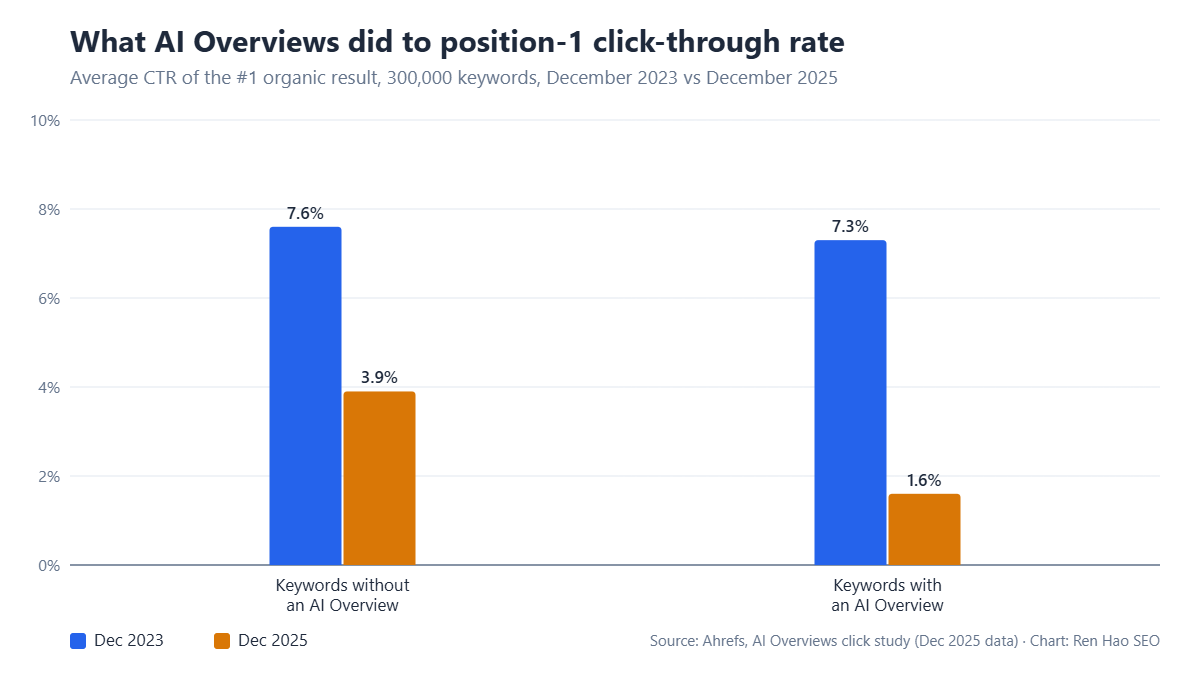
The threat is real and worth stating plainly. For purely informational queries — definitions, how-tos, quick facts — AI answers increasingly satisfy the user directly, which can reduce the click-through traffic that informational content used to earn. Brands whose entire SEO strategy depends on top-of-funnel informational clicks are right to pay attention. But the opportunity is larger and more durable: being one of the few cited sources places your brand inside the answer at the exact moment of research, with the AI effectively vouching for you. For commercial and consideration-stage queries — comparisons, recommendations, ‘best tool for X’ — this is enormously valuable, because the buyer is being pointed toward you by a trusted intermediary.
Critically, the brands that get cited are not random, and they are not simply the biggest names. AI engines draw on the same underlying signals of relevance, authority and trust that power traditional search — they are, after all, largely built on top of or alongside existing search infrastructure — plus some patterns specific to how they select and synthesise sources. Understanding those patterns lets you position your content to be the source the AI reaches for. That is the entire focus of our AI Overview Optimization and ChatGPT Optimization services.
How AI engines actually choose and cite sources
To optimise for AI citation, it helps to understand the rough mechanics. When an AI engine answers a query, it typically retrieves a set of candidate sources (often via a search index), evaluates them for relevance and reliability, synthesises an answer from the strongest, and cites the ones it drew on most heavily or trusts most. Different engines weight this differently — Google’s AI Overviews lean heavily on the same signals as Google Search, while ChatGPT with browsing and Perplexity have their own retrieval and ranking layers — but the broad shape is consistent.
What this means practically is that citation is downstream of two things: being retrieved as a candidate (which depends on classic relevance and discoverability), and being selected as a trusted source to synthesise from (which depends on authority, clarity and trustworthiness). A page can be relevant but never retrieved because it is poorly structured or thin; or retrieved but never cited because a more authoritative, clearer source is preferred. You have to win on both fronts.
It also means the old foundations still apply. If your content cannot be crawled, indexed and understood — the basics covered in how search engines work — it cannot be retrieved by the AI’s search layer either. Technical SEO, far from being irrelevant in the AI era, remains the price of entry. With that mechanical picture in mind, here are the patterns we consistently observe behind cited sources.
Pattern 1: Genuine topical authority beats single optimised pages
The single strongest pattern we observe is that AI engines favour sources with genuine, demonstrated authority on a topic — not a single cleverly optimised page, but comprehensive, expert coverage of a whole subject area. A site that thoroughly and credibly covers a topic, with depth, internal linking and evident expertise, is far more likely to be cited than one with a thin, isolated page targeting the same query, even if that single page is well optimised in the traditional sense.
This rewards the topical-authority approach that already wins in traditional search, but it raises the stakes. Because the AI is effectively choosing which sources it trusts to build an accurate answer from, it gravitates toward sources that demonstrate they genuinely know the subject — the way a researcher prefers a specialist text over a generalist’s passing mention. Covering your subject comprehensively, structuring it into a logical cluster of interlinked content, and demonstrating real expertise throughout is therefore the highest-leverage AI-visibility investment you can make.
In practice, this means building genuine content hubs around your core topics rather than scattering disconnected posts. A SaaS company that wants to be cited on ‘project management methodology’ should own that topic comprehensively — the concepts, the comparisons, the practical guides, the data — and interlink it tightly, rather than publishing one thin post and hoping. This is the same topical authority strategy behind the results in our case studies, now paying a second dividend in AI visibility.
Pattern 2: Clear, extractable answers get quoted
AI engines need to extract and synthesise information, so content that states its answers clearly and directly is far easier to cite than content that buries the answer beneath marketing throat-clearing. The pages that perform best lead with a clear, concise answer to the question, then expand with the depth, evidence and nuance that demonstrate expertise. This ‘answer first, then elaborate’ structure is good writing practice in general, but it is especially powerful for AI visibility because it makes your content trivially easy for an AI to lift and quote accurately.
Concretely, this means several things. Use clear, descriptive headings that mirror the real questions people ask, because AI engines (and featured snippets before them) map questions to well-labelled sections. Answer the question directly in the first sentence or two of each section. Use structured formats — lists, tables, definitions, step-by-step instructions — where they genuinely fit, because structured content is easier to extract reliably. And cut the filler: the long, keyword-stuffed preambles that add nothing make your content harder to extract from and signal lower quality.
A useful mental test when writing or editing: imagine an AI trying to quote your page in a one-paragraph answer. Is there a clean, accurate sentence it can lift? If your key point is tangled up in qualifications and marketing language, the answer is no, and a clearer competitor will be cited instead. Writing for extractability is rapidly becoming as important as writing for engagement.
Pattern 3: E-E-A-T and trust signals decide who is believed
AI engines, like Google’s traditional ranking, lean heavily on signals of Experience, Expertise, Authoritativeness and Trust (E-E-A-T) — and they lean on them even harder for topics where accuracy matters, such as health, finance and anything that could affect someone’s wellbeing or money. This is because an AI that cites an unreliable source and produces a wrong answer damages its own credibility, so the engines are strongly incentivised to prefer sources they can trust.
The trust signals that matter are familiar but now doubly important: clear authorship by genuine, named experts with real credentials; citations and references to credible primary sources; a trustworthy site overall (secure, transparent, with clear about and contact information); and a track record of accuracy. Content that demonstrably knows what it is talking about, written by identifiable people who are accountable for it, is exactly what AI engines want to build answers from. This is why the byline, review and update information on this very article is not decoration — it is an E-E-A-T signal.
This is also why original research is such a disproportionately powerful AI-visibility asset. When you publish genuine first-party data — a survey, a benchmark, an analysis of your own dataset — you become a primary source that others, and AI engines, cite, rather than one more site repeating what everyone else already said. Original data makes you quotable in a way that derivative content never can, which is why we invest in it through our research and insights hub. Conversely, thin, AI-spun content is a losing strategy for AI visibility: the engines are increasingly good at recognising genuine expertise versus filler, and citing filler helps no one.
Pattern 4: Brand presence and consistency across the web
A subtler but real pattern is that AI engines appear to favour brands with a consistent, credible presence across the wider web, not just on their own site. Mentions in reputable publications, genuine reviews on trusted platforms, consistent business information, an authoritative backlink profile, and a coherent brand identity all contribute to the overall sense that this is a real, established, trustworthy entity worth citing.
This connects AI visibility to digital PR and authority building. The same activities that earn you high-quality editorial coverage and links — being genuinely newsworthy, publishing original data, earning mentions from respected sources — also build the off-site signals that help AI engines trust you. It is another instance of AI search rewarding the fundamentals rather than replacing them: a brand that is genuinely authoritative and well-regarded across the web is exactly the kind of source an AI wants to cite.
For challenger brands, this is both a challenge and an opportunity. You cannot manufacture decades of brand presence overnight, but you can deliberately build the signals that matter: earn genuine coverage, publish citable data, get listed and reviewed on the platforms your industry trusts, and be consistent everywhere. Over time, this compounds into the kind of recognised authority that AI engines reach for — much as it always has in traditional search. The encouraging reality is that AI engines, unlike some incumbents, have no inherent loyalty to established brands; they cite whoever is genuinely the most relevant, clearest and most trustworthy source for a given query.
That means a focused challenger that builds real authority in a specific niche can earn citations alongside or ahead of far larger but more generic competitors — the same dynamic that lets a specialist outrank a generalist in traditional search, and exactly how we approach competitive industry SEO.
A practical, prioritised action plan
- 1Secure the technical foundationEnsure your content can be crawled, indexed and understood. If the AI’s search layer can’t retrieve you, nothing else matters. Fix the basics first — see our technical SEO guidance.
- 2Build genuine topical authorityPick your core topics and cover them comprehensively in interlinked content hubs, rather than scattering thin, disconnected posts. Depth and structure signal the expertise AI engines cite.
- 3Restructure for extractabilityRewrite key content to lead with clear, direct answers to real questions, with descriptive headings and structured formats. Make it trivially easy for an AI to quote you accurately.
- 4Strengthen E-E-A-T signalsAdd clear expert authorship, credentials, review and update information, and credible sourcing. Publish original first-party data wherever you can — it makes you a primary source.
- 5Build brand presence off-siteEarn genuine coverage, reviews, mentions and quality links. Be consistent everywhere. These off-site signals build the trust AI engines reward.
- 6Measure and iterateTrack your visibility in AI Overviews and answer engines for your key queries, see which content gets cited, and double down on what works. This is a new, fast-moving discipline — stay close to the data.
What to stop doing: AI-visibility anti-patterns
Just as important as what to do is what to avoid, because several tempting shortcuts actively harm AI visibility. The first is mass-producing thin, AI-generated content to ‘cover more topics.’ This is exactly backwards: it dilutes your topical authority, adds filler the engines can recognise, and risks the perception of an unreliable source. Fewer, genuinely expert, comprehensively researched pages beat a flood of shallow ones every time.
The second anti-pattern is chasing AI visibility as a separate, gimmicky game — looking for ‘AI SEO hacks’ or trying to manipulate the engines. Beyond being fragile and short-lived, this distracts from the durable work that actually earns citations: genuine authority, clarity and trust. There is no secret trick; there is doing the fundamentals exceptionally well with an awareness of how AI selects sources.
The third is neglecting traditional SEO in a panic about AI. The two are deeply intertwined: the content, authority and technical foundations that win traditional rankings are largely the same ones that earn AI citations. Abandoning your proven SEO strategy to chase AI is like rebuilding your house because you bought a new car. Extend your strategy into AI; do not replace it. This is the same prioritisation discipline we cover in why most SEO fails.
How the major AI engines differ — and why it matters
Although the underlying patterns are consistent, the major AI engines differ enough that it pays to understand each. Google’s AI Overviews sit directly in the search results and lean heavily on the same signals as Google Search — so strong traditional SEO is the dominant lever for Overview visibility, and a page that ranks well organically is far more likely to be drawn into the Overview. This is the most important surface for most businesses simply because of Google’s scale, and it rewards the topical authority and technical health we have already discussed.
ChatGPT, when browsing the web, retrieves and synthesises live sources, and increasingly influences purchase research as people ask it for recommendations. Being the brand ChatGPT suggests in your category is a genuine competitive advantage, and it rests on the same authority and clarity signals plus a strong, consistent brand presence across the sources it draws on. Perplexity, built around citation from the ground up, is especially transparent about its sources and especially rewarding of clear, well-structured, citable content. Gemini and other assistants follow broadly similar logic.
The practical implication is not to chase each engine with a separate strategy — that way lies wasted effort — but to build the genuine authority, clarity and trust that all of them reward, while paying particular attention to Google AI Overviews given their reach. A brand that is genuinely the best, clearest, most trustworthy answer tends to surface across all of them, which is exactly why we optimise for the fundamentals through AI Overview Optimization rather than gaming any single engine. The engines change constantly; genuine authority is durable.
How to measure your AI search visibility
You cannot improve what you do not measure, and AI search visibility is harder to measure than traditional rankings — but it is far from impossible, and a disciplined approach gives you real feedback. Start by defining the queries that matter for your business: the questions, comparisons and ‘best X for Y’ searches where being cited would put you in front of a buyer. These are your target AI queries, the equivalent of your priority keywords in traditional SEO.
Then check, regularly and systematically, whether you appear. Run your target queries through Google (noting whether an AI Overview appears and whether you are cited), through ChatGPT with browsing, through Perplexity and through any other engine your audience uses, and record where you appear, where a competitor appears instead, and which of your pages (if any) gets cited. Doing this monthly builds a picture of your AI visibility over time and, crucially, of which content earns citations so you can produce more of it. A handful of emerging tools now track AI citations at scale, but even a manual, structured check of your top queries is genuinely valuable and more than most competitors bother to do.
Tie this back to outcomes wherever you can. Watch for referral traffic from AI engines in your analytics, for branded search lifts that often follow AI exposure, and for prospects mentioning they found you through an AI assistant. AI visibility is still maturing as a measurable channel, so combine the hard data you can get with these softer signals, and treat it as you would any new channel: measure what you can, learn fast, and double down on what works.
This measurement discipline is part of how we approach ChatGPT Optimization for clients, and it connects directly to measuring SEO against real outcomes rather than vanity metrics. The brands that win in AI search will be the ones treating it as a serious, measured channel today, while most competitors are still either ignoring it or panicking about it — the same early-mover advantage that rewarded the businesses who took traditional SEO seriously a decade ago.
What AI search means for your content strategy
Stepping back from tactics, AI search has a few important implications for how you should think about content strategy as a whole. The first is that depth and genuine expertise matter more than ever, while thin, churned-out content matters less than ever. In a world where AI can instantly generate a mediocre overview of any topic, the value — and the citations — flow to sources that offer something the AI cannot generate itself: genuine first-hand experience, original data, real expertise, and a point of view earned through actually doing the work. This is good news for businesses willing to invest in quality and bad news for content mills.
The second implication is that the middle of the funnel becomes more valuable relative to the very top. Purely informational, top-of-funnel queries are the ones most likely to be answered directly by AI without a click, so leaning your entire strategy on them is increasingly risky. Consideration and commercial queries — where buyers compare options, seek recommendations and make decisions — are both more valuable and more likely to send qualified traffic or citations your way. Shifting some content investment toward these stages, and toward the specific problems your buyers are trying to solve, is a sensible hedge, and one we build into the industry strategies we design.
The third implication is that brand matters more. As AI intermediates more discovery, being a brand that AI engines recognise and trust — and that buyers actively seek out — becomes a durable advantage that is hard to disrupt. Investing in genuine authority, a consistent presence, original thought leadership through your research, and the kind of reputation that earns mentions and recommendations is not a soft, unmeasurable nicety; it is increasingly the foundation of visibility itself. The brands that treat content as a genuine expertise-and-trust investment, rather than a volume game, are the ones positioned to win as search continues to evolve.
How AI search visibility fits your wider strategy
The throughline of this guide is reassuring: getting cited in AI Overviews and ChatGPT is not a separate, fragile discipline you have to master from scratch. It is the natural extension of genuine, authority-building SEO into a new surface. Topical authority, clear and extractable content, strong E-E-A-T, original data, and a credible brand presence — these win in traditional search and in AI search alike. The brands investing in these fundamentals now are building an advantage in AI visibility that will be very hard for shortcut-seekers to displace, exactly as early movers built durable advantages in traditional SEO.
That said, AI search does reward a deliberate awareness of how engines select and synthesise sources — the extractability, the answer-first structure, the citable data — which is why it is worth treating as a distinct lens even though it rests on familiar foundations. The brands that combine sound SEO fundamentals with that awareness are the ones we see being cited most consistently across our client work.
If you want to know where your brand currently stands in AI search — which queries cite you, which cite competitors, and what would move the needle — that is exactly what our AI Overview Optimization service assesses, and what a free SEO audit begins to map. The AI search era rewards the same thing it always has: being genuinely the best, most trustworthy answer. We just have to make sure the machines can recognise it.
For primary sources, see Google’s official Search blog for AI Overviews announcements, and Google Search Central — Google has confirmed that standard, quality-focused SEO is what qualifies content for AI features.
Written by the Ren Hao SEO team and reviewed by Ren Hao, founder and lead SEO strategist. Our guidance comes from real client work — over 100 SEO audits and $1,500,000+ in client sales value generated with white-hat, data-driven methods — not recycled theory.