
The Technical SEO Checklist for 2026
Technical SEO is the foundation that lets your content and authority actually pay off — if search engines can’t crawl, index and understand your site, nothing else matters. This practical, prioritised checklist walks through what to check and fix, in roughly the order that matters most, so you address the issues that genuinely cap your rankings rather than chasing minor details. It reflects how we approach technical SEO for real clients: foundations first, by impact.
- Technical SEO is the foundation — crawling and indexing issues cap everything else.
- Check crawlability (robots.txt, sitemap, structure) and indexing (right pages indexed, no accidental noindex) first.
- Then address Core Web Vitals/speed, mobile-friendliness with content parity, and HTTPS.
- Use logical structure, clean URLs, internal linking and schema to help search engines understand your site.
- Work by impact: foundations first, then speed and mobile, then refinements.
Crawling: can Google find your pages?
Start with crawlability, because a page that can’t be crawled can’t rank. Check that your robots.txt isn’t accidentally blocking important pages, that you have a clean, current XML sitemap submitted in Google Search Console, and that your site structure makes important pages reachable within a few clicks. Strong internal linking helps crawlers (and authority) flow through your site — orphan pages with no internal links are easily missed.
Schema markup deserves its own line on the checklist because the common defects are invisible to a validator: our review of which structured data still moves the needle in 2026 covers duplicate Article nodes, retired types and the script-wrapper regressions that quietly cost visibility.
Use Search Console’s coverage and crawl reports to see what Google has found and any errors it hit. For larger sites, watch for crawl budget waste from endless filter/parameter URLs and duplicate content. The principle is to help Google spend its crawling on your valuable pages, as we explain in how search engines work.
Indexing: is Google storing the right pages?
Next, confirm your important pages are actually indexed (Search Console shows this) and that you’re not accidentally applying ‘noindex’ where you don’t intend to. Equally, ensure low-value or duplicate pages aren’t bloating your index. Indexing is no longer automatic — Google increasingly declines to store thin or duplicative content — so your pages need to be genuinely worth indexing.
Handle duplication deliberately: use canonical tags to point to the preferred version of similar pages, and avoid generating many near-identical URLs. Clean indexing means Google understands and stores exactly the pages you want competing in search.
Speed and Core Web Vitals
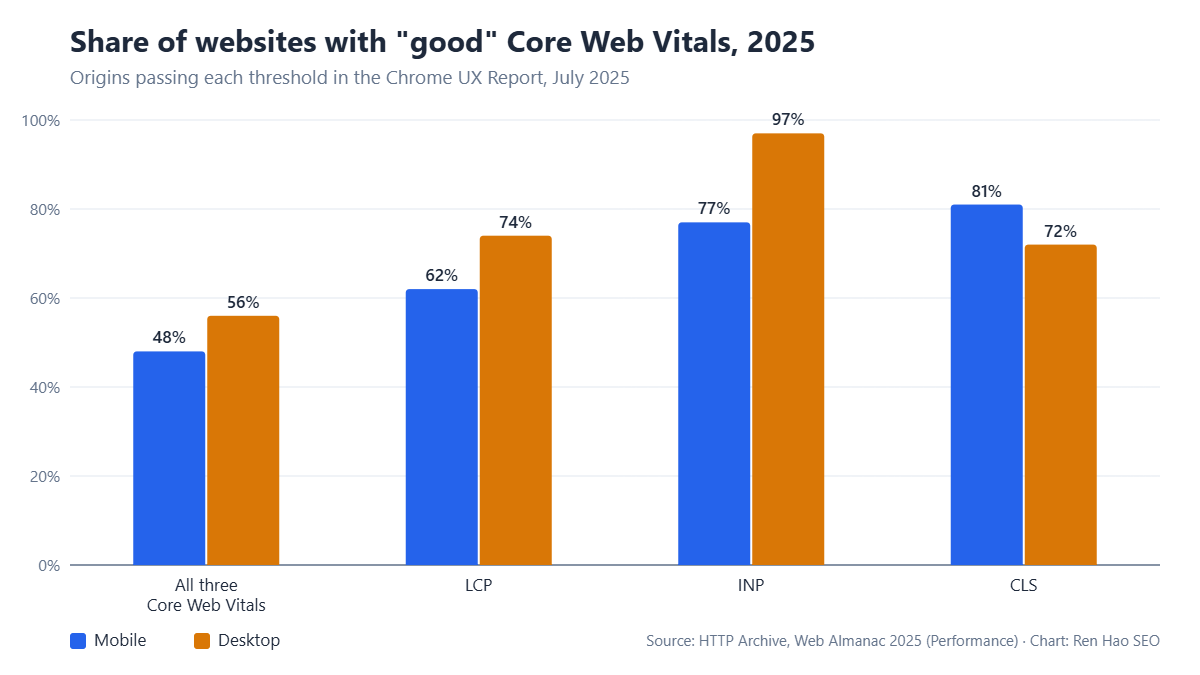
Check your Core Web Vitals in Search Console (field data) and diagnose any failures with PageSpeed Insights. The common fixes are image optimisation, fast hosting and caching, and reining in heavy JavaScript. Speed is a ranking tie-breaker and a major conversion factor, so it’s worth getting genuinely good — see our Core Web Vitals guide and how site speed affects rankings for depth.
Mobile-friendliness and HTTPS
Google predominantly uses the mobile version of your site for indexing and ranking, so ensure your mobile experience is excellent and has content parity with desktop — don’t hide content or strip links on mobile. Confirm your site is fully responsive and fast on real mobile devices. And ensure HTTPS is properly implemented sitewide (it’s a trust essential and a minor ranking signal), with no mixed-content or certificate issues.
Structure, schema and the rest
Beyond the essentials, check your site architecture is logical and shallow, your URLs are clean and descriptive, and you’re using internal linking to establish topical relationships and spread authority. Add structured data (schema markup) where relevant to help search engines understand your content and enable rich results. Fix broken links and redirect chains, and ensure important pages aren’t buried.
Work through this checklist by impact: crawling and indexing first (they cap everything), then speed and mobile, then structure and refinements. If you’d like a prioritised technical audit of your specific site — what’s actually wrong and what to fix first — that’s exactly what a free SEO audit delivers.
How to prioritise technical fixes when everything looks broken
A crawl report with 4,000 ‘issues’ is paralysing, and most of those issues don’t matter. The way through is impact-based triage. First, anything that blocks crawling or indexing of revenue pages — robots.txt rules, noindex tags, broken canonicals, redirect chains on money pages — gets fixed before anything else, because no other optimisation matters on a page Google can’t index. Second come sitewide template problems: a heading error or missing schema repeated across 800 product pages is one fix with 800 pages of payoff. Third, performance issues on the pages that earn money or traffic — not your privacy policy. Everything else is backlog.
A useful discipline is to attach every technical task to the question ‘which pages does this affect, and what do those pages earn?’. A 2-point CLS improvement on a blog nobody reads loses to a canonical fix on your best-selling category every time. Agencies that hand you an undifferentiated 200-row spreadsheet are exporting a tool, not doing technical SEO.
The technical mistakes we find most often in audits
- 1Accidental noindex left over from stagingA staging site goes live with its meta robots noindex intact, or a deploy re-applies it. Weeks of invisibility follow. Check indexing status in Search Console after every major release.
- 2Redirect chains and loopsA → B → C → D wastes crawl budget and dilutes link equity at every hop. Flatten chains to a single 301 from every legacy URL to the final destination.
- 3Canonical tags pointing to the wrong pageSelf-referencing canonicals are the default for a reason. We regularly find category pages canonicalised to the homepage or to filtered duplicates, quietly removing them from the index.
- 4Internal links to redirected or dead URLsEvery internal link should point at a final, 200-status URL. Linking through redirects leaks signal and slows crawling at scale.
- 5JavaScript-dependent content Google can’t renderIf your prices, headings or copy only exist after client-side rendering, test what Google actually sees with the URL Inspection tool — not what your browser sees.
- 6Unminded faceted navigationFilter combinations can generate millions of crawlable near-duplicate URLs that drown your real pages. Control them with robots rules, canonicals and selective internal linking.
Technical SEO in the AI search era
AI Overviews and answer engines raise the technical bar rather than lowering it. To be cited, your content must be crawlable, rendered quickly, and unambiguous to machines — which is exactly what clean HTML structure, fast responses and accurate schema provide. Structured data has graduated from ‘nice to have’ to a primary disambiguation layer: Organization, Product, FAQ and Article markup help systems understand who you are and what each page asserts.
Render speed matters more too. AI crawlers fetch aggressively and tolerate less; sites that respond slowly or hide content behind heavy client-side rendering simply appear less often in AI-generated answers. The practical takeaway: the same checklist that wins traditional rankings — crawlability, speed, clean structure, schema — is also your AI-visibility checklist. There is no separate trick.
A monthly technical health workflow
- 1Week 1 — crawl and compareRun a full crawl and diff it against last month’s: new 404s, new redirects, title/canonical changes. Changes you didn’t plan are your first investigation targets.
- 2Week 2 — Search Console triageReview Indexing (what dropped out and why), Core Web Vitals (URLs newly failing), and Crawl Stats (response-time trends, spikes in non-200s).
- 3Week 3 — template spot-checksInspect one URL per template with the URL Inspection tool: rendered HTML, canonical Google chose, structured-data validity. Templates drift; spot-checks catch it early.
- 4Week 4 — fix, deploy, verifyShip the month’s fixes, then re-inspect affected URLs and request indexing on the priority ones. Unverified fixes are unfinished fixes.
How to verify your fixes actually worked
Technical SEO has a feedback loop most teams skip. After every fix, confirm three layers: the implementation (view-source or rendered HTML shows the change), Google’s perception (URL Inspection shows the new canonical/status/markup), and the outcome (Indexing report counts recover, impressions return in Performance). A canonical fix that Google hasn’t recrawled yet hasn’t happened; a speed fix that field data doesn’t reflect within a month needs re-examination.
Keep a dated changelog of every technical change alongside your rank and traffic data. When movements happen — good or bad — the changelog turns guesswork into diagnosis, and it’s the evidence base that makes the next prioritisation call obvious.
Google’s own documentation is the primary source for everything on this page: see Google Search Central for crawling and indexing fundamentals, and web.dev’s Core Web Vitals documentation for the performance metrics Google actually measures.
Written by the Ren Hao SEO team and reviewed by Ren Hao, founder and lead SEO strategist. Our guidance comes from real client work — over 100 SEO audits and $1,500,000+ in client sales value generated with white-hat, data-driven methods — not recycled theory.