
How Search Engines Work: Crawling, Indexing & Ranking Explained
Every good SEO decision rests on understanding how search engines actually work. It is the difference between following tactics blindly and understanding why they matter — and that understanding is what lets you adapt when algorithms change, diagnose why a page isn’t ranking, and prioritise correctly. Once you grasp the three core stages — crawling, indexing and ranking — most SEO advice stops feeling like a random list of tricks and starts making logical sense. This complete guide explains each stage plainly, covers the often-missed steps of rendering, mobile-first indexing and crawl budget, shows how search intent and algorithm updates fit in, and connects the mechanics to the practical decisions that grow organic traffic. By the end you will have a durable mental model that outlasts any individual tactic — one you can use to diagnose problems, evaluate advice, and prioritise with confidence. Everything here reflects how we think about diagnosing and fixing client sites across many industries, not abstract theory.
- Search works in three stages: crawling (discovery), indexing (understanding/storage), and ranking (ordering).
- If a page can’t be crawled or indexed, it cannot rank — technical foundations and structure come first.
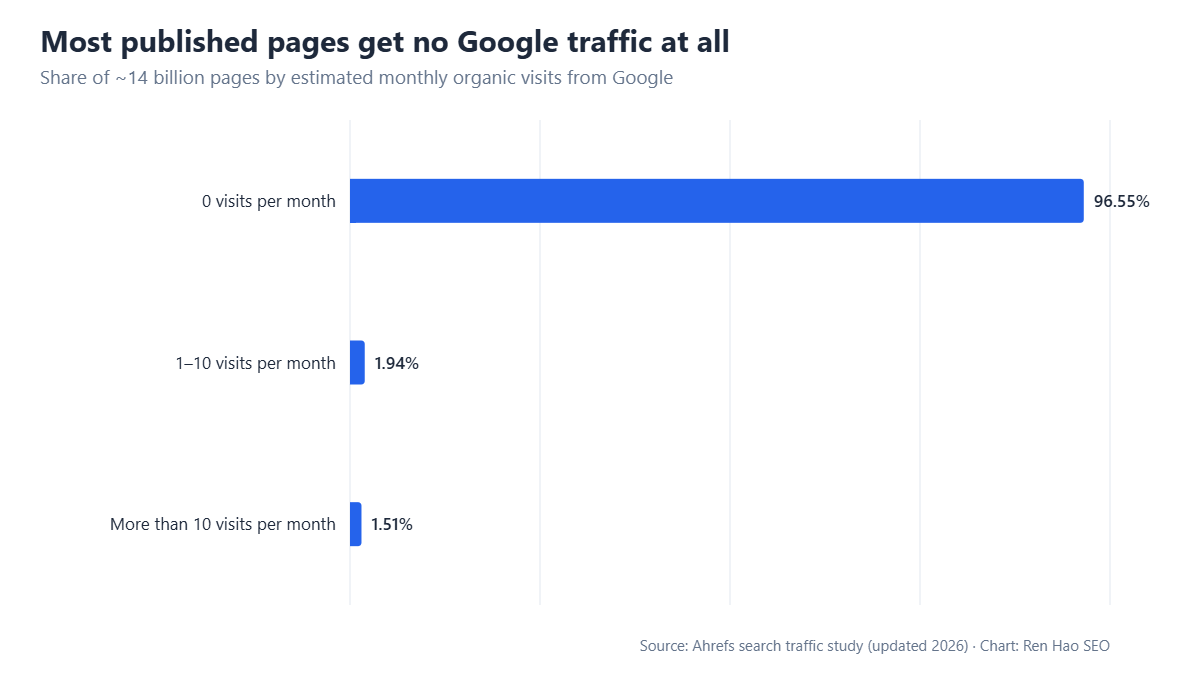
- Indexing isn’t automatic; Google increasingly declines to store thin or duplicate content.
- Ranking rewards four clusters: relevance, content quality, authority, and page experience.
- Matching search intent is non-negotiable — create the content type the top results already show.
- Algorithm updates reward the same fundamentals; genuine quality and authority tend to gain over time.
- The pipeline imposes a natural order — findable, understandable, best trusted answer — so prioritise accordingly.
- Modern sites must also mind rendering (JavaScript), mobile-first indexing, and crawl budget at scale.
The big picture: from your page to a search result
Before diving into the stages, it helps to see the whole journey. When you publish a page, it does not instantly appear in Google. Instead, it goes through a pipeline: first Google has to discover and fetch it (crawling), then analyse and store it (indexing), and only then can it be considered when someone searches and Google decides what to show and in what order (ranking). A page can fall out of the pipeline at any stage — never crawled, crawled but not indexed, or indexed but never ranked well enough to be seen.
How engines rank has shifted again in 2026: our analysis of the May 2026 core update and its quality-tier mechanism explains how site-level assessment now gates what individual pages can achieve.
This pipeline view is genuinely useful because it tells you where to look when something goes wrong. If your page isn’t appearing in search at all, the problem is almost always at the crawling or indexing stage. If it’s indexed but buried, the problem is at the ranking stage. Diagnosing which stage is failing is the first step to fixing it — and it is exactly what a technical SEO audit does. Understanding the pipeline turns ‘my SEO isn’t working’ from a vague frustration into a specific, solvable problem.
It is also worth knowing that this pipeline runs continuously and at enormous scale. Google is constantly re-crawling the web, updating its index, and refining how it ranks. Your pages are not processed once and forgotten; they are revisited, re-evaluated and re-ranked over time as your site, your competitors and the search landscape all change. SEO is therefore an ongoing relationship with this pipeline, not a one-time submission.
Stage 1: Crawling — how Google discovers your pages
Crawling is the discovery stage. Search engines use automated programs called crawlers — Google’s is called Googlebot — to find pages across the web. These crawlers work by following links: they start from pages they already know, follow the links on those pages to new pages, follow the links on those, and so on, continuously discovering new and updated content across billions of pages. They also use sitemaps you submit and other signals to find content.
The critical implication is simple but frequently overlooked: if a crawler cannot reach a page, that page effectively does not exist as far as search is concerned. Pages can be unreachable for several reasons — nothing links to them (orphan pages), the site’s structure buries them too many clicks deep, the site accidentally blocks crawlers (via robots.txt or meta tags), or crawl budget is wasted on low-value URLs so important pages get crawled rarely. The best content in the world earns nothing if Googlebot never sees it.
This is why technical foundations and site structure matter so much, and why they come first in any sound SEO strategy. A logical site architecture, strong internal linking, a clean and current XML sitemap, and a crawlable, unblocked setup all ensure search engines can actually find your content. Internal linking deserves special mention here: it is how you guide crawlers (and authority) through your site, and a well-linked site gets discovered far more thoroughly than a collection of isolated pages. We go deep on the technical side in our technical SEO service, because getting crawling right is the price of entry for everything else.
How to help search engines crawl your site
Since crawling is foundational, it is worth knowing how to support it. Start with a clear, logical site structure where important pages are reachable within a few clicks of the homepage — a flat, well-organised architecture is far easier to crawl than a deep, tangled one. Use internal links generously and meaningfully, linking related content together so crawlers can move through your site and understand how pages relate. Maintain an up-to-date XML sitemap and submit it in Google Search Console, which gives Google a direct map of the pages you want crawled.
Equally important is not actively blocking or wasting crawling. Check that your robots.txt file isn’t accidentally disallowing important pages, that you’re not applying ‘noindex’ tags where you don’t intend to, and that you’re not generating endless low-value URLs (from filters, parameters or duplicate content) that soak up crawl budget. For large sites especially, helping Google spend its crawling on your valuable pages rather than junk can make a real difference to how completely and frequently you’re crawled.
Google Search Console is your window into all of this. Its crawl and indexing reports show you which pages Google has found, which it has indexed, and any errors it hit along the way. Checking these reports regularly is one of the highest-value habits in technical SEO, because crawling and indexing problems are both common and quietly devastating — and entirely fixable once you can see them. If you’ve never looked at your Search Console coverage report, that is one of the most useful first steps you can take.
Signs Google is having trouble crawling your site
You can check crawling yourself in Google Search Console, without specialist tools. These are the signs worth acting on, and what each one tells you.
- ✓New pages take weeks to appearInspect the URL in Search Console. If Google has not crawled it, link to the page from an established page and confirm that it is in your sitemap.
- ✓Many pages marked “Discovered – currently not indexed”Google knows the URLs exist and has not fetched them. This usually points to weak internal linking or a large number of low-value URLs competing for attention.
- ✓Errors or slow responses in the Crawl Stats reportServer errors and slow response times cause Google to crawl less. Raise them with your host or developer.
- ✓Important pages buried deep in the siteA page that takes many clicks to reach from the home page, or that nothing links to, is crawled rarely. Bring it closer with links from your navigation, hub pages and related articles.
- ✓Crawling spent on filter and parameter URLsIf Crawl Stats shows Googlebot fetching endless filtered or tracking-parameter addresses, consolidate them with canonical tags or block the patterns in robots.txt.
Each of these has a clear fix, and resolving them is often the quickest way to get existing content working. Our technical SEO service starts with exactly these checks.
Stage 2: Indexing — how Google understands and stores pages
Once a page is crawled, it moves to indexing. Here, the search engine analyses the page — its content, structure, topics, images, and how it relates to other pages — and stores what it learns in its index, a colossal database of all the content it has processed and understood. Being in the index is non-negotiable: a page must be indexed to appear in search results at all. Crawling finds the page; indexing is Google actually reading it, working out what it’s about, and filing it away to be served when relevant.
Not everything that’s crawled gets indexed, and understanding why is important. Google may decline to index pages it considers low quality, thin, or duplicative of content it already has, as well as pages explicitly marked ‘noindex’ or blocked. As the web has grown, Google has become more selective about what it indexes — it has little reason to store yet another thin, derivative page. This means indexing is no longer automatic; your content has to earn its place by being genuinely worth storing. Thin or duplicate content frequently gets crawled and then quietly ignored.
This is where content quality and clarity start to matter mechanically, not just for ranking. Clear, well-structured, genuinely useful content is easier for search engines to understand and categorise correctly, and more likely to be deemed worth indexing. Good use of headings, logical structure, descriptive titles, and unique, substantial content all help Google understand and index your pages accurately. If Google can’t easily work out what a page is about, or decides it adds nothing new, that page won’t compete — which is one more reason the thin-content-at-scale approach backfires.
Stage 3: Ranking — how Google decides the order
Ranking is the stage everyone obsesses over, and it’s where the real competition happens. When someone searches, Google sifts its index for the pages most relevant to that query and orders them by which it judges most useful, highest quality and most trustworthy. This happens in a fraction of a second, drawing on hundreds of signals — but those signals cluster into a few that matter most, and understanding those clusters is far more useful than chasing any individual ranking factor.
The first cluster is relevance: does the page actually match the query and, crucially, the intent behind it? Google has become extraordinarily good at understanding intent — what the searcher really wants, not just the words they typed — and at matching it to content that genuinely satisfies it. The second cluster is content quality and depth: how well and completely does the page answer the need, compared to the alternatives? The third is authority: do other trustworthy sites and signals vouch for this page and site, principally through backlinks? The fourth is experience: is the page fast, usable, mobile-friendly and trustworthy, as captured partly by Core Web Vitals?
Understanding this clarifies the whole of SEO. You optimise to be findable (crawling), understandable (indexing), and then the best, most trusted answer (ranking). Every legitimate SEO tactic maps back to one of these. When you encounter a piece of SEO advice, ask which stage and which cluster it serves — it keeps you focused on what actually matters and immune to gimmicks that serve none of them. Relevance, quality, authority and experience are the enduring fundamentals; the specific signals and their weightings change, but those clusters remain the heart of ranking and are very unlikely to stop mattering, because they reflect what genuinely makes a result useful to a human being. Anchor your strategy to them and you are anchored to something durable, whatever the next update brings.
The role of search intent in ranking
Of all the ranking factors, search intent deserves special attention because misjudging it is one of the most common reasons good content fails to rank. Intent is what the searcher actually wants when they type a query. The same words can carry very different intent: someone searching ‘coffee’ might want a definition, a recipe, the nearest café, or to buy beans. Google works out the dominant intent for each query and ranks content that matches it — which is why understanding intent is essential to ranking.
Broadly, intent falls into a few types: informational (seeking knowledge — ‘how does SEO work’), navigational (looking for a specific site or brand), commercial (researching before a purchase — ‘best SEO agency’), and transactional (ready to act — ‘hire SEO agency’). Google shows different kinds of results for each: how-to articles for informational, product or service pages for transactional, comparison content for commercial. If you create the wrong type of content for the intent, you will struggle to rank no matter how good it is, because it simply isn’t what the searcher (and therefore Google) wants for that query.
The practical method is straightforward: before creating content for a keyword, search it yourself and study what already ranks. The format and angle of the top results reveal the intent Google has decided to reward. If they’re all in-depth guides, write a better in-depth guide; if they’re all product pages, a blog post won’t win. Matching intent is non-negotiable, and getting it right is often the difference between content that ranks and content that disappears. This is a core part of the keyword and content strategy we cover in our beginner's guide.
How algorithm updates fit in
Google continuously refines how it ranks, releasing both routine updates and larger ‘core updates’ several times a year. These updates can shift rankings, sometimes significantly, and they cause a lot of anxiety in the SEO world. But understanding the pipeline demystifies them: updates are Google getting better at the same fundamental job — identifying the most relevant, highest-quality, most trustworthy content and ordering it well. They are not arbitrary, and they are not out to get you.
This has a reassuring implication. If your strategy is built on genuinely being the best, most trustworthy answer — rather than on exploiting loopholes — algorithm updates are far more likely to help you than hurt you over time, because each update is trying to reward exactly that. The sites that get hammered by core updates are usually those relying on thin content, manipulative links or intent-mismatched pages — the things updates are designed to stop rewarding. Sites built on real quality and authority tend to be stable or to gain.
So the right response to algorithm updates is not to panic or chase the latest theory about what changed, but to keep building genuine quality, relevance, authority and experience. When you do get hit by an update, the diagnosis is the same as always: which of the fundamentals is weak, and how do you strengthen it? That said, a sudden drop can also be technical or a misdiagnosis, which is where a proper audit earns its keep. If you’ve been hit hard, our recovery service diagnoses the real cause rather than guessing.
Rendering: the often-missed step between crawling and indexing
There is an important nuance modern sites must understand: between crawling and indexing, Google often has to render your page — actually run its JavaScript and build the page the way a browser would — to see the full content. In the early web, pages were mostly plain HTML, so crawling and understanding were nearly the same step. Today, many sites build their content with JavaScript in the browser, which means Google has to do extra work to see what’s really there.
This matters because rendering is resource-intensive, so it can be delayed or, in some cases, incomplete. If your critical content and links only appear after JavaScript runs, you are relying on Google to render the page correctly and promptly before it can fully index you — and that doesn’t always happen cleanly, especially at scale. Content that depends entirely on client-side JavaScript can be indexed late, partially, or occasionally not at all, which is a silent killer of rankings for otherwise good sites.
The practical guidance is to make your important content and links available in the initial HTML wherever possible — through server-side rendering, static generation, or hybrid approaches — rather than depending solely on client-side rendering. This ensures Google can see your content immediately, without waiting on a rendering step that may be delayed. It is exactly the kind of consideration our web development team builds in from the start, because retrofitting it into a heavy JavaScript site after the fact is far harder. If your site is built on a modern framework and you’re unsure whether Google sees your content properly, it’s well worth checking — Search Console’s URL inspection tool shows you the rendered version Google actually sees.
Mobile-first indexing: Google sees your mobile site
A foundational shift that still trips up many sites is mobile-first indexing. Google predominantly uses the mobile version of your site for both indexing and ranking — not the desktop version. This means that when Googlebot crawls, indexes and evaluates your pages, it is primarily looking at what mobile users see. If your mobile site shows less content, fewer links, or a degraded experience compared to desktop, that lesser mobile version is what Google indexes and ranks.
The implications are significant and frequently overlooked. If you hide content behind tabs or accordions on mobile, strip out internal links to save space, or serve a stripped-down mobile experience, you may be quietly weakening how Google understands and ranks your pages. The mobile version needs to contain the same valuable content, structured data, and internal links as the desktop version — content parity between mobile and desktop is essential, not optional.
This connects directly to page experience and Core Web Vitals, which are also predominantly measured on mobile. A site that is fast, complete and well-structured on mobile is one that Google can crawl, index and rank well; a site that treats mobile as an afterthought undermines itself at every stage of the pipeline. Given that most searches now happen on mobile anyway, building a genuinely excellent mobile experience isn’t just good for users — it is how Google fundamentally sees and judges your entire site. We treat mobile performance as core to both technical SEO and Core Web Vitals.
Crawl budget: why it matters for larger sites
For most small sites, crawling happens thoroughly and crawl budget is not a concern — Google can easily crawl every page. But for larger sites — big eCommerce stores, publishers, sites with thousands or millions of URLs — crawl budget becomes a real factor. Crawl budget is, loosely, how much crawling Google is willing to do on your site in a given period, and on large sites it can mean that important pages get crawled infrequently, or that new and updated content takes a long time to be discovered and re-indexed.
Crawl budget gets wasted in predictable ways: endless URL variations from filters and parameters, duplicate content, low-value pages, broken links and redirect chains, and slow server responses that let Google fetch fewer pages per visit. When budget is wasted on junk, your valuable pages get less attention. The fixes are about efficiency: consolidate or block low-value URLs, fix redirect chains and errors, keep your server fast, maintain a clean sitemap, and ensure your internal linking prioritises your important pages so Google spends its crawling where it counts.
For most businesses this is not a day-one concern, but for large sites it can be the hidden reason new content takes weeks to rank or important pages underperform. It is one of the technical issues a thorough audit uncovers, and addressing it is part of how we approach enterprise SEO for sites at scale. The principle is the same as everywhere in SEO: help Google spend its finite resources on what genuinely matters. The larger and more complex your site, the more this efficiency compounds — a well-organised million-page site can be crawled and indexed far more completely than a chaotic ten-thousand-page one, simply because it doesn’t squander Google’s attention on noise. Architecture, in other words, is not just a tidiness concern; at scale it directly determines how much of your site can compete at all.
What this means for your SEO strategy
Pulling it together, understanding how search engines work gives you a durable mental model that outlasts any specific tactic. Make your site crawlable and well-structured so Google can discover your content. Create genuinely useful, clearly-structured content so Google can understand and index it, and so it deserves to rank. Match search intent precisely so your content is the right answer to the query. Build authority through quality links and a credible presence so Google trusts you on competitive terms. And provide an excellent page experience so you win the close calls and convert the traffic you earn.
This model also explains the correct order of operations, which is why prioritisation matters so much. There is no point building authority to a page Google can’t crawl, or optimising content for the wrong intent, or chasing rankings on a page that isn’t even indexed. The pipeline imposes a natural sequence — findable, then understandable, then the best trusted answer — and respecting that sequence is the difference between SEO that compounds and SEO that stalls, as we explain in why most SEO fails.
Finally, this understanding is empowering because it means SEO is not a black box or a game of luck. It is a knowable system that rewards genuine quality, made discoverable and understandable. You don’t need secret tricks; you need to be genuinely the best answer and to make sure search engines can find, understand and trust that you are. If you’d like to know exactly where your site stands in this pipeline — what’s crawlable, what’s indexed, where you rank and why — that is precisely what a free SEO audit reveals, giving you a clear, prioritised picture of what to fix first.
The primary sources behind this guidance: Google's helpful content documentation on what it rewards, and Google's ranking systems guide for how those rewards are applied.
Written by the Ren Hao SEO team and reviewed by Ren Hao, founder and lead SEO strategist. Our guidance comes from real client work — over 100 SEO audits and $1,500,000+ in client sales value generated with white-hat, data-driven methods — not recycled theory.