Best WordPress Hosting Setups for Speed
WordPress speed is decided by a stack, not a plugin: the web server and its cache, the PHP version and its settings, the object cache behind the database, and the CDN in front of everything. We tested the combinations the way we benchmark hosting for clients — identical WordPress builds, measured cold and warm from multiple regions — and the results are unambiguous about which layers matter, in which order, and which popular advice is decoration. This is the setup guide by measurement: the configurations that delivered, the numbers behind them, and the order to apply them to your own site.
- The stack order that matters: server-level page caching first, PHP version second, object caching third, CDN fourth — each layer's gain measured, and the first layer dwarfs the rest for anonymous traffic.
- LiteSpeed with LSCache was the study's efficiency winner: server-level caching plus a properly configured plugin delivered warm TTFB under 200ms on hardware that cost less than most "premium" plans.
- PHP upgrades are the most neglected free win: moving old sites to current PHP delivered double-digit percentage gains on uncached responses in our tests — with a compatibility check, not a leap of faith.
- Object caching (Redis) earns its place only where uncached, logged-in or query-heavy workloads exist — WooCommerce yes, brochure blog mostly no; measure before installing.
- Stacking cache plugins, chasing 100/100 lab scores and CDN-ing an unfixed origin are the three most common wastes of effort — field data over vanity metrics, every time.
How we tested — and why most speed advice fails
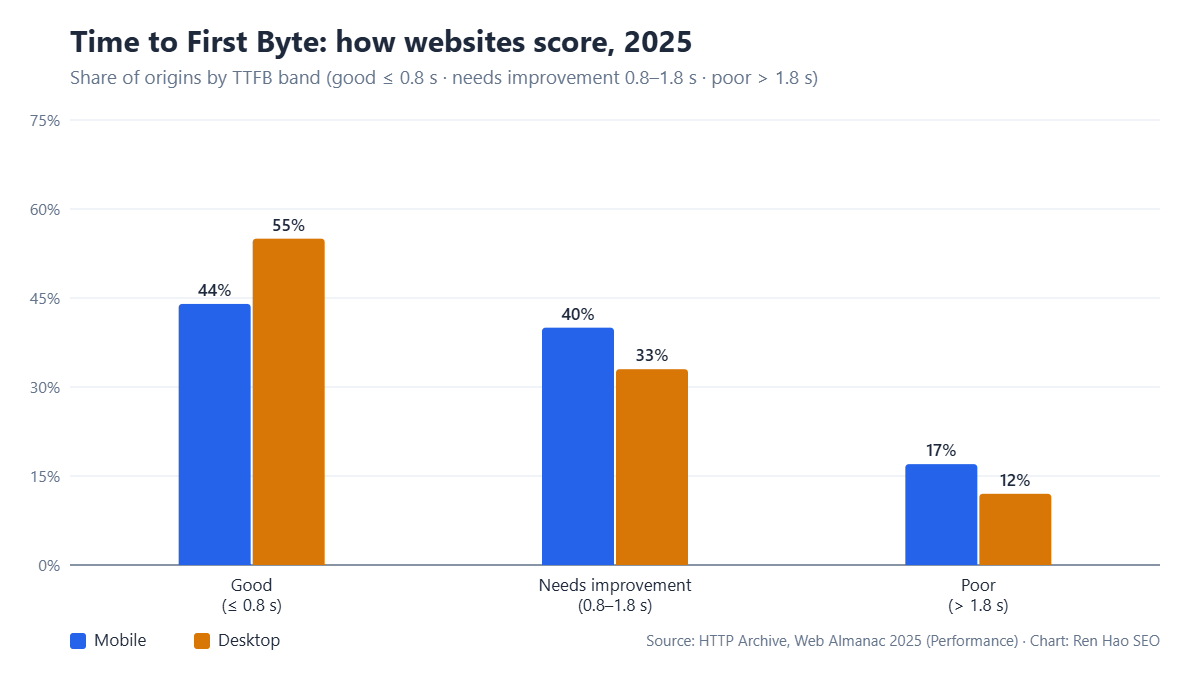
The method mirrors our hosting benchmark discipline: identical WordPress builds — same theme, same plugin load, same content — deployed across the candidate stacks, measured on cold (uncached) and warm (cached) TTFB plus full-page load at p50 and p95, sampled from multiple regions across weeks rather than in a single flattering afternoon. That last clause is where most published speed advice fails: one-off lab tests on idle servers measure the best case, while rankings and users experience the distribution, tail included. The percentile discipline is the same one behind our 90-day TTFB study, and it changes conclusions — several configurations that looked identical at p50 separated dramatically at p95 under load. Second methodological note: we measure layers in isolation and in combination, because the gains do not simply add — a CDN in front of a well-cached origin contributes latency reduction for distant users and little else, while the same CDN in front of a slow origin merely caches the slowness closer to the victim. The layer order below reflects measured marginal gains, and it is the order to apply them.
If you want the practical next step on this point, our guide on Server Location & CDNs: Does It Still Matter Where You Host? goes into the detail.
For a closer look at this topic, see How to Choose a Reliable and Cheap Hosting Service.
Layer one: server-level page caching — the 80% layer
For anonymous visitors — which for most content sites means nearly all visitors and every crawler — page caching decides the experience, and where the cache lives decides its ceiling. The study's clearest result: server-level caching (the web server returning stored HTML before PHP wakes up) categorically outperforms PHP-level plugin caching (WordPress booting to serve a stored page). On identical hardware, LiteSpeed with LSCache returned warm TTFB in the 120–180ms band from near regions; the same site on Apache with a well-configured PHP-level cache plugin sat in the 350–500ms band — the difference being the entire PHP boot the server-level cache skips. Nginx with FastCGI cache matched LiteSpeed's class when configured correctly, with the honest caveat that "configured correctly" is a sysadmin task, while LiteSpeed ships the behaviour through a plugin a site owner can operate. This is why our budget hosting tests for bloggers keep landing on LiteSpeed hosts as the value play: the architecture delivers tier-two performance at tier-one prices, provided the plan actually enables the cache — the verification step most buyers skip. Whatever your stack: confirm server-level caching is on and working (response headers tell you), set sensible TTLs with tag-based purging on content updates, and only then spend attention anywhere else.
Layer two: PHP version and settings — the neglected free win
Every uncached request — first visits, logged-in users, search, checkout, and every cache miss — runs through PHP, and PHP's own performance has improved dramatically across recent major versions. Our test builds moved from legacy versions still common on neglected hosting to current PHP and measured double-digit percentage improvements on uncached response times, with OPcache (enabled and sized properly) contributing a further reliable slice. The reason this win goes unclaimed: fear. Sites sit on old PHP because nobody wants to discover which plugin breaks — a fear that costs performance daily against a risk that is testable in an afternoon on staging. The upgrade sequence that removes the drama: clone to staging, switch the PHP version, run the site's critical paths (pages, forms, checkout, admin), check the error log, fix or replace the rare incompatible plugin, then repeat in production during a quiet window. Settings worth verifying while you are there: OPcache enabled with adequate memory, realistic memory limits, and no debug logging left on from a forgotten troubleshooting session — we find that last one in production more often than anyone would like to admit.
Layer three: object caching — for the workloads that need it
Object caching (Redis, or Memcached) stores the results of expensive database queries in memory so repeated work is skipped — and its value is entirely workload-dependent, which is why the study measured it across site types rather than blessing it universally. On the brochure-and-blog build, Redis moved cached-page performance not at all (the page cache already skips the database) and improved uncached responses modestly. On the WooCommerce build — carts, sessions, logged-in users, layered product queries — Redis delivered its reputation: substantially faster uncached and logged-in responses, steadier p95 under concurrent load, and an admin experience the team could feel. The rule the numbers support: install object caching where meaningful traffic bypasses the page cache — commerce, membership, forums, heavy search — and skip it where it would idle behind a page cache that already answers everything. One operational note: a misconfigured or memory-starved object cache degrades instead of helping; provision it deliberately and monitor evictions, or leave the layer out.
Layer four: CDN — geography, not salvation
The CDN's measured contribution is precise: it moves your cached content closer to distant users. On our multi-region sampling, a CDN in front of the well-configured LiteSpeed origin cut far-region TTFB dramatically while leaving near-region numbers essentially unchanged — exactly what edge caching should do. What it did not do is fix anything: in front of the deliberately slow origin, the CDN cached slow HTML and served it quickly only after the first victim per edge paid full price, while every uncached path remained as slow as the origin made it. The deployment guidance that follows: fix the origin first (layers one to three), then add the CDN for its genuine gifts — edge caching for a distributed audience, image optimisation and modern-format conversion at the edge, and absorption of traffic spikes and hostile noise. For single-market sites with near-region hosting, the CDN is optional polish; for international audiences it is the difference between one market's experience and everyone's. Configure full-page edge caching where the platform supports it (not just static assets), respect cache-purge hooks from the origin, and verify with response headers from each target region rather than trusting the dashboard's green checkmarks.
The anti-patterns the data keeps refuting
Three habits consumed effort in our test environments while producing nothing measurable. Stacking cache plugins: two page caches do not cache twice — they conflict, double-purge, and produce the stale-content bugs that get caching blamed for unreliability; one page-cache authority per site, full stop. Chasing 100/100 lab scores: several of our fastest field configurations scored in the low 90s on lab tools while a slower, over-optimised rival hit 100 — the lab score is a diagnostic aid, and the field percentiles (the ones Google actually uses) reward different work, as our Core Web Vitals analysis details. And optimising the origin last: teams add CDNs, install optimisation plugins and minify assets while the server underneath serves 800ms TTFB — decorating a slow foundation. The stack order exists because the marginal gains are ordered; run it in sequence and each layer's measurement tells you whether the next is worth buying.
The setups we would deploy today
Translating the measurements into concrete recommendations by situation. Budget blog or content site: quality LiteSpeed shared hosting with LSCache configured (cache on, sensible TTLs, tag purging), current PHP with OPcache, no object cache, CDN optional unless the audience is international — this combination hit warm TTFB under 200ms in our tests at the lowest cost tier on the board. Growing WooCommerce store: managed LiteSpeed or Nginx VPS-class hosting, Redis object cache provisioned with headroom, current PHP, CDN with full-page edge rules for guest traffic — the configuration that held p95 steady under our concurrency tests. International content operation: the same disciplined origin plus a CDN doing full-page edge caching and image optimisation, verified region by region. In every tier, the sequence is identical even when the components differ: server cache, PHP, workload-appropriate object cache, then geography — measured at each step, because your site's numbers outrank our study's the moment you have them.
Test methodology: identical WordPress builds across candidate stacks, cold/warm TTFB and full-page load at p50/p95, multi-region sampling over weeks; percentile discipline per our 90-day TTFB benchmark. Field-vs-lab framing per Google's Core Web Vitals documentation. Specific hosts meeting the configuration bar are maintained in our tested hosting shortlist.