
Owning Definitions: Glossary Hubs for Cybersecurity AI Search
Definition queries are where AI answer engines cite sources most consistently. A glossary hub — one citable definition per URL, connected through a hub page — is how a cybersecurity vendor becomes the reference for its category.
- Definitions are the most-cited content in AI Overviews and assistants because they are bounded claims that can be lifted intact.
- A glossary hub is one URL per term plus a hub page that scopes the domain — not a single long glossary page.
- The first 40–60 words of each term page must be a quotable definition: term, genus, differentiator, nothing else.
- Prioritize terms by citation potential and commercial adjacency; build tier 1 (20–40 terms) first.
- Inbound contextual links from your own guides and solution pages are what turn a term page from a stub into the canonical definition.
Why definitions are the most-cited content in AI search
Definition queries are where AI answer engines cite sources most consistently, because a definition is a bounded claim that a model can lift intact and attribute. When we log the citations in AI Overviews for cybersecurity terms — zero trust, SBOM, XDR, attack surface management — the cited passage is a one- to two-sentence definition followed by a distinguishing clause, and it comes from a glossary page far more often than from a vendor product page or a 4,000-word guide.
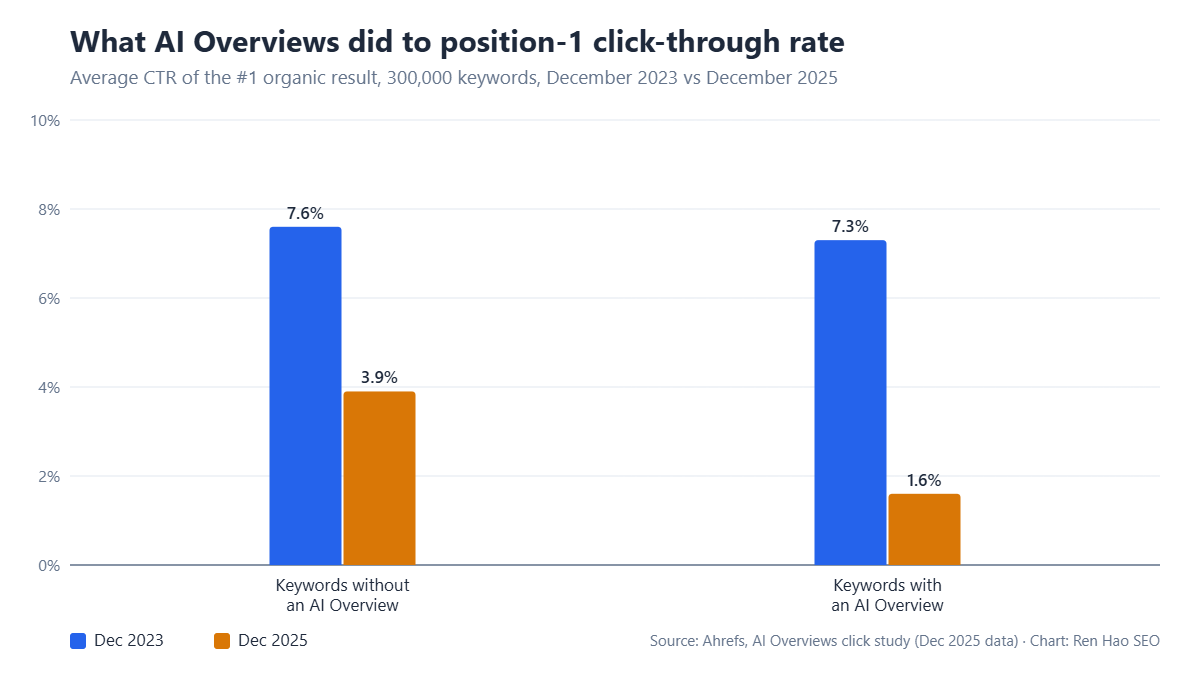
The chart above shows why that matters commercially. Ahrefs measured position-1 click-through falling from 7.3% to 1.6% on keywords with an AI Overview. For a cybersecurity vendor that means the traditional ‘what is X’ blog post no longer earns the click; the citation inside the answer is the visibility. Owning the definition is now the top of the funnel, and the shift of cybersecurity research into AI search makes it the part of the funnel most buyers pass through before they ever see a product page.
A glossary hub is the format that wins this reliably: one URL per term, each with a citable definition at the top, connected through a hub page that establishes the site as the reference for the category rather than for one term.
What a glossary hub is — and what it is not
A glossary hub is a hub-and-spoke cluster in which the hub page lists and links every term in a defined domain, and each spoke is a standalone page whose first paragraph is a precise, attributable definition. It is not a single long glossary page with anchor links, and it is not a set of ‘what is X’ blog posts scattered through a news feed. The difference is structural: separate URLs let each term rank and be cited independently, and the hub lets Google and answer engines see the set as one authority.
The hub page carries three jobs. It defines the scope of the domain (‘identity and access’, ‘cloud security posture’), so the entity relationship between the site and the category is explicit. It links every spoke with the term as the anchor, which is one of the few cases where exact-match anchors are correct, because the term is the topic. And it groups terms into sub-domains that mirror how a security buyer’s research actually branches, which is the same structure that topical authority in cybersecurity depends on.
Each spoke follows a fixed layout that we will describe in the next section. Consistency is not a stylistic preference here; answer engines extract more reliably from a predictable structure, and Google’s helpful-content evaluation reads a consistent, well-scoped glossary as reference material rather than as thin pages.
The spoke template that gets extracted
The first sixty words decide whether a term page gets cited. They must contain the term, a genus (‘is a security control’, ‘is a framework’), a differentiator that separates it from the adjacent term, and nothing else. Marketing language, ‘in today’s threat landscape’, and a paragraph of context before the definition all reduce extraction, because the model has to search the page for the definitional sentence and often chooses a competitor’s cleaner one instead.
- 1Definition block (40–60 words)Term, genus, differentiator, and the one clause that distinguishes it from its nearest neighbor. Written so it can be quoted without editing.
- 2How it works (150–250 words)Mechanism in plain language, with the components named. This is where an extension section adds gain beyond the definition.
- 3Where it sits in the stackA short list of adjacent terms with links to their spoke pages — the internal-link layer that makes the cluster legible.
- 4Why it matters to the buyerTwo or three sentences on the decision the term affects: a compliance requirement, a procurement criterion, an incident scenario.
- 5Related product or service pathOne contextual link to the relevant solution page. Not a call-to-action block — a sentence that a researcher would follow.
- 6FAQ (3–5 questions)The People Also Ask variants for the term, answered in one paragraph each, marked up as FAQPage.
The pages are short by design — 600 to 900 words — because the job is to be the cleanest definition on the web, not the longest guide. Depth lives in the linked guides and the hub, which is what keeps the glossary from reading as thin content.
Mapping the term set from real search demand
Build the term list from query data and from the sales conversation, not from a competitor’s glossary. Start with the cybersecurity keyword landscape: every ‘what is’, ‘X vs Y’ and ‘X meaning’ query in your category with measurable volume. Add the terms your SDRs hear on discovery calls and the ones that appear in RFP templates. Then group them by sub-domain and check each group against the analyst frameworks buyers already use, because a hub that mirrors a familiar taxonomy is easier for a model to place.
Prioritize by two scores. Citation potential: how often the term already triggers an AI Overview or featured snippet, which signals that engines want a definition. Commercial adjacency: how close the term sits to a purchase decision. A term like ‘SBOM’ scores high on both — it is a definitional query and a procurement requirement — and belongs in the first build. A term like ‘phishing’ scores high on volume and near zero on adjacency for most vendors; it goes in a later tier or is skipped.
| Tier | Selection rule | Typical count | Build order |
|---|---|---|---|
| Tier 1 | High citation potential and directly adjacent to your product category | 20–40 terms | First 4–6 weeks |
| Tier 2 | Adjacent terms buyers compare against yours; vs-type queries | 30–60 terms | Weeks 6–12 |
| Tier 3 | Foundational category terms with low adjacency | 40–100 terms | Only once tiers 1–2 are indexed and cited |
Hub architecture and internal linking
The hub sits one click from the site’s main navigation and links every spoke. Each spoke links back to the hub in the breadcrumb and body, links to two to four adjacent terms, and links to one guide or solution page. Guides and solution pages link down to the relevant term pages wherever the term first appears. That last rule is the one most sites miss, and it is the one that moves rankings: a term page with twenty contextual inbound links from the site’s own product and guide content is treated as the canonical definition; the same page with only the hub linking to it is treated as a stub.
Architecture also determines crawl priority. With sixty spoke pages, the hub should be paginated only if it exceeds roughly 150 links; below that, one page with sub-domain headings is better for both crawlers and readers. Every term page needs a self-referencing canonical, DefinedTerm schema with the definition as the description, and the FAQPage markup for its questions. Do not add Article schema to definitions; they are reference pages, and mixing types dilutes the signal.
How the buyer research path changes with a glossary hub
Security buying is committee research over months, and the way CISOs and their teams use search starts with terms rather than vendors. A glossary hub intercepts that stage. The pattern we see in analytics for clients that have built one is a long first-touch tail — hundreds of sessions a month landing on term pages — followed by a measurable share of those users returning through branded search or a solution page within 30 to 90 days. The glossary does not convert on the session; it makes the brand the reference the buyer remembers when the evaluation begins.
The same path runs through AI assistants. A buyer asking a model to compare approaches gets an answer built from cited definitions, and the vendor whose definitions are cited is the one the follow-up question is about. That is why the credibility signals in cybersecurity content — named authors, dated updates, references to standards — belong on glossary pages as much as on research reports.
Writing definitions that survive fact-checking
Security definitions are contested, and a glossary that takes a vendor-convenient position on a contested term loses citations once a model cross-checks it against standards bodies. Anchor every definition to a primary source where one exists: NIST for frameworks and controls, the relevant ISO standard for management terms, CISA advisories for threat terminology. Cite the source by name in the definition block or immediately after it. A definition that reads ‘as defined in NIST SP 800-207’ is both more citable and harder for a competitor to displace.
Where no standard exists — most product-category terms — write the definition around what the term does rather than what your product does, and state the disagreement openly if analysts split. ‘XDR is used by some analysts to mean a platform and by others to mean an integration layer; this page uses the platform sense’ is the kind of sentence engines quote, because it resolves the ambiguity the searcher hit. Vendor-neutral definitions with a named source are the single largest driver of citation share in the hubs we have measured.
Add a maintenance rule: every tier-1 term is reviewed when its source standard is revised, and the page shows the review date. Stale definitions are the fastest way to lose a citation to a competitor that updated first.
Common mistakes that turn a glossary into thin content
- Publishing all 150 terms in one month with 200-word pages and no mechanism section — Google indexes a fraction and treats the rest as duplicates of the hub.
- Definition blocks that open with the company name or a product claim, so the extractable sentence is a marketing line rather than a definition.
- One long glossary page with jump links instead of one URL per term; nothing on it can rank or be cited independently.
- Term pages that link out only to the hub, with no inbound links from guides or solution pages.
- Copying an analyst’s definition verbatim without attribution — it is both a citation risk and a duplication signal.
- Missing DefinedTerm and FAQPage markup, or adding Article schema that mislabels the page type.
None of these require new writing to fix. The usual order is: rewrite the definition blocks, add the inbound links from existing guides, correct the schema, then resume publishing new tiers.
Measuring whether the hub is working
Track four numbers. Index coverage: the share of spoke pages indexed within 30 days of publishing, which tells you whether Google reads the cluster as reference material. Citation share: the number of tracked term queries where your page is cited in the AI Overview or holds the featured snippet. Assisted conversions: sessions that touched a glossary page before a demo or contact conversion, which is the commercial justification. And inbound links: glossary pages attract editorial links from other sites at a higher rate than product content, because writers link to definitions.
A hub that is not moving on citation share after 90 days usually has one of two problems: definitions that bury the term under context, or spoke pages that only the hub links to. Both are fixable without new content. The cybersecurity SEO programs we run audit both before writing new terms, because a glossary that exists but is not cited is the most common state we find.
AI Overview click-through data: Ahrefs study linked in the chart caption. Google guidance on structured data for definitions: schema.org DefinedTerm; helpful-content evaluation: Google Search Central. Citation and traffic observations are from our own client analytics and are described as patterns, not as industry benchmarks.