
How a Fintech Outranked Banks: A 12x Visibility Breakdown
Conventional wisdom says a fintech cannot outrank established banks on money keywords: the banks own decades of domain authority, YMYL scrutiny favours incumbents, and the SERPs are fortified. One of our fintech clients now holds page-one positions directly against national banks across their core product terms, with search visibility up 12x over the engagement. This breakdown covers how it was done — the trust architecture YMYL actually demands, the query territory banks structurally cannot defend, and the sequence that turned a challenger domain into a cited financial source.
- The engagement delivered a 12x visibility increase and page-one rankings against national banks — without a fraction of their domain authority.
- YMYL scrutiny is a moat that can be crossed: demonstrable expertise, verifiable authorship and evidence-backed claims are requirements banks often satisfy institutionally but execute poorly page by page.
- Banks are structurally weak on explanation: their content answers what the bank offers, not what the searcher is confused about — that gap was the entire early strategy.
- Trust was built as an architecture, not a paragraph: credentialed authors, reviewed-by attribution, sourcing standards and consistent entity data across every page.
- Head-term victories came last, funded by hundreds of question-level wins that made the domain a recognised answer source in its category first.
The starting position: a challenger in a fortress category
The client — anonymised as always, with every number below drawn from their analytics and rank tracking — is a regulated fintech competing directly with national banks on core financial product terms. At kick-off the asymmetry was almost comic: competitors with decades-old domains, tens of thousands of referring institutions, and permanent brand demand, against a challenger whose organic presence barely registered beyond its own name. And the category is fully YMYL — Your Money or Your Life — where Google’s systems apply their heaviest quality scrutiny, a bar usually read as protection for incumbents.
Fintech Content & Conversion SEO covers the same ground with more data.
If financial services SEO is the part you are working on next, our article on YMYL & E-E-A-T for Fintech is the practical follow-on: Every fintech page competes under YMYL — Your Money or Your Life — the category Google scrutinises most heavily because the content can affect people's financial wellbeing.
Related reading: 6x Organic Sales in 3 Months: Inside a Jewellery SEO Campaign — it picks up where this section leaves off.
The diagnostic reframed that bar as the opportunity. YMYL scrutiny does not reward being a bank; it rewards demonstrating expertise, authoritativeness and trust on every ranking page. The banks satisfied that institutionally — regulated, known, linked — but their content frequently did not: anonymous product pages, help-centre fragments, jargon-first explanations reviewed by nobody a searcher could see. As our earlier analysis of how fintechs rank against banks argued, the incumbents’ authority is real but bluntly applied. A challenger that out-demonstrates trust page by page is not fighting the moat — it is walking across the parts the defenders never built.
The trust architecture YMYL actually demands
Phase one built the substrate every later ranking depended on. Every content page got a named author with verifiable financial credentials, linked to a real profile with existence beyond the site. Every substantive claim — rates, rules, thresholds, tax treatment — carried a citation to a primary source: the regulator, the statute, the official figure. A reviewed-by layer put qualified review attribution on every YMYL page, in the visible byline and in structured data. Entity signals were made ruthlessly consistent: one canonical organisation identity, complete schema, matching registration details everywhere the company appeared. None of this ranked anything by itself. All of it determined what the content phase could achieve — because in YMYL, content published on an untrusted substrate simply does not surface, no matter how good it is.
The query territory banks cannot defend
Phase two attacked where the asymmetry favoured the challenger. Banks dominate navigational and brand-adjacent queries permanently — that territory was conceded on day one. What they systematically fail is the explanation layer: the confused, specific, situational questions real people ask about money. How a rule applies to an edge case. What a fee actually means. Which option fits a specific circumstance. Bank content answers what the bank offers; searchers ask what they should do. That gap is thousands of queries wide in every financial category, each individually modest, collectively enormous — and almost none of them defended by content written to answer them directly.
- 1Own the questions, hundreds at a timeAnswer-first explainers for the situational queries banks ignore, each one direct, sourced and reviewed. Individually small; together they made the domain the recognised explainer in its category within months.
- 2Convert explanation authority into comparison rankingsWith question-level trust established, comparison and decision pages — the mid-funnel money terms — began ranking against aggregators and banks both, inheriting the topical authority the question layer built.
- 3Take the head terms lastCore product terms fell in the final phase, funded by everything beneath them: by then the domain ranked for the entire question neighbourhood around each head term, and the head term followed the neighbourhood.
- 4Compound through citationsThe explainer layer earned links and media references banks’ product pages never attract — journalists and AI systems cite whoever explains best — feeding authority back into every phase behind it.
The 12x visibility multiple accumulated across this sequence, and its shape matters as much as its size: growth was question-led and broad-based, hundreds of terms improving together, rather than a few head-term spikes. That breadth is what made the head-term victories durable — the domain was not gaming individual SERPs, it had become part of how the category gets answered, a position that also translated directly into AI Overview and assistant citations as those surfaces expanded.
What transfers to your fintech
Three principles transfer intact. Trust is an architecture, not a paragraph — authorship, review, sourcing and entity consistency built before content scales, because YMYL content on an untrusted substrate does not surface. Attack explanation, not navigation — the banks’ content gap is structural, rooted in compliance-first publishing cultures that cannot ship a plain answer, and it is not closing. And sequence for compounding — questions fund comparisons fund head terms; run in reverse, the same budget produces a domain shouting money keywords with no earned right to rank for them. The full verified numbers live in the fintech page-one case study, and our fintech SEO services page covers how we scope this playbook to a specific product, regulator and competitive set — including an honest read of which banks in your category are actually defendable and which are walkable.
YMYL and quality-rating context from Google’s helpful content documentation and published Search Quality Rater Guidelines. Engagement data is drawn directly from the client’s analytics and rank tracking, anonymised.
The operating numbers behind the 12x
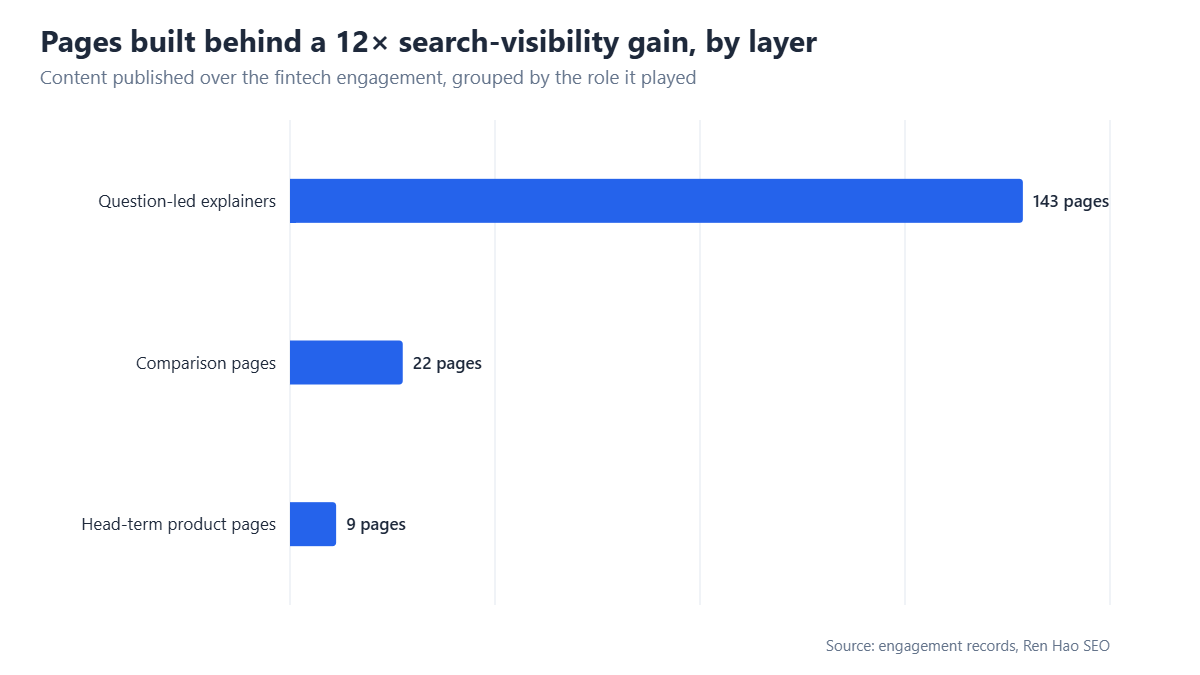
The multiple accumulated from unglamorous ratios, so here they are. The question layer ran to 143 published explainers over the engagement, produced at a steady cadence with a two-stage review — subject-matter accuracy by a credentialed reviewer, compliance sign-off second — that added days per page and was never once skipped; in YMYL, the review trail is part of the asset. Those explainers were individually modest: the median one settled between positions one and three for a family of long-tail variations worth a few hundred monthly searches combined. Collectively they changed what the domain was: within months the site held first-page positions for a four-figure count of question-form queries in its niche, and the entity had become a recognised answerer in exactly the neighbourhoods where the comparison terms lived. The comparison layer was 22 pages; the head-term set was nine. By the final quarter, visibility-weighted share across the tracked keyword set stood at twelve times the baseline — with the question layer contributing most of the breadth and the comparison layer most of the commercial value, a division of labour the phase sequence was designed to produce. One more ratio worth recording: media and AI-surface citations. The explainer layer earned unsolicited references — journalists sourcing plain-language explanations, answer engines citing definitional passages — at a rate the bank competitors’ product pages structurally cannot, because nobody quotes a brochure.
The YMYL page checklist we shipped on every URL
Trust architecture only works as a per-page discipline, so every ranking page carried the same eleven fields, verified at publication: a named author with financial credentials stated; an author profile page with verifiable existence beyond the site; reviewed-by attribution naming a qualified reviewer, in the visible byline and in schema; a visible dated last-review stamp, maintained on a fixed cycle for rate-sensitive and rule-sensitive pages; primary-source citations for every figure, rule and threshold — regulator, statute or official statistics, never a competitor’s blog; risk and downside framing wherever an upside was claimed; complete Article schema with author and reviewer entities; organisation schema consistent to the field with the registration records; internal links placing the page inside its topical cluster; a disclosure block separating information from advice; and a change-log practice for pages whose facts move. None of these is clever. The compounding came from the completeness — quality raters and quality systems alike evaluate patterns, and a domain where every money page carries the full pattern reads as an institution rather than a content operation. The checklist added roughly a third to per-page production cost and was, by the engagement’s own arithmetic, the highest-ROI spend in it.
What we tried that did not work
Three honest failures, recorded because the misses shaped the method. A financial news vertical: we spent two months publishing rapid coverage of rate changes and regulatory announcements, reasoning that freshness would earn visibility. It earned traffic spikes and nothing durable — the news SERPs belonged to publishers with wire-speed operations, the visitors converted at close to zero, and the effort competed with the explainer cadence for the same review capacity. We killed it and reallocated. A broad-keyword shortcut: mid-engagement, under head-term pressure, we shipped four pages targeting core product terms ahead of the sequence. All four stalled outside the top twenty for months and moved only after the question neighbourhood around them was owned — a controlled demonstration of the sequencing thesis, purchased with wasted quarters of patience. And a link-buying temptation resisted the hard way: an early authority push through paid placements was scoped, priced and rejected after the risk review; two competitors who took that route visibly lost ground in the June 2026 spam enforcement, which retired the debate. The pattern in all three: in YMYL, everything that looks like a shortcut is a detour, and the boring sequence is the fast one.