
Baidu Rank Tracking Tools Compared: How to Track Baidu Rankings in 2026
Which rank trackers really support Baidu, why PC and mobile must be tracked separately, and how to combine Baidu’s own tools with a third-party tracker so the report matches what buyers in China actually see.
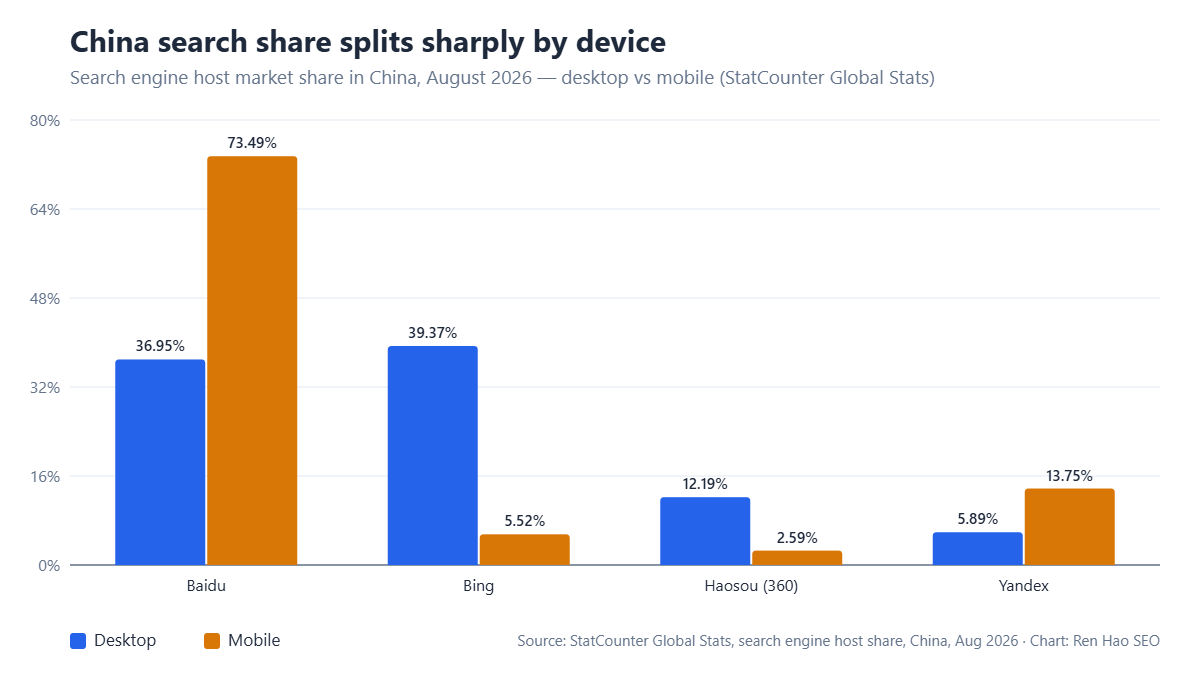
- Baidu serves about 73% of mobile search in China but only ~37% of desktop, where Bing leads (StatCounter, Aug 2026) — track PC and mobile as separate projects.
- Dragon Metrics, AccuRanker, Advanced Web Ranking and Semrush Position Tracking support Baidu; Ahrefs Rank Tracker does not.
- Anchor every report on Baidu Search Resource Platform (impressions, clicks, indexing) and Baidu Tongji (visits, conversions); use the third-party tracker for daily movement only.
- Report position among independent sites as well as raw position — Baidu-owned properties occupy slots no third-party site can win.
- Validate any tool for two weeks with manual checks from a mainland proxy before reporting to stakeholders.
Why Baidu rank tracking is harder than Google rank tracking
Baidu rank tracking is harder for three structural reasons: Baidu returns different results on PC and mobile, its own properties (Baidu Baike, Zhidao, Baijiahao, Wenku) occupy positions that third-party sites cannot win, and most Western rank trackers either do not support Baidu at all or check it from outside mainland China. A tracker that ignores any one of those three will report positions that do not match what a buyer in Shanghai actually sees.
The device split is the largest distortion. StatCounter’s host-level data for August 2026 puts Baidu at about 73% of mobile search in China but only around 37% of desktop, where Bing’s cn.bing.com now leads. A B2B exporter whose buyers research on office desktops and a consumer brand whose buyers search on phones are effectively operating in two different markets, and a single “Baidu position” blends them into a number that describes neither.
The second distortion is Baidu’s self-preferencing. On many commercial and informational queries the first screen is filled by Baidu-owned answers, ads and aggregator cards before the first independent organic result. A tracker that counts every result as an organic slot will tell you that you rank sixth when you are in fact the second independent website on the page — a very different competitive picture.
The third is location. Baidu personalises by region and by whether the request appears to come from inside China. Trackers that query Baidu from Singapore or Frankfurt servers see a different SERP from trackers with mainland proxies. That is why the tool comparison below separates “supports Baidu” from “checks Baidu from inside China”.
The three data layers a Baidu ranking report should combine
A reliable Baidu report combines three layers: Baidu’s own Search Resource Platform for impressions and clicks, Baidu Tongji for the traffic and enquiries those clicks produce, and a third-party tracker for daily position movement. Each layer answers a question the other two cannot, and none of them is sufficient alone.
| Layer | Tool | What it tells you | Limit |
|---|---|---|---|
| Visibility (source of truth) | Baidu Search Resource Platform (百度搜索资源平台) | Impressions, clicks, indexed pages, crawl errors, mobile adaptation status | Two- to three-day lag; requires site verification; keyword detail is thinner than Google Search Console |
| Outcome | Baidu Tongji (百度统计) | Sessions, engaged visits and conversion goals from Baidu organic | Needs a tracking snippet on the site; ICP-licensed hosting makes the data far cleaner |
| Movement | Third-party rank tracker with Baidu support | Daily PC and mobile positions for a defined keyword set, competitor positions, SERP-feature ownership | Only as good as its proxy location and its handling of Baidu-owned results |
The reason to keep all three is attribution. Position gains that produce no impressions usually mean the tracker is checking a query nobody types. Impressions that produce no Tongji sessions usually mean a Baidu-owned card is absorbing the click. And Tongji conversions that rise while positions fall usually mean your brand searches are growing — good news that a rank-only report would hide.
Third-party rank trackers that support Baidu in 2026
Four Western trackers currently support Baidu as a search engine: Dragon Metrics, AccuRanker, Advanced Web Ranking and Semrush’s Position Tracking. Ahrefs’ Rank Tracker does not track Baidu. Several other popular tools list “China” as a location while still querying Google, which is not the same thing — always check that Baidu appears as a selectable engine, not just a country.
| Tool | Baidu support | Best fit | What to verify before you buy |
|---|---|---|---|
| Dragon Metrics | Yes — built around Baidu and other Asian engines, with Baidu-specific SERP features | Teams whose primary market is China or East Asia | Proxy locations for the cities you sell into; PC/mobile split per keyword |
| AccuRanker | Yes — Google, Bing, YouTube and Baidu; keyword-based pricing | Agencies that need fast on-demand refresh across many engines | Which Baidu location is used for checks; how Baidu-owned results are labelled |
| Advanced Web Ranking | Yes — Baidu among its supported engines | Reporting-heavy teams that want scheduled white-label reports | Mobile Baidu depth; export of SERP snapshots |
| Semrush Position Tracking | Yes — Bing and Baidu alongside Google and AI search | Teams already on Semrush who want one dashboard | Baidu keyword-volume coverage is thinner than for Google; check your list before committing |
| Ahrefs Rank Tracker | No | — | Use it for Google markets; pair with one of the tools above for China |
Whichever tool you choose, run a two-week validation before you report to anyone. Take 20 keywords, search them manually from a mainland proxy on both a phone emulator and a desktop browser, screenshot the first screen, and compare with the tool’s stored SERP. If more than three of the 20 disagree by more than two positions, the tool’s proxy or its result parsing is not fit for your use, whatever its marketing says.
Baidu’s native tools: Search Resource Platform, Tongji and Baidu Index
Baidu’s own tools are free, authoritative and under-used by non-Chinese teams because they require Chinese-language interfaces and, in some cases, mainland verification. They should anchor every report because they measure what Baidu itself recorded rather than what a scraper inferred.
Baidu Search Resource Platform (ziyuan.baidu.com) is the closest equivalent to Google Search Console. Once the site is verified it reports indexed page counts, crawl diagnostics, mobile-adaptation status and a traffic and keywords report with impressions and clicks. It also exposes the sitemap and active-push submission features that decide how quickly new pages enter Baidu’s index, which for a foreign-hosted site is the single biggest lever on visibility.
Baidu Tongji (tongji.baidu.com) is Baidu’s analytics product. Its value for rank tracking is that it attributes visits to Baidu organic reliably, where Google Analytics often misclassifies Baidu referrals. Configure conversion goals (enquiry form, WeChat QR scan, phone tap) so that keyword movement can be tied to something the business cares about.
Baidu Index (index.baidu.com) is the demand-trend tool. It requires a Baidu account and increasingly a verified Chinese mobile number, so plan access before you plan reports. Use it to confirm that the keywords you are tracking are ones people search — a tracker will happily report position one for a query with no demand.
Device-split figures: StatCounter Global Stats, China desktop search engine hosts and the mobile equivalent, August 2026. StatCounter’s China panel is small and skews towards internationally facing sites, so treat the absolute percentages as directional; the desktop-versus-mobile gap is consistent across every measurement we have seen. Google’s guidance on managing multi-regional and multilingual sites still applies to the technical foundations (hreflang, hosting, canonicals) that Baidu also depends on.
How to set up Baidu rank tracking that matches what buyers see
Set the tracker up around the buyer, not around the keyword list. That means separate PC and mobile projects, mainland proxy locations that match where your customers are, a keyword set built from Baidu Index demand rather than Google volumes, and a rule for how Baidu-owned results are counted. The steps below are the sequence we use for every China engagement.
- Verify the site in Baidu Search Resource Platform first. Without it you have no ground truth to validate the tracker against, and you cannot use active push to get new pages indexed.
- Build the keyword set from Baidu Index and Baidu Keyword Planner. Keyword Planner lives inside a Baidu Ads (百度推广) account; Index needs a Baidu login. Prioritise Simplified Chinese queries with confirmed demand, then add the English brand and product terms your international buyers use.
- Create two projects: Baidu PC and Baidu mobile. Use the same keyword set in both. Choose proxy locations in the two or three cities that generate most of your enquiries — Shanghai, Shenzhen and Beijing are the usual starting points.
- Tag Baidu-owned results. In tools that expose SERP snapshots, mark Baike, Zhidao, Baijiahao, Wenku and Tieba results so that reports can show “position among independent sites” as well as raw position.
- Connect Tongji goals to the tracked keywords. Map each keyword to a landing page and each landing page to a conversion goal; the report then shows movement, visits and enquiries on one line.
- Validate for two weeks before reporting. Manual spot checks from a mainland proxy, PC and mobile, against the tool’s stored SERP.
Teams that skip step three are the ones who tell us “Baidu rankings look fine but China leads have stopped” — the leads were mobile, the tracker was desktop.
Building the keyword set: Simplified Chinese first, brand second, long tail last
Build the Baidu keyword set in three tiers: Simplified Chinese category and product terms with confirmed Baidu Index demand, then brand and product names in both Chinese and English, then long-tail question and comparison queries. Google keyword volumes are useless for this — the terms Chinese buyers use are often not translations of the English query but different framings of the need, and Baidu’s autocomplete and related-search blocks are the fastest way to find them.
Start from your sales team, not from a tool. Ask the China-facing sales or distributor team how customers describe the product on WeChat and in tenders; those phrases are the seed list. Expand each seed with Baidu’s own suggestions (the drop-down as you type and the “相关搜索” block at the foot of the results page), then check each candidate in Baidu Index for demand and seasonality. A term with no Index curve is either too niche to matter or phrased in a way nobody uses.
Brand terms deserve their own tier because they behave differently. Baidu’s results for a foreign brand name are frequently dominated by Baike entries, Zhidao questions and distributor pages, and the goal is not a position but ownership of the first screen: the official site, a verified Baike entry, a Baijiahao presence and a clean set of Zhidao answers. Track the brand tier as “share of first screen” rather than as a position.
The long tail is where English-language content can still win on Baidu, particularly on PC, because much of the competition on technical and B2B queries is thin. Track those queries weekly rather than daily, group them by landing page, and use them as the early-warning signal: when long-tail impressions in Search Resource Platform rise for a page, the head terms on that page usually follow within a few weeks.
| Tier | Source of terms | Tracking cadence | Metric to report |
|---|---|---|---|
| Category and product (Simplified Chinese) | Sales team seeds, Baidu autocomplete, Baidu Index | Daily, PC and mobile | Position among independent sites; impressions |
| Brand (Chinese and English) | Brand, product and model names; common misspellings | Daily | Share of first screen; Baike and Baijiahao presence |
| Long tail (questions, comparisons, specs) | Related searches, Zhidao questions, Search Resource Platform queries | Weekly | Impressions per landing page; keywords with impressions |
Tracking Baidu’s AI answers and SERP features
Since Baidu began placing AI-generated answers above organic results on a large share of queries, rank tracking has to record whether the tracked page is cited in or displaced by that answer. A page can hold position one in the organic list and still lose most of its clicks to the AI block; a page cited inside the AI answer can earn traffic from a query it does not rank for organically. Trackers that store SERP snapshots let you audit this; those that store only a position number hide it entirely.
Treat the AI answer as a feature to be owned, like a featured snippet on Google. In practice the pages Baidu cites share three traits: they answer the question in the first paragraph in plain Simplified Chinese, they are hosted or at least mirrored on infrastructure Baidu can fetch quickly, and they carry structured, clearly labelled sections rather than marketing copy. That is the same answer-first structure that wins Google’s AI Overviews, so the content work transfers between markets even when the ranking systems do not.
Other SERP features worth flagging per keyword are Baidu Aladdin cards (Baidu’s own vertical answer modules), Baijiahao article carousels, Zhidao question boxes and, for products, the Baidu Youxuan shopping results. Each one that appears on a query pushes independent results down the screen; a monthly count of which features appear on which of your keywords is the best early explanation for click-through changes that positions alone cannot explain.
Report AI and feature presence as a simple three-state field per keyword — cited, present but not cited, absent — alongside the position. Over a quarter that field explains more of the traffic variance on most China accounts than the position column does.
Reading a Baidu ranking report: what the numbers actually mean
Read Baidu reports for share of winnable results, not for raw position. A position of five on a page whose first four results are Baidu Baike, two ads and a Baijiahao article is a first-place result among independent sites; a position of three on a clean page is a genuine third. Reports that show both numbers side by side stop teams from over-reacting to Baidu’s own layout changes.
Three patterns come up on almost every account. First, mobile positions move more than PC positions week to week, because Baidu’s mobile results lean more heavily on its own app ecosystem; a two-position mobile swing is usually noise, a five-position swing is signal. Second, English-language pages hold PC positions better than mobile ones, so an international brand with English content will typically see a healthier desktop report — remember that desktop is the minority device. Third, sudden drops across every keyword at once are almost always a crawl or hosting issue (a blocked crawler, a slow foreign server, an expired ICP record) rather than an algorithm change; check Search Resource Platform’s crawl diagnostics before touching content.
The healthiest signal in a Baidu report is a rising count of keywords with impressions in Search Resource Platform. It means Baidu is testing your pages on more queries, which precedes any stable position gain by several weeks and is the earliest evidence that the indexing and content work is landing.
Rank tracking without a Chinese entity: what is realistic
A foreign company can track Baidu rankings without a Chinese legal entity, but with limits: Search Resource Platform verification works for foreign-hosted sites, Tongji works with a snippet, while Baidu Index, Keyword Planner and ICP licensing need Chinese accounts, phone numbers or a local partner. Plan the reporting stack around what you can access, and be honest with stakeholders about the gaps.
Practically, the stack for most international brands is: verified Search Resource Platform, Tongji with goals, one third-party tracker with mainland proxies for PC and mobile, and a monthly manual review of the first screen for the ten keywords that matter most. That combination costs a fraction of a mainland entity and produces a report that survives scrutiny from a China country manager. When the business grows enough to justify ICP-licensed hosting and a Chinese domain, the same report simply gets better data.
If you want that stack built and run for you, our Baidu SEO agency services include the tracking configuration above as a standard deliverable, alongside Chinese content and technical work; for the broader question of which markets to enter first, see our international SEO services, and for how we report results across markets, our client case studies show the format we use.