
Local SEO After the 2026 Directory Shake-Up
The May and June 2026 updates demoted directory and aggregator sites across local categories. Here is where the queries went, who can claim them, and the first-party page structure that inherits the listicle.
- The May–June 2026 updates demoted directory and aggregator sites at site level; the local queries they held moved to businesses with first-party evidence.
- Openings concentrate in best-of, cost and comparison queries; the map pack mechanics did not change.
- The page that inherits a demoted listicle is an evaluation page: buyer criteria, evidence per criterion, honest limits, local proof.
- Citations shift from ranking lever to trust confirmation; reallocate that budget to review operations, which now do the comparison job.
- Multi-location and multi-country structures survive only when each page carries location-unique information and correct hreflang signals.
The May and June 2026 Google updates cut the visibility of directory and aggregator sites across many local categories, and the queries they held did not disappear: they moved to businesses with first-party evidence. Local SEO after the shake-up is a claim-the-vacancy exercise, and the winners are the businesses whose own pages now carry the substance the directories used to summarize.
What changed in local search, and what did not
Three things changed: directory-hosted “best X in [city]” pages lost rankings at the site level, comparison and listicle SERPs opened up to first-party pages, and the value of a citation shifted from ranking signal to trust signal. Two things did not change: the map pack still runs on proximity, relevance and prominence, and Google Business Profile is still the entry point for most local queries.
The site-level nature of the demotion is the detail most operators miss. In our eight-market tracking, aggregator domains did not lose one category at a time; they lost visibility across categories at once, which matches the way Google describes its core updates, as reassessments of a whole site’s helpfulness rather than of individual pages. Google Search Central’s guidance on core updates is explicit that recovery for demoted sites typically waits for the next update, so the vacancy you can see in your category today is measured in months, not days.
What did not change matters just as much. Our complete guide to local SEO still holds for the map pack: a verified, fully categorized Business Profile, consistent name, address and phone data, review velocity and a service page that matches the query. The shake-up moved the organic results below and beside the map pack; it did not rewrite the map pack’s rules.
- Directory and aggregator pages: demoted at site level across many local categories.
- Best-of, comparison and near-me organic results: opened to first-party business pages.
- Citations: still useful for entity confirmation, no longer a ranking lever on their own.
- Map pack mechanics: unchanged; proximity, relevance and prominence still decide.
Why the directories fell: the pattern behind the demotion
Directories fell because the updates reward first-party expertise and penalize scaled, repackaged information, and directories are by construction repackaged information. A page that lists twenty plumbers using data those plumbers supplied adds little beyond what the businesses’ own sites say, and Google’s spam policies on scaled content abuse now treat volume-driven pages produced primarily to rank as a site-level problem.
Three patterns separated the directories that held from the ones that fell. First, unique evidence: platforms that published their own inspections, verified transaction data or original photography kept more visibility than platforms that only aggregated. Second, review integrity: sites with visible moderation and low duplicate-review rates held better than those with obvious templated reviews. Third, structural bloat: directories that had spun out thousands of near-identical city-times-category pages were hit hardest, an echo of the same scaled-content test that applies to any site publishing programmatically.
This is why the opportunity is real rather than temporary. The vacated queries were not held by pages Google now considers wrong; they were held by pages Google now considers insufficient. A business page with real service detail, real pricing logic, real reviews and real local proof is the kind of page the update was designed to surface. If you are new to the discipline, our local SEO primer for beginners explains the foundations before you build the evidence layer described below.
There is a second-order effect worth planning for. As directories lose traffic they also lose the referral leads they used to send, so businesses that bought placement or paid per lead on those platforms are seeing acquisition costs rise at the same moment their own pages can rank. The right response is not to move the budget to a different directory but to convert it into owned assets: pages, reviews and local proof that keep working after the next update.
Query by query: where the openings are
The openings are concentrated in three query types: “best [service] in [city]”, “[service] near me” organic results below the map pack, and “[brand A] vs [brand B]” or “[service] cost in [city]” comparisons. Branded queries and pure navigational intent were untouched, and informational queries about a service (“how long does a boiler service take”) were already dominated by publishers and remain so.
Our own cross-market data from June to September 2026 shows the same shape in every market we track. Best-of queries turned over most: in the categories we monitor across eight countries, a large share of the top ten organic URLs changed hands after the June update, with first-party business pages and local publishers taking most of the gained positions, and the pattern was consistent enough across markets that we treat it as structural rather than as noise. Near-me organic slots moved less, because the map pack absorbs most of that intent, but the first organic result under the map pack is now more often a business page than a listing site. Comparison and cost queries opened widely, because directories held them on thin templated pages that no longer rank.
| Query type | Who held it before | Who gains now | Page you need |
|---|---|---|---|
| best [service] in [city] | Directories, listicles | Businesses with evidence pages | Evaluation page with criteria, proof, pricing logic |
| [service] near me (organic) | Aggregators, chains | Local specialists with area pages | Service-area page tied to the Business Profile |
| [service] cost in [city] | Directory cost guides | Businesses that publish real ranges | Transparent pricing page with local factors |
| [A] vs [B] | Comparison sites | Brands with honest comparisons | Comparison page that names the trade-offs |
The practical instruction is to pull your category’s best-of, cost and comparison queries from Search Console and a rank tracker, check who ranks today, and shortlist every query where the top ten still contains a demoted directory URL or a page that is clearly thinner than what you could publish. Those are the vacancies. The map pack terms belong in the same plan, but they run on the Business Profile playbook rather than on new pages.
The evaluation page that inherits the listicle
The page that inherits a demoted “best X in [city]” listicle is not a copy of the listicle; it is an evaluation page that answers the same buyer question from the inside. It states the criteria a buyer should use, shows how your business meets them with evidence, names the situations where you are not the right fit, and gives a clear next step. That structure is what makes a single-business page a legitimate answer to a comparative query.
- 1Lead with the buyer’s decision criteriaOpen with the four to six things that actually decide the choice in your category: response time, credentials, guarantee terms, price structure, coverage area. Write them as criteria, not as adjectives about yourself.
- 2Attach evidence to every criterionA certificate number, a photo of a completed job with a date, a named review that mentions the criterion, a public pricing range. Evidence is the thing directories could not supply and Google now rewards.
- 3Name your limitsThe fastest way to be believed is to say who you do not serve: “we do not take emergency call-outs after 10pm”, “we work within 40 km of the depot”. Honest limits raise the credibility of every other claim on the page.
- 4Add local proof that cannot be templatedJobs in named suburbs, references to local regulations, a note on typical lead times in that city, a map of the areas you actually cover. This is the layer that separates a real local page from a city-swapped template.
- 5Close with a low-friction next stepA quote request, a call, a booking link. Match the step to the intent: a best-of searcher is comparing, so offer a comparison-friendly action such as a fixed-price quote rather than a sales call.
The evidence layer is where a data-driven approach pays off, because you can measure which proof elements move conversion. The pattern we see repeatedly is that pages which add dated job photography and a published price range convert comparison traffic at a materially higher rate than pages that only describe the service, because the searcher arriving from a best-of query is already comparing and rewards the page that makes comparison easy; the same first-party evidence logic is documented in our jewellery retailer organic sales case study, where evidence-rich category pages lifted rankings and organic revenue together.
Citations after the shake-up: what still counts
Citations still matter for entity confirmation and for the small number of directories that kept visibility, but they no longer justify a monthly submission budget. Google confirms your business exists and is where it says it is by cross-checking the Business Profile, your website, and a handful of authoritative sources; a hundred low-quality listings add nothing to that check and can introduce inconsistencies that harm it.
A post-shake-up citation plan has three tiers. Tier one is the sources Google itself leans on: the Business Profile, Apple Business Connect, Bing Places, the national business registry in your market and the two or three category authorities (a professional body, a regulator’s register, a chamber of commerce). Tier two is the directories that kept rankings in your category after June; check them query by query rather than assuming. Tier three, the long tail of general directories, is maintenance only: keep the listings you already have accurate and stop creating new ones.
- ✓Registry and regulator listings firstCompany registry, licensing body, professional association: the sources a searcher would trust and a search engine can verify.
- ✓Surviving category directories secondOnly the platforms that still rank for your queries after the June update; verify with a live search, not a 2024 list.
- ✓NAP consistency auditOne canonical name, address and phone format everywhere, including the footer of your own site and your schema markup.
- ✓Retire the restDelete or ignore listings on demoted, low-quality directories; do not pay for bulk citation packages.
The reallocation is simple: the hours and budget that went into citation submissions go into review generation and evidence pages, which are the two levers that now compound.
Reviews are the new directory
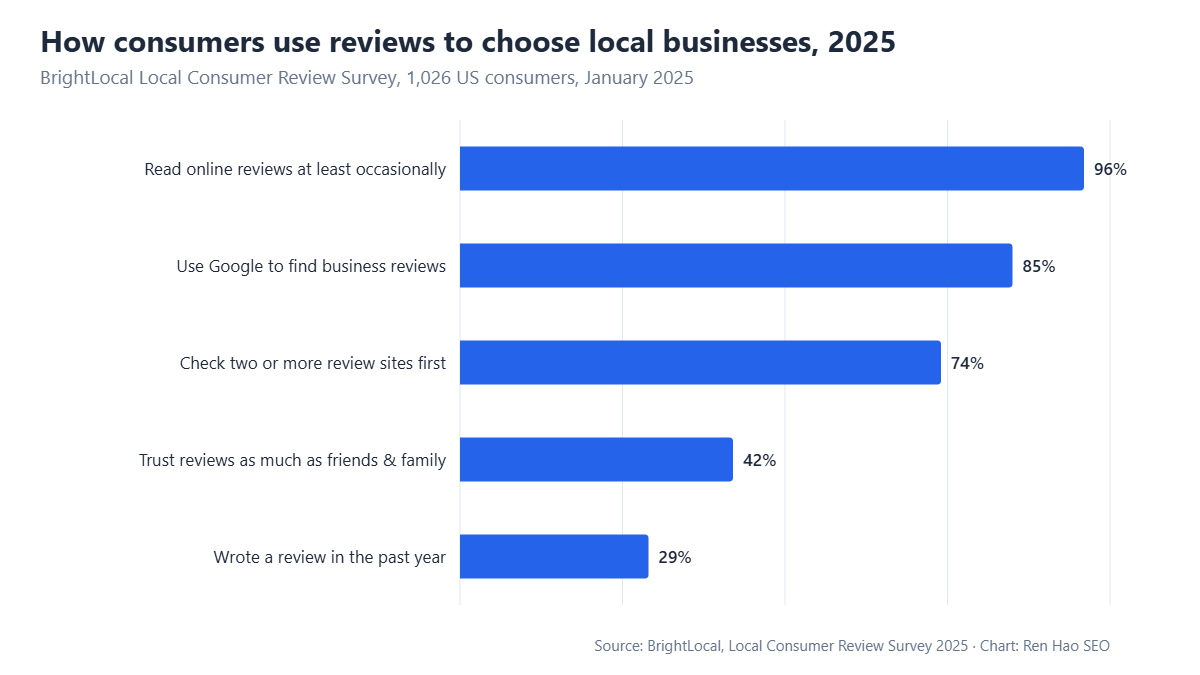
Reviews replaced directories as the comparison layer of local search because they are first-party in origin, hard to scale artificially, and visible directly on Google. With 85% of consumers checking reviews on Google itself and 74% consulting two or more review sources before deciding, review velocity, recency and response quality now do the job that directory ratings used to do, and they do it inside the map pack.
Treat reviews as a data operation rather than a favor you ask occasionally. Instrument the request: a post-service message with a direct review link, sent at the moment satisfaction peaks, with the ask varied by channel and measured by conversion. Respond to every review, because responses are content Google indexes and buyers read. Watch the distribution across platforms, because Google weights consistency: a five-star Google average next to a two-star average on an industry platform is a credibility problem, not a rounding error. And track the words your reviewers use, because those words are the vocabulary of your category’s search queries and belong in your evaluation pages.
- 85%of consumers look for reviews on Google first
- 74%check two or more review sites before deciding
- 42%trust reviews as much as personal recommendations
The measurement layer is straightforward. Track review count and average rating by month for your profile and your three closest competitors, log response time to new reviews, and correlate review velocity with map pack impressions in the Business Profile performance report. In the profiles we manage, the relationship between sustained monthly review growth and map pack visibility is the most reliable one in local search, which is why it deserves a process rather than a reminder.
One caution: never fabricate or incentivize reviews with rewards that violate platform terms. The same update cycle that demoted directories also tightened enforcement on fake engagement, and a review-gating penalty removes the asset you are trying to build.
Multi-location and multi-market: structure that survives the next update
Businesses with several locations or several countries face the same test the directories failed: their location pages are, from Google’s point of view, potentially scaled content. The pages that survive are the ones where each location page carries information that is true only of that location, and where country-level versions are correctly signaled rather than duplicated.
For multi-location businesses, the rule is one page per location with unique local evidence: the team at that branch, the services it actually offers, its reviews, its opening hours, its photography, its local pricing factors. A page that swaps the city name in a shared template is the pattern the June update targets, and it is also the pattern that converts worst. For multi-country businesses the additional layer is technical: each market page needs the correct hreflang signal so that Google serves the right country version, and our guide to international SEO and hreflang covers the implementation, including the x-default and self-referencing rules that most sites get wrong.
The ownership structure also matters. Keep location and market pages on your own domain rather than on a directory’s hosted profile; the demotion showed how quickly rankings held on a third party’s domain can vanish. If you need a partner to design that architecture and the evidence layer that fills it, our local SEO services are built around exactly this post-shake-up model: first-party pages, Business Profile operations and review systems, measured against the queries that actually vacated in your market.
Google Search Central: what site owners should know about core updates. Google Search Central: spam policies, including scaled content abuse. BrightLocal: Local Consumer Review Survey 2025.