
The Complete Local SEO Guide for Businesses
Local SEO is how area-based businesses win customers from search — high-intent searchers ready to call, visit or buy nearby. This practical guide covers the essentials of ranking locally, building on our beginner’s guide to local SEO with a focus on the factors that genuinely move local rankings. It reflects how we approach real local SEO work.
- Local search shows a ‘local pack’ (map + 3 listings); ranking there is the goal of local SEO.
- Your Google Business Profile is the biggest local ranking driver — optimise it fully and keep it active.
- Reviews and NAP consistency are powerful local factors; build a review habit and fix inconsistent listings.
- Add local on-page signals (location, NAP, schema, real location pages) and locally relevant content.
- Build local authority and treat local SEO as ongoing — it compounds with steady effort.
How local search works
When Google detects local intent — a location in the query, ‘near me’, or a search that usually has local intent — it shows localised results, most visibly the ‘local pack’ (a map with typically three business listings) above or near the top of the page. Ranking in that local pack, and in the localised organic results below it, is the goal of local SEO.
The 2026 core updates changed who holds the best-of and comparison queries in most local categories. Our analysis of local SEO after the 2026 directory shake-up shows which openings appeared and how a single business page can inherit a demoted listicle.
Local ranking weighs factors specific to location alongside the usual SEO signals: your Google Business Profile, proximity to the searcher, the consistency of your business information across the web, and your reviews. So local SEO needs its own playbook on top of sound general SEO.
Google Business Profile: the foundation
Your Google Business Profile is the single biggest driver of local pack visibility, so optimise it fully: claim and verify it, choose accurate categories, complete every field (description, hours, services, attributes), add quality photos regularly, and use Google Posts to stay active. Treat it as a living asset, not a set-and-forget listing — an actively maintained, complete profile signals a genuine, responsive business and is rewarded with visibility.
A huge proportion of businesses leave their profile half-finished, which is exactly the gap you can exploit by doing it thoroughly.
Reviews and NAP consistency
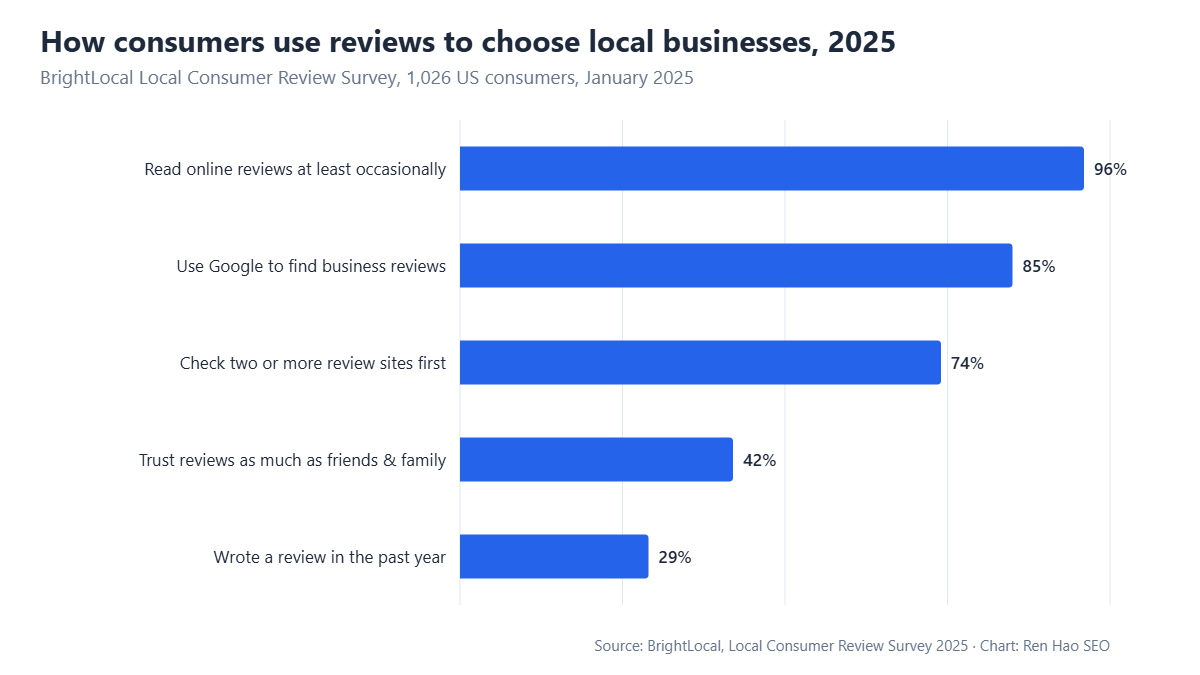
Reviews strongly influence both local rankings and whether customers choose you. Build a systematic habit of earning genuine reviews — ask satisfied customers at the right moment, make it easy, and respond professionally to all of them. Never buy fake reviews; it violates Google’s policies and risks penalties.
NAP consistency — keeping your Name, Address and Phone number identical everywhere online — is a foundational local factor. Inconsistencies confuse search engines and erode trust, so audit and fix discrepancies across your site, Google Business Profile, directories and listings, and build accurate citations on relevant, reputable platforms.
On-page local signals and local content
Your website matters too. Include your location naturally in titles, headings and content; put your NAP on the site; add a map and local business schema markup; and, if you serve multiple areas, create genuinely useful location-specific pages (not thin doorway pages). Locally relevant content — addressing local questions, events and customer needs — builds local relevance and helps you rank for a wider range of local searches.
Local authority and ongoing effort
Build local authority through links and mentions from local and relevant sources — local news, chambers of commerce, community organisations, sponsorships — which signal you’re a genuine, established part of your community. And treat local SEO as ongoing: maintain your profile, keep earning reviews, and stay consistent, because local SEO compounds with steady effort.
Because local search is often less competitive than national SEO, disciplined execution of these fundamentals can produce strong results relatively quickly. To see where your local presence stands and what to prioritise, a free SEO audit is a good starting point. For the step-by-step beginner version, see our local SEO for beginners guide.
The local ranking system, demystified
Google’s local results weigh three factors: relevance (does your profile and site clearly state what you do?), distance (proximity to the searcher — the one factor you can’t optimise), and prominence (reviews, links, citations and overall reputation). Since you can’t move your premises, the levers are relevance and prominence: a completely filled, correctly categorised Business Profile; a website whose pages reinforce each service and area; and a steady accumulation of genuine reviews and local mentions.
The compounding loop most businesses miss: review velocity and review responses feed prominence; prominence lifts map-pack visibility; visibility produces customers who leave more reviews. Starting that flywheel — politely, systematically asking every happy customer — outperforms almost any other single local tactic.
Local SEO mistakes that keep good businesses invisible
- 1Wrong or diluted primary categoryThe primary category is your strongest relevance signal. ‘Marketing agency’ when you mean ‘SEO agency’ costs map-pack positions daily.
- 2Inconsistent name, address and phoneConflicting details across directories erode Google’s confidence in your existence. Audit and align everywhere.
- 3Ignoring reviews — or worse, faking themUnanswered reviews signal neglect; purchased ones risk platform and regulatory penalties. Earn them, answer all of them.
- 4Doorway pages for every suburbThin near-duplicate area pages are a documented spam pattern. Build genuinely distinct pages only where you have a real presence or story.
- 5A profile that’s never updatedPhotos, posts, hours, services — staleness reads as closure. Fifteen minutes a week keeps the profile alive.
Local search in the AI era
AI assistants answer ‘best X near me’ by synthesising the same signals — profiles, reviews, citations, local content — which means a strong classic local presence is also your AI-recommendation strategy. Notably, review text matters more than ever: assistants quote and paraphrase what customers actually wrote. A profile rich in detailed, genuine reviews is now marketing copy you didn’t have to write, distributed by every AI that answers local queries.
A weekly local-visibility routine
- 1Monday — profile pulseTen minutes: new questions answered, hours verified, one fresh photo or post. Active profiles outrank abandoned ones.
- 2Midweek — review engineEvery completed job triggers a polite review request with the direct link. Respond to every review, positive or negative, within the week.
- 3Monthly — citation sweepCheck name-address-phone consistency on the directories that matter in your market; fix drift immediately.
- 4Quarterly — competitor checkSearch your money terms from your service area. Who entered the pack, what categories and review velocity do they run? Adjust.
Troubleshooting a map-pack drop
Pack positions move for findable reasons. Check in order: profile suspension or edits (Google sometimes applies category or name changes silently); a competitor’s review surge (velocity beats totals — check their last 90 days); category mismatch after a Google taxonomy update; new entrants physically closer to the search centroid; and review stagnation on your side — three months without fresh reviews reads as decline.
Diagnose before reacting: most panicked ‘optimisation’ after a drop addresses none of these and occasionally trips spam filters. The fix that works is the one matched to the actual cause.
For the primary sources, see Google’s documentation on local ranking factors and Google’s hreflang documentation for international targeting.
Written by the Ren Hao SEO team and reviewed by Ren Hao, founder and lead SEO strategist. Our guidance comes from real client work — over 100 SEO audits and $1,500,000+ in client sales value generated with white-hat, data-driven methods — not recycled theory.