
International SEO & Hreflang: Targeting Multiple Markets
Expanding into multiple countries or languages brings real SEO complexity — done wrong, you can confuse search engines, split your authority, or serve the wrong content to the wrong market. This guide explains how to do international SEO properly: choosing a site structure, implementing hreflang, and targeting multiple markets effectively. It reflects how we approach international SEO for clients expanding across markets.
- International SEO ensures the right content reaches the right market and search engines serve the right version.
- Three structures: ccTLDs (strong signal, split authority), subdirectories (consolidate authority, usually best), subdomains (in between).
- Hreflang tells search engines which language/region version to show — fiddly but important to get right.
- Adapt and localise content per market (not just translate), and do keyword research per market.
- Build authority in each market — it’s essentially doing good SEO market by market on a sound foundation.
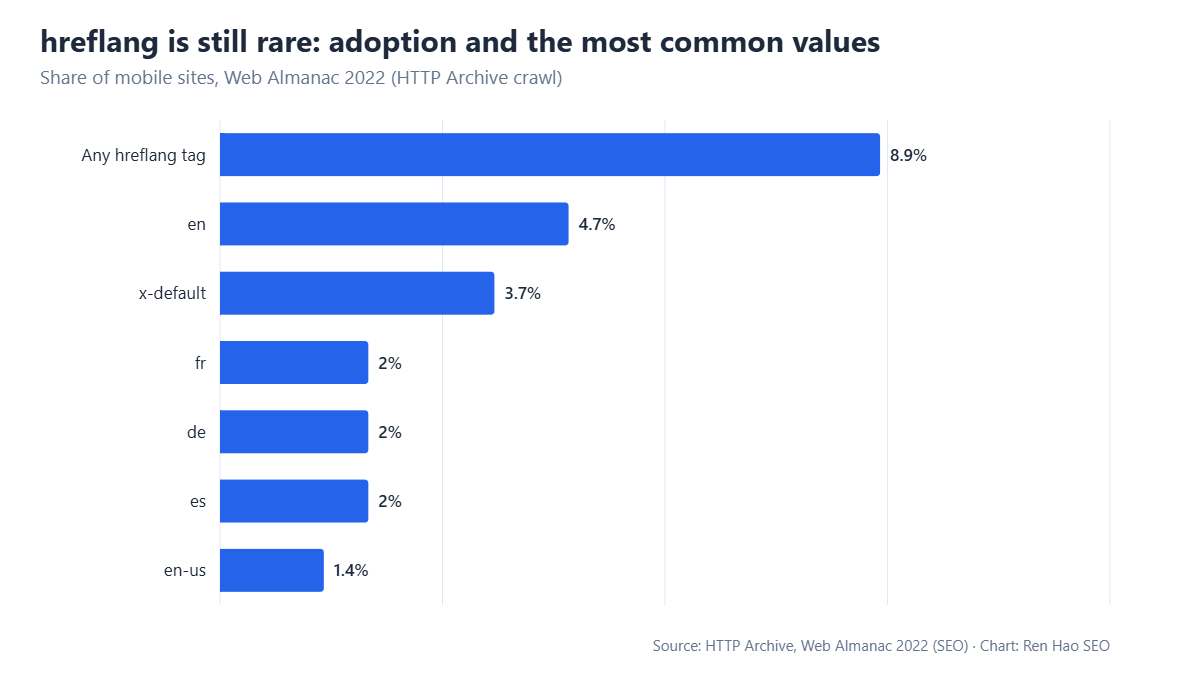
What international SEO involves
International SEO is the work of optimising your site so the right content reaches the right audience in each country or language you target, and so search engines understand which version to show where. It involves decisions about site structure, language and country targeting, hreflang annotations, and adapting content for different markets — all while consolidating rather than splitting your authority.
Multi-country businesses face the same scaled-content test that demoted the directories in 2026: location and market pages survive only when each carries information unique to that place. Our guide to local SEO after the directory shake-up explains how that test applies to multi-location structures alongside correct hreflang signals.
The goal is for a searcher in each market to find the version of your site intended for them — the right language, currency, and locally relevant content — and for search engines to serve it confidently. Get this right and you compete effectively in each market; get it wrong and you undermine yourself everywhere.
Choosing a site structure
There are three main structures for international sites. Country-code top-level domains (example.de) send the strongest geographic signal but split authority across separate domains and cost more to maintain. Subdirectories (example.com/de/) keep all authority on one strong domain and are usually the most practical choice for most businesses. Subdomains (de.example.com) sit between the two.
For most businesses, subdirectories on a single domain are the pragmatic recommendation: they consolidate authority, are simpler to manage, and work well with hreflang. The right choice depends on your resources and how distinct your markets are, but splitting authority across many ccTLDs is rarely worth it unless you have strong reasons and the resources to build authority for each.
Implementing hreflang correctly
Hreflang annotations tell search engines which language and regional version of a page to show to which users — for example, that you have an English version for the US, English for the UK, and German for Germany. Implemented correctly, hreflang prevents the wrong version showing in the wrong market and stops your own regional versions competing against each other.
Hreflang is notoriously fiddly to get right: every version must reference every other version (including itself), language and region codes must be correct, and the annotations must be consistent. Errors are common and can undermine the whole setup, so it’s worth implementing carefully and validating. This is one of the more technical areas where expert help often pays for itself.
Adapting content and building local authority
Beyond structure and hreflang, genuine international SEO means adapting content for each market — not just translating words, but localising for language nuance, currency, local relevance and search behaviour, which can differ significantly between countries. Keyword research should be done per market, since the terms and intent people use vary by language and region.
You also need to build authority in each market, ideally with locally relevant links and a presence that’s credible there. International SEO is essentially doing good SEO multiple times over, market by market, on a sound technical foundation. If you’re expanding internationally and want to get the structure and strategy right from the start, a free SEO audit and our international SEO service can help you avoid the common, costly mistakes.
Getting hreflang right: the rules that matter
Hreflang fails silently, so precision matters. The non-negotiables: every page in a language/region group must reference every other and itself (self-referencing, fully reciprocal — if A claims B as its alternate, B must claim A back or Google ignores both); codes must be valid ISO language and region pairs (en-GB, not en-UK — a mistake that invalidates the annotation); every referenced URL must be a live, indexable, canonical page; and x-default should mark the page for unmatched users. Annotations can live in the head, HTTP headers or the sitemap — pick one source of truth and keep it generated, not hand-edited.
The mental model: hreflang doesn’t boost rankings. It routes them — telling Google which of your equivalent pages to show in which market, and declaring that your localised versions are deliberate alternates, not duplicate content. Routing plus duplicate-protection is the entire job, and it’s worth doing perfectly.
International SEO mistakes beyond hreflang
- 1Translating instead of localisingWord-for-word translation misses what each market actually searches. Keyword research must be done natively per market.
- 2One page targeting many countriesA single ‘global English’ page can’t carry country-specific pricing, proof and intent. Equivalent localised pages win.
- 3Geo-redirecting crawlers and users by IPForced redirects prevent Google from ever seeing alternate versions. Suggest, don’t force; let hreflang do the routing.
- 4Mixed signalsHreflang saying one thing while canonicals point elsewhere cancels both. Canonicals must be self-referencing within each localised version.
- 5Identical content with swapped place namesSearch-and-replace localisation invites duplicate-content consolidation. Each market version needs genuinely local substance.
Structuring a multi-country site that scales
Architecture choices compound. Subdirectories (/au/, /sg/) on one strong domain concentrate authority and are the pragmatic default; country-code domains signal maximum local commitment but split authority across properties; subdomains sit awkwardly between. Whatever the structure, the scaling discipline is the same: a shared global layer for genuinely universal content, localised market layers for everything commercial, and automated hreflang generation across the whole set — because hand-maintained annotations across hundreds of pages and multiple markets will drift into silent failure within months.
Implementing hreflang without the usual disasters
- 1Choose one source of truthHead tags, HTTP headers or XML sitemap — pick one, generate it programmatically from your URL inventory, never hand-edit.
- 2Generate from real URLsBuild annotations from pages that actually exist and are indexable. Mapping by slug-pattern guesswork creates dead targets and broken reciprocity.
- 3Validate the full matrixEvery page references every alternate including itself; every reference is mutual; every code is a valid ISO pair. Audit the whole set, not samples.
- 4Align canonicalsEach localised page self-canonicalises. A canonical pointing across markets silently cancels the hreflang routing.
- 5Re-validate on every releaseSite changes break annotations invisibly. A post-deploy hreflang check belongs in the release checklist.
Monitoring international performance after launch
Hreflang’s job is routing, so measure routing: in Search Console (per property or filtered by directory), watch each market’s pages earning impressions in their own country and the wrong-country impressions declining. Persistent cross-market leakage — the UK page surfacing in Australia — means broken reciprocity or conflicting canonicals on that group; the cure is auditing that specific cluster, not adding more annotations.
Expect weeks, not days, for routing to settle after launch, and longer for large sites. Stability plus correct per-market impressions is the success signal; chasing day-to-day fluctuations during settling only obscures it.
For the primary sources, see Google’s documentation on local ranking factors and Google’s hreflang documentation for international targeting.
Written by the Ren Hao SEO team and reviewed by Ren Hao, founder and lead SEO strategist. Our guidance comes from real client work — over 100 SEO audits and $1,500,000+ in client sales value generated with white-hat, data-driven methods — not recycled theory.