
Why SEO Matters for Malaysian Businesses in 2026
For Malaysian businesses weighing where to spend a limited marketing budget, SEO is often the highest-return option over time — yet it is widely misunderstood. This guide explains, with data-grounded honesty, why organic search matters so much in the Malaysia market, how it compounds into a defensible advantage, and where it fits against paid channels. No hype, no ranking guarantees.
- Malaysia buyers research on Google before they buy — SEO puts you in front of them at the decision moment.
- Unlike paid ads, SEO compounds: the authority you build keeps working long after the spend.
- Over 12–24 months, organic typically becomes the most cost-efficient acquisition channel for Malaysia SMBs.
- SEO is a patient investment, not a quick fix — but it builds a moat competitors struggle to cross.
Malaysian businesses are already investing in search
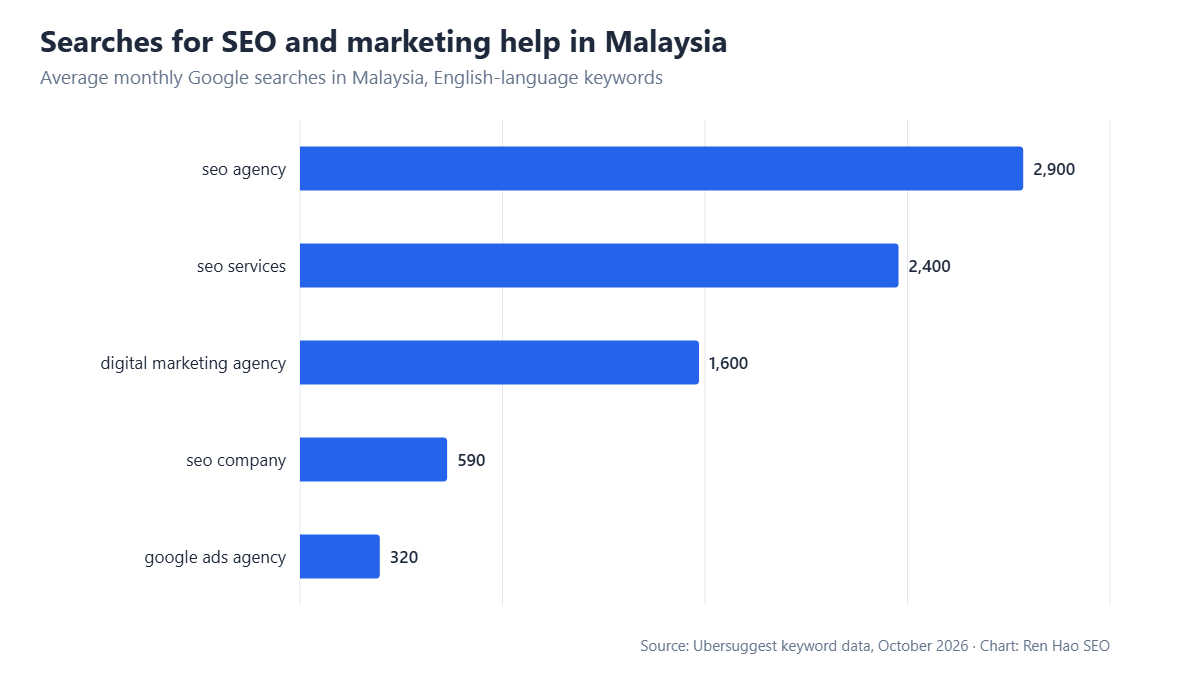
The clearest sign that SEO matters in Malaysia is how many businesses are looking for help with it. Ubersuggest data for October 2026 shows about 2,900 searches a month in Malaysia for “seo agency” and 2,400 for “seo services”, ahead of “digital marketing agency” at 1,600 and far ahead of “google ads agency” at 320.
Deciding which city to prioritise? See how SEO demand differs across Malaysian cities.
If you sell software on subscription, the playbook changes. SaaS SEO in Malaysia shows how to turn search demand into trials and pipeline.
Those searches are your competitors and peers deciding to invest. Each month they do and you do not, they add pages, reviews and links that will be harder to catch later. The good news is that most Malaysian categories are still far from saturated, so a business that starts properly now can still lead.
Logistics is the clearest example of a Malaysian industry where the buyer's shortlist is built on Google before any RFQ is sent: shippers search by gateway and lane. Our guide to logistics and freight SEO in Malaysia, from Port Klang to global lanes shows how forwarders capture those searches.
Selling across the causeway? Our guide to cross-border SEO for Malaysian SMEs targeting Singapore maps the categories, objection content and market signals that convert Singaporean buyers.
If your customers search in two languages, start with our bilingual keyword strategy for Bahasa Malaysia and English — the demand data most Malaysian competitors never look at.
Malaysia buyers search before they buy
Whether someone in Kuala Lumpur is choosing an accountant, an Petaling Jaya shopper is comparing products, or a business in Penang is evaluating software, the journey almost always runs through search. If your business is invisible at that moment — sitting on page two while a competitor holds page one — you are invisible at the exact point the decision is being made.
This is the core case for SEO in Malaysia: it is not about traffic for its own sake, but about presence at the precise moment your future customers are deciding who to trust. Capturing that demand before competitors enter the conversation is the real prize.
Why SEO compounds when paid does not
A paid campaign stops working the moment your budget does — turn off the spend and the leads disappear. Well-executed SEO behaves differently: the rankings and authority you earn this quarter keep delivering qualified Malaysia visitors next quarter, and the one after. Over 12 to 24 months that compounds into a defensible moat competitors struggle to cross.
That compounding is why, for most Malaysia SMBs, organic becomes the most cost-efficient acquisition channel over time. The cost per lead falls as authority builds, while paid costs tend to rise with competition. SEO and paid work best together — but only SEO builds a durable asset.
SEO vs paid: the honest comparison
Paid search is fast and predictable — ideal for immediate demand and testing. SEO is slower to start but compounds and does not stop when you pause spending. The smartest Malaysian businesses use paid to capture demand now and SEO to build a durable, lower-cost channel for the long term.
The mistake is treating them as either/or, or expecting SEO to behave like paid (instant, switchable). It is a patient investment. Most Malaysia campaigns see meaningful movement within 3–6 months and stronger compounding gains over 6–18 months.
What good SEO actually involves
Genuine SEO is an integrated system, not a checklist: technical excellence (a fast, crawlable site), intent-matched content (built around how Malaysia buyers actually search), and authoritative, white-hat link building (earning credibility), all measured against pipeline and revenue. Skip any one and the others underperform.
If you want to understand the cost side, see our honest guide to how much SEO costs in Malaysia. If you want it handled, explore our Malaysia SEO services.
The Malaysian search landscape in 2026
Malaysia is one of the most digitally connected markets in the world. According to the Department of Statistics Malaysia, the overwhelming majority of Malaysia households have internet access, and search remains the dominant way people research products, services and providers before they buy. For Malaysian businesses, this means that whether someone is choosing an accountant in Petaling Jaya, comparing solar installers in Penang, or evaluating software for a Kuala Lumpur startup, the decision journey almost always passes through a search engine.
What makes this decisive is intent. A person searching “emergency plumber Penang” or “best CRM for small business Malaysia” is not browsing — they are close to a decision. If your business is visible at that moment, you have a chance to win them; if you are on page two, you are effectively invisible at the precise point that matters most. This is the core argument for SEO in Malaysia: it puts you in front of buyers at the moment of intent, in a market where almost everyone searches first.
The compounding maths: why SEO out-earns paid over time
The most important — and least understood — property of SEO is that it compounds. A paid search campaign delivers leads only while you are paying; the moment you pause the budget, the leads stop. Well-executed SEO behaves like an asset: the authority, content and rankings you build this quarter keep delivering qualified Malaysia visitors next quarter, and the one after, often for years.
Consider the rough shape of the two curves. With paid, your cost per acquisition tends to stay flat or rise as competition increases, and your lead volume tracks your spend exactly. With SEO, the early months require investment with limited return as foundations are built — but as authority compounds, the cost per acquisition falls and the traffic keeps growing without proportional extra spend. Somewhere between 12 and 24 months, for most Malaysia SMBs, organic crosses over to become the lowest-cost, highest-volume channel. The businesses that win are the ones patient enough to fund the early build-up — which is exactly why understanding realistic SEO costs and budgeting is so important.
SEO vs paid vs social: where each fits for Malaysian businesses
- 1SEO (organic search)Best for capturing high-intent demand at the lowest long-run cost. Slow to start, but compounds into a durable asset. The foundation of sustainable growth for most Malaysian businesses.
- 2Paid search (Google Ads)Best for immediate demand and testing. Fast and predictable, but stops the moment you stop paying, and costs tend to rise with competition. Works best alongside SEO, not instead of it.
- 3Paid socialBest for demand generation and brand building, reaching people before they are actively searching. Strong for visual and impulse categories, weaker for high-consideration B2B purchases.
- 4The integrated approachThe smartest Malaysian businesses use paid to capture demand now while SEO builds a compounding, lower-cost channel for the long term — then shift budget toward organic as it matures. See our Malaysia SEO services for how we build this.
Industry by industry: what SEO looks like across Malaysia sectors
SEO is not one-size-fits-all; what ‘good’ looks like depends heavily on your industry. For Malaysian SaaS companies, it means building topical authority that lowers customer acquisition cost over a long B2B buying cycle — see our SaaS SEO page. For fintech and healthcare, both ‘Your Money or Your Life’ (YMYL) categories, Google demands exceptional trust signals and demonstrable expertise, and content must comply with the Consumer Protection Act 1999 — covered on our fintech and healthcare pages. For eCommerce, it is category and product optimisation at catalogue scale, detailed on our eCommerce SEO page. For local and service businesses, it is local SEO — Google Business Profile, citations and reviews.
The common thread is that each sector rewards genuine, data-driven depth tailored to how its buyers actually search — not a generic checklist. That is why we build industry-specific strategies rather than applying the same playbook everywhere.
Common reasons SEO ‘fails’ for Malaysian businesses
When a business tells us SEO ‘didn’t work’ for them, the cause is almost never that SEO is ineffective — it is one of a handful of avoidable mistakes. The most common is impatience: stopping at three or four months, before the compounding has begun. The second is unfocused effort — spreading thin content across dozens of unrelated topics instead of building genuine authority on the themes closest to a buying decision. The third is neglecting technical foundations, so that even good content cannot rank. The fourth is chasing vanity keywords that bring traffic but no qualified buyers.
Each of these is fixable with a data-driven approach: prioritise ruthlessly, build the technical foundation first, measure against revenue rather than traffic, and give the work time to compound. Our guide to choosing an SEO agency explains how to find a partner who works this way, and a free audit will tell you honestly where your current approach is falling short.
Measuring SEO ROI honestly
Because SEO compounds and assists other channels, measuring its return requires more than counting rankings. The honest metrics are business metrics: organic-sourced enquiries, pipeline and revenue, tracked over 12+ months. Rankings and traffic are leading indicators — useful, but only meaningful insofar as they translate into qualified buyers. A page-one ranking for a keyword nobody valuable searches is worthless; a page-three ranking for a high-intent commercial term may be worth chasing hard.
We report against pipeline and revenue in MYR, and we set realistic, data-grounded expectations rather than promising specific numbers — both because it is honest and because the Consumer Protection Act 1999 requires it. If you want to model the potential return for your own business, our pricing guide and a free audit are the place to start.
Case studies: what SEO has done for Malaysian businesses
The abstract case for SEO becomes concrete when you look at real Malaysia results. A B2B SaaS platform we worked with was stuck on page two and dependent on rising paid costs; a data-driven topical-authority strategy grew its organic traffic 320% in eight months and turned organic into its biggest pipeline source — the full story is in our SaaS case study. A Malaysia online retailer cut its blended customer acquisition cost by 40% by building organic as a lower-cost channel — see the eCommerce case study. A fintech in a heavily regulated, YMYL niche earned page-one rankings against established competitors by building genuine E-E-A-T — the fintech case study.
What these have in common is not luck but method: ruthless prioritisation, technical foundations fixed first, genuine authority built on the themes closest to a buying decision, and everything measured against revenue rather than vanity metrics. As always, results vary by starting point, competition and market, and we set realistic expectations in line with the Consumer Protection Act 1999 rather than promising specific outcomes. But the pattern is consistent: patient, data-driven SEO compounds into a business’s most reliable channel.
The risk of doing nothing
It is easy to frame SEO as a discretionary investment — something to do when there is spare budget. But this misses the competitive reality of Malaysian search. Search demand for your category exists whether or not you compete for it; the only question is who captures it. Every month you are absent from page one, a competitor is capturing the buyers who were looking for exactly what you offer, and — because SEO compounds — they are building authority that gets harder to displace over time. The cost of doing nothing is not zero; it is the steady, compounding loss of market share to competitors who showed up.
This is especially acute in growing or consolidating Malaysia markets. In sectors where a few players are building dominant organic positions now — many B2B and SaaS categories, competitive local markets — the window to establish authority cost-effectively narrows each year. The businesses that invest early, while competition is still winnable, secure positions that later entrants must pay far more to challenge. Doing nothing feels safe because the cost is invisible, but it is real and it compounds.
Building an SEO-ready organisation
Getting full value from SEO is not only about what an agency does; it is about how ready your organisation is to support and capitalise on it. The most successful Malaysia SEO programmes have a few organisational ingredients: leadership that understands SEO is a 12-month-plus investment, not a switch; a willingness to act on technical recommendations (developer time to implement fixes); subject-matter input for genuinely expert content; and a way to capture and value the enquiries SEO generates, so its ROI is visible. Where these are present, SEO compounds faster and ROI is clearer.
Conversely, the most common organisational blockers are slow developer implementation (great recommendations that never get built), thin internal input (forcing generic content where expertise was needed), and poor lead tracking (so SEO’s contribution is invisible and under-funded). A good agency will flag these and help you address them, because the partnership only works if both sides play their part. To explore how we work with Malaysian businesses, see our services and start with a free audit.
The strategic role of SEO in your marketing mix
SEO should not sit in isolation; its real power emerges when it is integrated into your wider marketing and business strategy. Organic search captures demand that already exists — people actively looking for what you offer — which makes it the most efficient channel for converting intent into customers. But it works best alongside demand-generation channels (paid social, content marketing, PR) that create awareness, and alongside conversion optimisation that turns the traffic SEO earns into actual enquiries and sales. SEO that drives traffic to a poorly-converting site wastes much of its value, which is why we pair it with conversion rate optimisation.
Viewed strategically, SEO is the channel that compounds and lowers your blended customer acquisition cost over time, creating a durable competitive advantage. Paid channels are a tap you turn on and off; SEO is an asset you build. The businesses that understand this allocate budget accordingly — funding the patient build of an organic asset while using paid to capture demand in the meantime — and over several years they find themselves with a powerful, low-cost channel competitors cannot easily replicate. That is the strategic case for treating SEO as core infrastructure, not a discretionary line item.
Frequently asked questions about SEO for Malaysian businesses
Is SEO worth it for a small Malaysian business? For most, yes — over time it is often the highest-ROI channel because it compounds. The key is realistic expectations and patience: meaningful results take 3–6 months to begin and 6–18 months to compound. A small business that commits properly often finds SEO becomes its most reliable source of new customers.
How is SEO different in Malaysia compared to other countries? The fundamentals are universal, but the execution must be local: Malaysian search behaviour, local intent and neighbourhood-level targeting, MYR pricing, the .com.my domain landscape, and compliance with the Consumer Protection Act 1999 and the Personal Data Protection Act 2010. Generic offshore SEO that ignores these underperforms in the Malaysian market.
Can I do SEO myself? You can do the basics — a well-optimised Google Business Profile, sound on-page content, fixing obvious technical issues — and for a small local business that may take you a meaningful distance. But competitive SEO requires expertise, tools and sustained time that most business owners cannot spare. The honest answer is that DIY suits early-stage and very local situations; competitive growth usually needs specialist help. Our technical SEO checklist is a good DIY starting point.
What happens if I stop doing SEO? Unlike paid ads, your rankings do not vanish overnight — the authority you have built persists for a time. But search is dynamic: competitors keep improving, Google keeps evolving, and your content ages. Over months, a site that stops investing gradually loses ground. SEO is best thought of as an ongoing investment that maintains and grows an asset, not a one-time purchase.
What SEO solves for a Malaysian business
SEO is worth the investment when it removes a problem the business has today:
- Dependence on paid clicks and marketplaces. Ads stop when the budget stops, and marketplace fees rise. Rankings you earn keep bringing customers to a channel you own.
- Being invisible in one language. Malaysians search in Bahasa Malaysia, English and Chinese. Covering the languages your customers use opens demand competitors miss, as our bilingual keyword guide shows.
- Losing local customers to better-listed rivals. A complete Google Business Profile and consistent local information decide who gets the call.
- Being known only by word of mouth. Search lets customers outside your existing network find you, in other states and across the Causeway.
What a Malaysian business owns at the end of year one
The lasting return on SEO is a set of assets that belong to you and keep working whether or not you are spending. For a Malaysian business twelve months in, those assets usually look like this:
- A library of pages in the languages your customers use, answering the questions they ask before buying, written under your own team’s names. Competitors can copy the topics, not the experience behind them.
- A Google Business Profile with a year of answered reviews in Malay, English and Chinese, which decides who gets the call in Klang Valley, Penang or Johor local searches.
- Mentions and links from Malaysian publications, directories and partners, which are what move competitive national terms and cannot be bought credibly.
- A channel you own. Enquiries that arrive without a Shopee fee, a Google Ads bill or a marketplace commission, at a cost per lead that falls each quarter.
- Standing in your category. Journalists, partners and AI assistants cite the business that consistently gives the clearest answers, and that reputation stays with you.
All of it is built from what your business already knows. SEO is the discipline of writing it down clearly, in the right languages, where the people searching for it can find it. A free SEO audit shows where you stand against the competitors in your category and which of these assets to build first.
Why data-driven SEO outperforms guesswork
Throughout this guide we have returned to one phrase — data-driven — and it is worth explaining why it matters so much, because it is the single biggest differentiator between SEO that compounds into a valuable asset and SEO that quietly wastes money. Most underperforming SEO fails not because the people doing it lack effort, but because they work from assumptions and ‘best practice’ rather than evidence about your specific market, customers and site. They target keywords that feel relevant rather than ones the data shows your buyers actually use; they produce content on topics they assume matter rather than ones the search data confirms have demand and winnable competition; they apply generic technical fixes rather than diagnosing what is actually constraining your particular site.
The result is activity that looks like SEO but does not move the metrics that matter, because it is aimed at the wrong targets. A data-driven approach inverts this: every decision — which keywords to pursue, what content to build, which technical issues to fix first, how to allocate budget — is grounded in evidence about your real situation, so effort lands where it generates genuine return.
For Malaysian businesses specifically, data-driven SEO means starting from your market’s actual search demand, your real competitors’ strengths and gaps, your site’s measured technical health, and your genuine business goals — then continuously measuring results against revenue and refining the approach based on what the data shows is working. This is not only more effective; it is more accountable and more honest. It produces realistic, evidence-grounded expectations rather than inflated promises (which also keeps it compliant with the Consumer Protection Act 1999), and it lets you see exactly what is being done, what is moving, and what comes next.
It is also the foundation of trustworthy SEO in the AI era, where genuine authority and accuracy — not gaming tactics — determine visibility. This evidence-first discipline is the core of how we work, and it is why we begin every engagement with diagnosis rather than a fixed package. To see what a data-driven assessment of your own site reveals, request a free Malaysia SEO audit and read how we apply this thinking across our services.
Search volumes are from Ubersuggest (October 2026).
Written by the Ren Hao SEO team and reviewed by Ren Hao, founder and lead SEO strategist. Ren Hao SEO is a data-driven international SEO agency serving Malaysian businesses, with 100+ SEO audits and RM 5M+ in client sales value generated. We publish openly because an informed audience makes better decisions — and under the Consumer Protection Act 1999, we never guarantee rankings.