
AI Search in Australia: Getting Cited in AI Overviews & ChatGPT
Search in Australia is changing fast: AI Overviews, ChatGPT and answer engines increasingly sit between your business and the customer. This guide explains how AI search works, how it differs from traditional SEO, and how Australian brands stay visible — and get cited — as discovery shifts. Forward-looking, data-grounded, with no hype.
- AI Overviews and chatbots increasingly answer queries directly, changing how Australians discover brands.
- Getting cited in AI answers depends on genuine authority, clarity and structured, trustworthy content.
- Traditional SEO fundamentals still matter — AI visibility builds on them, it does not replace them.
- Brands that adapt now will own the next decade of organic visibility.
In the Australian market
This guide is written for the Australian market specifically. Australia’s mature, English-language search landscape — with demand concentrated in the major metros, high competition for valuable terms and sophisticated buyers who compare carefully — means the tactics that work here reward depth, evidence and genuine local relevance over volume.
The AI search visibility side of this deserves its own treatment. Our guide to Optimising for Google AI Overviews in Australia (2026) goes deeper: Google AI Overviews now answer many Australian searches directly at the top of the results page, often before the traditional blue links.
The AI search visibility side of this deserves its own treatment. Our guide to ChatGPT & AI Assistants goes deeper: More Australians than ever research products, services and providers using AI assistants like ChatGPT, Perplexity and Gemini before they buy.
Related reading: Mining Services B2B SEO: Winning Contracts via Search — it picks up where this section leaves off.
Which Australian sources AI answers lean on, and how to become one of them
Australian AI Overviews and assistant answers draw on a fairly small set of local sources: comparison sites such as Canstar and Finder for money questions, productreview.com.au for consumer goods and services, directory and marketplace data from Yellow Pages, hipages and Oneflare for tradies, Google Business Profiles for anything with a suburb in it, and .gov.au pages for regulated topics. If your business is missing from those sources, or described differently on each, the model has no consistent Australian evidence to cite. Fix the facts where you already appear before you commission new content.
There is also a publisher dimension that is peculiar to Australia. The News Media Bargaining Code, and the wider debate the Australian Competition and Consumer Commission has led on digital platforms, keeps the question of how search engines use and pay for local journalism firmly on the policy agenda. For an ordinary business the lesson is practical rather than political: do not treat one mention in a masthead as your main third-party proof. Comparison, review and directory records are updated more often, are structured, and are what answer engines tend to reuse for commercial questions.
| Source | Queries where it tends to surface | What to check this month |
|---|---|---|
| Canstar, Finder | “best home loan”, “cheapest health insurance”, energy plan comparisons | Product names, rates and fees match your website and product disclosure documents on the same date |
| productreview.com.au | “is [brand] legit”, “[brand] reviews”, mattress, pet food and appliance categories | Listing claimed, category correct, factual replies to critical reviews |
| Yellow Pages, hipages, Oneflare | tradie and service queries with a suburb or region | Identical trading name, phone and service area; licence number where the platform allows it |
| Google Business Profile | “near me”, suburb + state queries, opening-hours questions | Primary category, suburb-level service areas, public-holiday hours for each state |
| .gov.au pages | eligibility, rules, statistics | Your pages link to the official source and never contradict it |
The Australian naming convention matters more to an AI answer than most site owners realise. Locals search and write with the suburb and state together, “Parramatta NSW”, “Fitzroy VIC”, “Fortitude Valley QLD”, partly because suburb names repeat across states: there is a Richmond in Victoria, New South Wales, Queensland and Tasmania. A service page that says only “Richmond” gives an assistant an ambiguous fact; one that says “Richmond VIC, 3121” does not. The same applies to licences, which are issued by state bodies, so a plumbing or electrical page should say which state licence you hold rather than simply “fully licensed”.
Device context matters too. The Australian Communications and Media Authority’s research on how Australians use the internet has for years shown the smartphone as the main way adults go online, and the Australian Bureau of Statistics remains the reference for population and household data by region. Use those official sources when you describe your market, and link them: a page that cites the ABS for a regional figure is easier for an assistant to trust than a page that asserts the same figure unsourced.
Finally, put your ABN on the site as text. It is a public, verifiable identifier on the Australian Business Register, it ties your trading name to a legal entity, and it removes one of the easiest ways for an answer engine to confuse you with a similarly named business in another state.
Claims an assistant can repeat: Australian Consumer Law, ASIC and sector rules
Anything an AI assistant lifts from your site becomes a claim made in your name, so Australian pages need to stay lawful when a single sentence is quoted out of context. The Australian Consumer Law’s ban on misleading or deceptive conduct looks at the overall impression a representation creates, and a quoted line in an AI Overview can create a very different impression from your full page. The fix is to write every quotable sentence so it is true on its own, with its qualification attached.
That principle plays out differently by sector. Credit providers and financial advisers work under ASIC’s licensing and advertising regime, which means an advertised interest rate needs its comparison rate beside it and general advice needs its warning, in the same passage rather than a footer. NDIS providers should use precise language, “registered NDIS provider” rather than looser phrases such as “NDIS approved”, because an assistant will repeat whichever wording you publish. Health practitioners regulated under the national law cannot use testimonials about clinical care in advertising, so a clinic page built around patient outcome quotes is a liability whether a person or a model reads it.
- ✓Self-contained superlatives“Best”, “cheapest” and “fastest” appear only with their basis in the same sentence, for example the comparison date and the products compared.
- ✓Licence and registration numbers as textAustralian Financial Services or credit licence number, state trade licence, NDIS registration: near the claim, not only as an image in the footer.
- ✓Total price in AUDA single total price including GST and compulsory fees, as the component pricing rules require, so the figure an assistant quotes is the figure the customer pays.
- ✓Lawful use of reviewsNo selective publication of favourable reviews, no incentives without disclosure, and no clinical testimonials for regulated health services.
- ✓Dated rates and feesEvery rate, fee or waiting time carries an “as at” date so a cached answer can be recognised as old.
- ✓Privacy handled under Australian lawEnquiry forms and chat tools comply with the Privacy Act 1988 and the Office of the Australian Information Commissioner’s guidance, and customer data is never pasted into third-party AI tools without a lawful basis.
Two habits make this sustainable. First, keep a claims register: a simple sheet listing every factual claim on your key pages, its evidence and its review date, owned by the person who would answer an ACCC enquiry. Second, test how assistants currently describe you. Ask Google’s AI Mode and at least one chat assistant the questions your customers ask, for example “is [brand] a registered NDIS provider in Brisbane” or “what does [brand] charge for a switchboard upgrade in Perth”, and compare the answer with your own pages. Where the answer is wrong, the source is usually an outdated directory listing or an old blog post on your own site, and both can be corrected.
If you would rather have that comparison done for you, our Australian SEO audit now includes a check of how AI answers describe your business against the facts on your site, and the Australian case studies show how we document evidence for regulated clients.
How AI search is changing discovery
AI Overviews in Google, plus tools like ChatGPT and Perplexity, increasingly answer questions directly — often without the user clicking through to a website. For Australian businesses, this means visibility is no longer only about ranking blue links; it is about being the source the AI cites and trusts. The brands that adapt now will own the next decade of organic visibility.
How AI search differs from traditional SEO
Traditional SEO is about ranking your page; AI search is about being synthesised into an answer. AI systems favour content that is clear, well-structured, genuinely authoritative and trustworthy — and they cite sources that demonstrate real expertise. The good news: these overlap heavily with what good SEO has always rewarded.
The difference is emphasis. Clarity, structure (headings, concise answers, FAQs), and demonstrable E-E-A-T matter even more for AI citation than for traditional rankings.
How to get cited in AI answers
Build genuine topical authority, answer questions clearly and directly, structure content so machines can parse it (clear headings, concise summaries, FAQs, schema), and demonstrate real expertise and trust signals. For Australian brands, local relevance and accurate, compliant information also help. This is exactly what our AI SEO service focuses on.
Don’t abandon traditional SEO
AI visibility builds on traditional SEO fundamentals — it does not replace them. A fast, crawlable, authoritative site with genuine expertise ranks well and gets cited by AI. The smartest Australian strategy optimises for Google, Bing and AI answer engines together. See why SEO matters for the fundamentals.
How AI is reshaping search in Australia
Search is changing faster than at any point in its history. Google’s AI Overviews now answer many queries directly at the top of the results page, and a growing share of Australians use AI tools like ChatGPT, Perplexity and Gemini to research before they buy. For businesses, this represents a fundamental shift: visibility is no longer only about ranking blue links, but about being the source the AI cites, summarises and trusts. Google’s announcements on AI in Search is the best place to track how Google’s AI search features are evolving.
This is not a distant future — it is happening now, and the brands that adapt early will own a disproportionate share of the next decade’s organic visibility while competitors scramble to catch up. The encouraging news for Australian businesses is that the foundations of AI visibility overlap heavily with what good SEO has always rewarded.
How AI search differs from traditional SEO
Traditional SEO is about ranking your page so a user clicks through; AI search is about being synthesised into an answer the user may never click away from. This changes the emphasis in important ways. AI systems favour content that is clear, well-structured, genuinely authoritative and trustworthy, and they cite sources that demonstrate real expertise. Clarity and structure — concise answers, logical headings, FAQs, well-organised explanations — matter even more for AI citation than for traditional ranking, because the AI must be able to extract a clean answer.
The continuity is reassuring: the same genuine expertise, helpful content and technical soundness that earn traditional rankings also earn AI citations. AI search raises the bar on clarity and trust; it does not throw out the rulebook.
How to get cited in AI answers
- 1Build genuine topical authorityAI systems, like Google, favour sources with demonstrated depth and expertise on a topic. Comprehensive, expert content is the foundation.
- 2Answer questions clearly and directlyStructure content to give clean, extractable answers — lead with the answer, then elaborate. Vague, meandering content is hard for AI to cite.
- 3Structure content for machinesUse clear headings, concise summaries, FAQs and well-organised sections so AI systems can parse and extract your content.
- 4Implement structured data (schema)Schema markup helps AI and search engines understand your content’s meaning — see Google Search Central.
- 5Demonstrate E-E-A-TExperience, Expertise, Authoritativeness and Trustworthiness — genuine author credentials, accurate information and trust signals — increasingly determine who gets cited.
- 6Keep information accurate and currentAI systems favour reliable, up-to-date sources. For Australian businesses, accurate, compliant information (per the Australian Consumer Law) also builds the trust AI rewards.
E-E-A-T and why it matters more in the AI era
Google’s emphasis on E-E-A-T — Experience, Expertise, Authoritativeness and Trustworthiness — has grown steadily, and AI search amplifies it. When an AI system decides which sources to synthesise and cite, it leans heavily on signals of genuine expertise and trust: who wrote the content and are they qualified; is the information accurate and current; does the wider web treat this source as authoritative. For ‘Your Money or Your Life’ topics — finance, health, legal — this scrutiny is highest, which is why our fintech and healthcare strategies put E-E-A-T at the centre.
Practically, this means real author bylines with genuine credentials, accurate and well-cited information, and building the kind of authority — through quality content and earned links — that makes the wider web treat you as a trusted source. It is the opposite of thin, anonymous, AI-generated filler.
Don’t abandon traditional SEO foundations
A crucial caveat: AI visibility builds on traditional SEO fundamentals — it does not replace them. A fast, crawlable, well-structured site with genuine authority both ranks well in traditional results and gets cited by AI. If your technical foundations are broken, your content thin, or your authority weak, no amount of ‘AI optimisation’ will save you. The smartest Australian strategy optimises for Google, Bing and AI answer engines together, on a sound technical base — see our technical SEO checklist and why SEO matters guide.
In other words: do the fundamentals well, add the clarity and structure that AI rewards, and you are positioned for both today’s search and tomorrow’s.
Preparing your Australian business for the AI search era
- For Australian businesses, the practical path forward is clear. Audit your current foundations — technical health, content depth, authority and E-E-A-T signals. Strengthen the basics where they are weak. Then add the AI-specific layer: clearer structure, extractable answers, schema, and genuine expertise signals. Track your visibility not just in traditional rankings but in AI Overviews and chatbot answers for your key queries. And keep your information accurate and compliant with the Australian Consumer Law, because trust is the currency of AI search.
- This is exactly what our AI SEO service is built to do. To see where your business stands and what to prioritise, start with a free Australian SEO audit.
The shift from clicks to citations
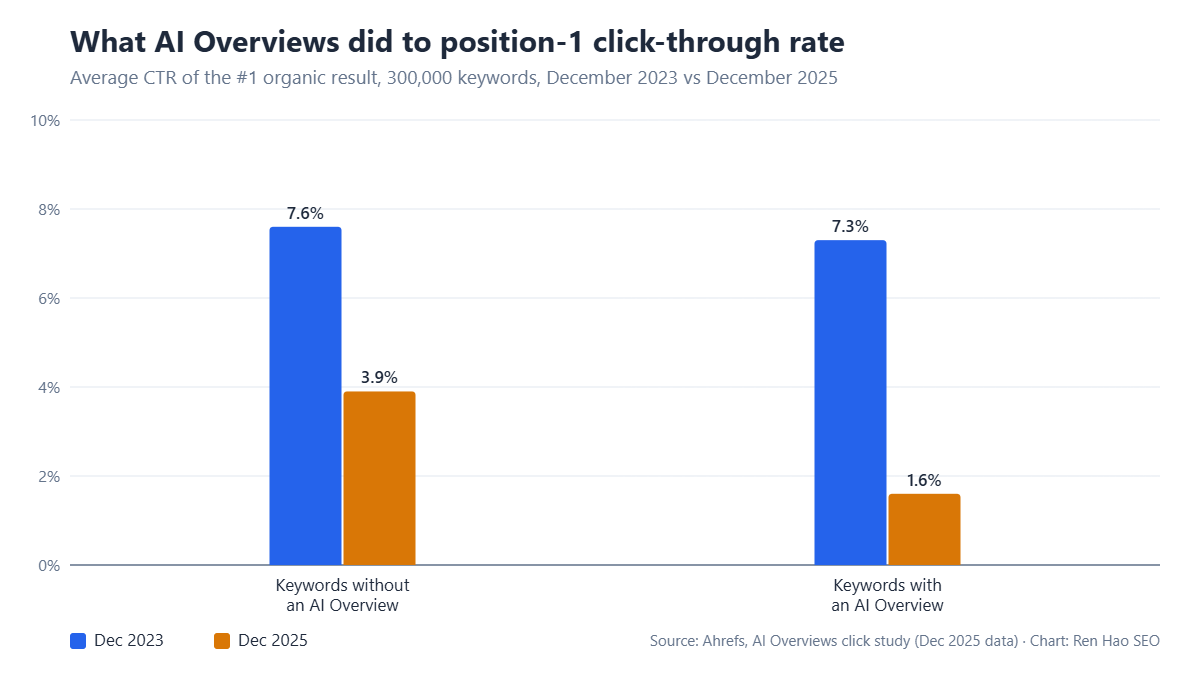
Perhaps the most profound change AI search brings is a shift in what ‘visibility’ even means. In traditional search, visibility meant a ranking that earned a click to your site. In AI search, an AI Overview or chatbot may answer the user’s question directly, citing your site as a source without the user ever clicking through. This worries many businesses — fewer clicks — but it also creates a new opportunity: being the cited, trusted source shapes the buyer’s understanding and shortlist even before they visit a site, and brands that are consistently cited build authority and familiarity that pays off when buyers do reach a decision.
The practical response is to optimise for both: continue earning clicks through strong traditional SEO, while also positioning your content to be the source AI systems cite. These are not in conflict — the same authority, clarity and trust that earn citations also earn clicks. What changes is that you must now measure and value citation-based visibility alongside click-based visibility, tracking whether your brand appears in AI answers for your key queries.
Practical AI-search optimisation techniques
- 1Lead with the answerStructure content so the direct answer to a likely question comes first, then elaborate. AI systems extract clean answers more easily from this structure.
- 2Use clear question-based headingsHeadings phrased as the questions users actually ask help AI (and users) find and extract relevant answers.
- 3Add concise summaries and FAQsSummary sections and FAQ blocks give AI systems clean, extractable, citable units of information.
- 4Implement comprehensive schemaStructured data helps AI understand your content’s meaning and context — see Google Search Central.
- 5Demonstrate genuine expertiseReal author credentials, accurate information and depth signal the trustworthiness AI systems favour when choosing sources to cite.
- 6Keep content current and accurateAI systems favour reliable, up-to-date sources; stale or inaccurate content is less likely to be cited, and inaccurate claims can breach the Australian Consumer Law.
What AI search means for different Australian businesses
The impact of AI search varies by business type, and understanding your exposure helps you prioritise. Informational and research-heavy categories — where buyers ask questions AI can answer directly — see the biggest shift, and need to focus hard on being the cited source. Transactional and local businesses are less disrupted in the short term (someone wanting an emergency plumber still needs to contact one), but even here AI is increasingly involved in the research and shortlisting stage. B2B and considered-purchase categories sit in between: AI shapes early research, but human decision-making and direct engagement still dominate the final choice.
For most Australian businesses, the right posture is neither panic nor complacency. AI search is a real, accelerating shift, but it rewards the same fundamentals as good SEO always has — genuine authority, clarity, trust and technical soundness — with added emphasis on structure and extractability. Businesses that build on solid foundations and add the AI-specific layer will thrive; those with weak foundations cannot ‘AI-optimise’ their way out of it. Our AI SEO service helps Australian businesses position for both today’s and tomorrow’s search.
Australian Competition and Consumer Commission: ACCC consumer law and digital platforms work. Australian Communications and Media Authority: ACMA research on internet use. Australian Bureau of Statistics: ABS population and household data. Australian Securities and Investments Commission: ASIC licensing and advertising guidance. Office of the Australian Information Commissioner: OAIC privacy guidance. Ahrefs: AI Overviews click-through study.
Frequently asked questions about AI search in Australia
How do I get my business cited in Google’s AI Overviews? Build genuine topical authority, answer questions clearly and directly (lead with the answer), structure content for extraction with clear headings, summaries and FAQs, implement schema, and demonstrate real expertise and trust signals. These overlap heavily with what good traditional SEO already rewards.
Does traditional SEO still matter now that AI search exists? Absolutely — AI visibility builds on traditional SEO fundamentals rather than replacing them. A fast, crawlable, authoritative site with genuine expertise both ranks in traditional results and gets cited by AI. Weak foundations cannot be ‘AI-optimised’ around.
Will AI search reduce my website traffic? It may reduce some informational clicks where AI answers directly, but it creates a new form of visibility — being the cited, trusted source that shapes buyer understanding before they choose. The right response is to optimise for both clicks and citations, which the same authority and clarity serve.
Is AI search actually relevant for Australian businesses yet? Increasingly, yes. Australians use ChatGPT, Perplexity and Google’s AI Overviews to research before buying, so being visible and cited in AI answers is becoming as important as traditional rankings — especially for research-heavy and B2B categories. See our AI SEO service.
What should I do first to prepare for AI search? Get your fundamentals right — technical health, content depth, authority and E-E-A-T — then add the AI-specific layer of clear structure, extractable answers and schema. A free audit will show where you stand.
Building an AI-ready content foundation
Preparing for AI search is less about chasing the latest tactic and more about building a content foundation that AI systems can trust, understand and cite. The cornerstone is genuine expertise made visible: real author credentials, accurate and well-sourced information, and demonstrable experience in your field. AI answer engines, like Google’s own ranking systems, lean heavily on signals of E-E-A-T when deciding which sources to synthesise and cite, and for ‘Your Money or Your Life’ topics — finance, health, legal — that scrutiny is highest. Building this foundation means investing in content written or genuinely reviewed by qualified people, keeping information current and accurate (which also keeps you compliant with the Australian Consumer Law), and earning the kind of authority across the web that makes AI systems treat you as a trustworthy source rather than one voice among many.
On top of that foundation sits the structural layer that makes content machine-extractable. AI systems work best with content that leads with clear answers, uses descriptive question-based headings, includes concise summaries and FAQ sections, and is marked up with accurate schema so its meaning is explicit. None of this means writing for machines at the expense of humans — the same clarity and structure that help AI extract answers also help human readers, and the same genuine depth that earns AI citations also earns reader trust and traditional rankings.
The businesses best positioned for the AI era are therefore not those chasing AI-specific gimmicks, but those building genuinely excellent, well-structured, authoritative content on a sound technical foundation. That is a durable strategy regardless of how the specific AI products evolve, and it is exactly what our AI SEO service is built around. To assess your readiness, start with a free audit.
Measuring and adapting in a fast-changing AI landscape
AI search is evolving rapidly, and a sensible strategy includes a way to measure and adapt rather than setting tactics in stone. The first step is to expand what you measure: alongside traditional rankings and organic traffic, begin tracking your visibility in AI Overviews and chatbot answers for your key queries — are you being cited, and how does your brand appear in AI-generated summaries of your category? This is a newer and less mature discipline than traditional rank tracking, but even a manual review of how AI tools answer your most important queries reveals whether you are present in the answers your buyers increasingly rely on. Watching this over time shows whether your AI-readiness work is paying off and where gaps remain.
The second step is to stay adaptable without overreacting. AI search products change frequently — features come and go, the prominence of AI Overviews shifts, new tools gain traction — and chasing every change is a recipe for wasted effort. The durable strategy is to keep building the fundamentals that consistently matter (genuine authority, clarity, trust, technical soundness) while monitoring the landscape closely enough to adjust emphasis as it becomes clear what is enduring versus transient. Following primary sources like Google’s announcements on AI in Search helps separate signal from noise.
For Australian businesses, the reassuring conclusion is that you do not need to predict exactly how AI search will evolve to prepare for it well — you need to build the genuine quality and structure that serve both today’s search and whatever comes next, and to measure and adapt as the picture clarifies. That balanced, evidence-based posture is how we approach AI search for clients, rather than selling speculative AI hype.
Putting it together: an AI-search action plan for Australian businesses
For an Australian business wanting to act on all of this rather than simply absorb it, here is a practical action plan that balances ambition with realism. Begin with an honest assessment of your foundations, because AI visibility builds on them: is your site technically sound, crawlable and fast; is your content genuinely authoritative and deep; do you have real E-E-A-T signals; and how does your brand currently appear when you ask the major AI tools about your category and key queries? This baseline tells you whether your priority is fixing fundamentals (usually the case for sites with weak technical health or thin content) or adding the AI-specific layer on an already-solid base. Resist the temptation to chase AI tactics while fundamentals are broken — it does not work, because no amount of AI optimisation rescues a site Google and AI systems cannot trust or properly access.
With fundamentals addressed, layer on the AI-readiness work: restructure key content to lead with clear answers, add question-based headings, summaries and FAQ sections, implement accurate schema, and strengthen the genuine expertise and trust signals that make AI systems cite you — all while keeping information accurate and compliant with the Australian Consumer Law. Then expand your measurement to include AI-answer visibility alongside traditional rankings, and review it regularly so you can see what is working and adapt as the fast-moving landscape clarifies (following primary sources rather than hype).
The throughline is that preparing for AI search is not a gamble on predicting the future — it is the disciplined pursuit of genuine quality, clarity and trust that serves both today’s search and whatever comes next. That balanced, evidence-based approach is exactly how our AI SEO service works, and a free audit is the natural first step to assess where you stand and what to prioritise.
The enduring fundamentals beneath the AI hype
Amid the rapid change and considerable hype around AI search, the most valuable thing an Australian business can hold onto is a clear sense of what is genuinely enduring versus what is transient noise. The transient layer — which specific AI products dominate, exactly how AI Overviews are formatted this quarter, which new tool is generating headlines — changes constantly and is not worth chasing in detail. The enduring layer is remarkably stable and maps closely onto what good SEO has always rewarded: genuine expertise and authority on the topics you cover; accurate, trustworthy, current information; content that is clear, well-structured and genuinely helpful; and a technically sound site that systems can access, crawl and understand.
AI answer engines, for all their novelty, choose which sources to trust and cite using signals of exactly this kind, because their value depends on synthesising reliable information — and reliability has the same hallmarks whether the consumer is a human reader, a traditional search ranking algorithm, or an AI summarising the web.
This is genuinely good news for Australian businesses, because it means preparing for the AI era does not require betting on uncertain predictions or chasing every new tactic. It requires the disciplined pursuit of real quality: building genuine authority and expertise, keeping information accurate and compliant with the Australian Consumer Law, structuring content clearly enough for both people and machines to extract answers, and maintaining the technical foundations everything depends on. A business that does these things well is positioned to win in traditional search, in AI Overviews, and in whatever interfaces emerge next — because all of them reward the same underlying substance. The businesses that struggle in the AI era will be those that tried to shortcut this substance with thin, gamed or inaccurate content, which AI systems are increasingly able to see through.
The strategic conclusion is to invest in genuine quality and sound foundations, add the clarity and structure that make that quality machine-extractable, measure and adapt as the landscape clarifies, and resist both complacency and panic. That balanced, substance-first, evidence-based approach — rather than AI hype — is how we help Australian businesses prepare, through our AI SEO service built on the foundations covered in our technical SEO checklist. To assess where your business stands, start with a free audit.
Getting started: preparing your business for AI search today
For an Australian business wanting to act on AI search now rather than wait, the encouraging reality is that the first steps are concrete, achievable and valuable regardless of how the AI landscape evolves. Begin with an honest assessment of where you stand: check your technical foundations (is your site fast, crawlable and accessible to the systems that parse it?), evaluate the genuine depth and authority of your content, review your E-E-A-T signals (real author credentials, accurate information, demonstrable expertise), and — practically — ask the major AI tools about your category and key queries to see how, or whether, your brand appears in their answers. This baseline tells you whether your priority is strengthening fundamentals or adding the AI-specific layer, and it grounds your effort in evidence about your actual situation rather than generic advice.
From there, the work is clear and sequential: address any foundational weaknesses first, because AI visibility builds on the same fundamentals as traditional SEO and cannot be faked on a weak base; then layer on the AI-readiness improvements — restructuring key content to lead with clear answers, adding question-based headings, summaries and FAQ sections, implementing accurate schema, and strengthening the expertise and trust signals that make AI systems cite you — all while keeping information accurate and compliant with the Australian Consumer Law.
Finally, expand your measurement to track AI-answer visibility alongside traditional rankings, and review it regularly so you can adapt as the landscape clarifies. None of this is speculative; it is the disciplined pursuit of genuine quality, clarity and trust that serves both today’s search and whatever comes next. That is precisely the substance-first approach behind our AI SEO service, built on the foundations in our technical SEO checklist — and a free audit is the natural first step to assess your readiness and priorities.
AI search as an opportunity, not just a threat
Much of the discussion around AI search frames it as a threat — fewer clicks, disrupted traffic, uncertainty — but for Australian businesses willing to adapt, it represents a genuine opportunity that early movers can seize. The businesses that build the genuine authority, clarity and trust that AI systems reward will not merely survive the transition; they will capture a disproportionate share of the new, citation-based visibility while slower competitors are still treating AI as a problem to worry about rather than an opportunity to pursue. Being the source that AI tools consistently cite for your category builds brand familiarity and authority at the exact moment buyers are forming their shortlists, an advantage that compounds much as traditional SEO authority does. The window to establish this position, while many competitors hesitate, is open now and will narrow as awareness spreads.
Seizing the opportunity does not require predicting the future or chasing every new AI product; it requires acting on the enduring fundamentals with discipline and a little ahead of the crowd: build genuine expertise and authority, keep information accurate and compliant with the Australian Consumer Law, structure content so both people and machines can extract clear answers, maintain sound technical foundations, and measure your AI-answer visibility so you can see your progress and adapt. Australian businesses that take this proactive, substance-first posture turn the AI-search transition from a threat to be feared into an advantage to be built — positioning themselves for visibility across traditional search, AI Overviews and whatever interfaces come next. That opportunity-focused, evidence-based approach is exactly how we help clients prepare through our AI SEO service, and a free audit is the first step to assessing and seizing your own AI-search opportunity.
Written by the Ren Hao SEO team and reviewed by Ren Hao, founder and lead SEO strategist. Ren Hao SEO is a data-driven international SEO agency serving Australian businesses, with 100+ SEO audits and AUD $1.5M+ in client sales value generated. We publish openly because an informed audience makes better decisions — and under the Australian Consumer Law, we never guarantee rankings.