
SEO for Beginners: The Complete Step-by-Step Guide (2026)
If you are new to SEO, the sheer volume of advice online can be paralysing — a thousand tactics, endless jargon, and contradictory opinions about what matters. This complete beginner’s guide cuts through all of it with a clear, logical framework: what SEO actually is, why it genuinely works, and the exact order to tackle it in so you make real progress instead of spinning your wheels. We will cover the fundamentals, the step-by-step process, how to do keyword research and on-page optimisation, how links and authority work, how to measure what matters, and — crucially — the single biggest mistake that causes most beginners to fail. Everything here is grounded in real client work across many industries, not recycled theory. By the end, you will understand not just what to do, but why, and in what order — which is the difference between SEO that compounds and SEO that stalls.
- SEO improves your site to rank for the terms your buyers search — free, compounding, intent-driven traffic.
- It works because search combines high intent (people tell you what they want) with high trust.
- Follow the order: technical foundation, keywords, content, on-page, authority, measure.
- Keyword research is about intent, not just volume — match the content type Google already rewards.
- Create the genuinely best answer; write for people first, optimise second. Quality beats volume.
- Earn quality white-hat links; authority is the harder half and the biggest differentiator on hard terms.
- Measure against revenue and leads, not vanity metrics; treat it as a feedback loop.
- The biggest beginner mistake is scattering effort — focus and sequence ruthlessly for compounding results.
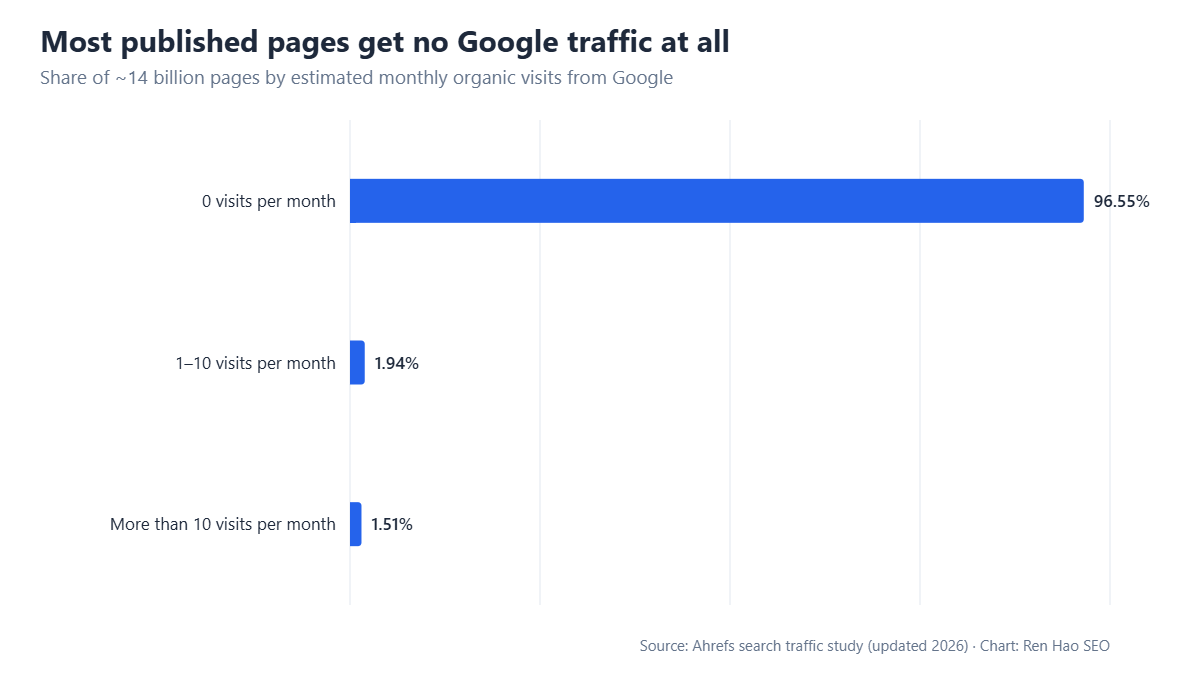
What SEO actually is (in plain English)
SEO stands for Search Engine Optimization: the practice of improving your website so it ranks higher on search engines like Google for the terms your potential customers are searching. The higher you rank, the more of that free, intent-driven traffic you capture. Unlike paid advertising, which stops the moment you stop paying, SEO focuses on organic — non-paid — traffic: visitors who find you naturally when they search for products, services or information related to your business.
That distinction is what makes SEO so valuable: it is an asset that compounds. A page that ranks well keeps earning traffic month after month without a per-click cost, and the authority you build over time makes future pages easier to rank. It is slower to start than ads, but far cheaper per visitor and far more durable over the long run — which is why organic search underpins most sustainable digital growth. Think of paid ads as renting traffic and SEO as owning the asset that produces it.
It helps to understand that SEO is not a trick you play on Google. Modern search engines are extraordinarily good at identifying genuinely useful, trustworthy content, and they get better every year. So the real goal of SEO is not to fool the algorithm but to genuinely be the best, most relevant, most trustworthy answer to what your audience is searching for — and then to make sure search engines can find, understand and trust that you are. Everything legitimate in SEO serves that goal.
Why SEO works so well
SEO works for two deep reasons that no amount of algorithm change will undo. The first is intent. Search is the one marketing channel where people actively tell you what they want, in their own words, at the moment they want it. Someone typing ‘best project management software for agencies’ is handing you their exact need. Showing up for that search means meeting a qualified buyer at the moment of highest interest — far more efficient than interrupting people who weren’t thinking about you at all, which is what most advertising does.
The second reason is trust. Users trust organic search results more than ads — they know the organic results earned their place rather than paying for it — and ranking highly itself signals credibility. When you combine high intent with high trust, you get a channel that does not just drive traffic but drives traffic that converts. This is precisely why we always optimise for revenue and leads, not just rankings: the point of SEO is qualified, ready-to-act visitors, not vanity numbers.
There is a third, compounding advantage worth understanding early. Because SEO builds durable assets — ranking pages and domain authority — its returns accumulate. The work you do this month keeps paying next year, and the authority you build makes everything after it easier. This is the opposite of paid channels, where you are back to zero the moment the budget stops. Over a multi-year horizon, this compounding makes SEO one of the highest-return investments in marketing — which our ROI calculator can help you estimate for your own business.
The step-by-step SEO framework
- 1Fix your technical foundationMake sure search engines can crawl and index your site, that it loads fast, and that it works flawlessly on mobile. Technical issues quietly cap everything else, so this comes first. See our Core Web Vitals guide.
- 2Research the right keywordsFind the terms your buyers actually use, prioritising high-intent searches closest to a buying decision over high-volume vanity terms. The right keywords are the foundation of everything that follows.
- 3Create genuinely useful contentBuild content that thoroughly answers the intent behind those searches — better than what currently ranks. Depth, accuracy and usefulness win; thin content does not.
- 4Optimise on-pageStructure each page so both users and Google understand it: clear titles, headings, internal links, and an excellent reading experience. Make each page unmistakably the best answer to its target query.
- 5Build authority through linksEarn relevant, white-hat links from trustworthy sites — the signal that lifts competitive rankings. See our link building approach.
- 6Measure and improveTrack against revenue and the rankings that matter, double down on what works, fix what doesn’t, and keep improving. SEO is iterative, not set-and-forget.
Keyword research: finding what your buyers search
Keyword research is the foundation of SEO because it tells you what to create content about and what to optimise for. Done well, it aligns your entire strategy with what your audience actually wants; done badly — or skipped — it leads to content nobody is looking for. The goal is not to find the keywords with the most searches, but the keywords with the right intent: terms your ideal customers use when they are close to needing what you offer.
Start by brainstorming the topics and problems your business solves, then expand them using keyword tools (Google’s own Keyword Planner, plus tools like Ahrefs, Semrush or free alternatives) to find the actual terms people search and roughly how often. For each candidate keyword, weigh three things: search volume (how many people search it), difficulty (how hard it will be to rank, given who already ranks), and — most importantly — intent (what the searcher actually wants, and how close that is to your offering). A lower-volume term with strong commercial intent and lower difficulty is usually far more valuable to a beginner than a high-volume term you have no chance of ranking for.
Pay special attention to search intent, because matching it is non-negotiable. The same words can carry different intent: ‘running shoes’ might be informational (someone researching) or transactional (someone ready to buy), and Google shows different kinds of results accordingly. Look at what currently ranks for a term — if it is all product pages, Google has decided the intent is transactional, and a blog post will not rank no matter how good it is. Always create the type of content that matches the intent Google is already rewarding for that term. We cover the deeper mechanics in how search engines work.
Creating content that ranks
Content is where most of SEO is won or lost, because genuinely useful content is what search engines ultimately want to rank. The principle is simple to state and hard to do: create the best, most complete, most useful answer to the search intent you are targeting — better than what currently ranks. That means thoroughly covering the topic, answering the questions a searcher actually has, and doing it more clearly and credibly than the competition.
Practically, good SEO content does several things at once. It matches intent precisely (the right type of content for the query). It is comprehensive without padding — covering what matters fully, but not stuffed with filler to hit a word count. It demonstrates genuine expertise and trust, ideally with real experience, data or examples, which is what the E-E-A-T (Experience, Expertise, Authoritativeness, Trust) framework rewards. And it is genuinely readable: clear structure, helpful headings, and a logical flow that serves the reader rather than the algorithm.
A common beginner mistake is writing for search engines instead of people — keyword-stuffing, producing thin pages for every minor keyword variation, or churning out volume. This backfires, because modern search engines reward genuine quality and increasingly recognise filler. Write for your reader first, optimise second. One genuinely excellent, comprehensive page that fully owns a topic will out-rank and out-last a dozen thin pages every time — and it is also what earns links and AI citations, as we explain in getting cited in AI Overviews.
On-page SEO: helping Google understand your pages
On-page SEO is everything you do on a page to help both users and search engines understand it and recognise it as the best answer. The good news for beginners is that the fundamentals are straightforward and high-impact. Each page should target a clear primary keyword and intent, and signal that clearly through a few key elements: a compelling, accurate title tag (the headline that appears in search results), a clear H1 heading, logical subheadings (H2s, H3s) that structure the content, and naturally-placed use of your target term and related terms throughout.
Beyond those basics, several on-page factors matter. A descriptive, readable URL helps. A well-written meta description, while not a direct ranking factor, influences whether people click your result. Internal linking — linking from one of your pages to another relevant one — is genuinely powerful and widely underused: it helps search engines discover and understand your pages, spreads authority around your site, and guides users to related content. Every article on this site, including this one, links internally to relevant guides and services for exactly this reason.
Images should be optimised too: compressed for speed, with descriptive alt text that helps accessibility and image search. And the whole page should offer an excellent experience — fast loading, mobile-friendly, easy to read — because user experience is both a ranking factor and a conversion factor. The aim of all on-page SEO is the same: make it effortless for a search engine to understand exactly what your page is about and to see that it genuinely deserves to rank, while making it a pleasure for a human to actually use.
Off-page SEO and authority: why links still matter
If on-page SEO is about making your page deserve to rank, off-page SEO is about proving to the wider web that it does. The dominant off-page factor is backlinks — links from other websites to yours. When a credible, relevant site links to you, it acts as a vote of confidence, and search engines treat these votes as a strong signal of authority and trust. This is, historically, one of the most important ranking factors, and it remains central to competing for anything valuable.
But not all links are equal — quality vastly outweighs quantity. A single link from a respected, relevant site is worth more than hundreds from low-quality or irrelevant ones, and spammy link-building can actively harm you. This is why we only ever practise white-hat link building: earning genuine links through great content, digital PR, and real relationships, rather than buying or manufacturing them. For a beginner, the best approach is to create content genuinely worth linking to, and to earn links through legitimate outreach and relationships over time.
Authority is broader than just links, too. Brand mentions, reviews, a consistent presence across the web, and overall reputation all contribute to how trustworthy search engines consider you — and, increasingly, how likely AI engines are to cite you. Building genuine authority is usually the harder, slower half of SEO, and it is often the biggest differentiator on competitive terms, which is why understanding the relationship between on-page and off-page SEO matters so much.
Measuring SEO: track what actually matters
SEO without measurement is guesswork, but measuring the wrong things is almost as bad as not measuring at all. The two essential, free tools are Google Search Console (which shows how you appear in Google search — your queries, clicks, impressions, rankings and any technical issues) and Google Analytics (which shows what visitors do once they arrive — traffic, behaviour and, crucially, conversions). Set both up from day one; they are your eyes on everything that follows.
The critical discipline is to measure against business outcomes, not vanity metrics. Rankings and traffic are means to an end; the end is leads, sales and revenue. A keyword ranking number one is worthless if it brings no qualified visitors who convert, while a modest ranking on a high-intent commercial term can be transformative. So track the metrics that connect to your business: organic conversions, leads generated, revenue from organic traffic, and the rankings of the specific terms that drive those outcomes. This is exactly the principle behind every result in our case studies — we report on pipeline and revenue, not just traffic.
Finally, treat measurement as a feedback loop, not a report card. The point of tracking is to learn what works so you can do more of it: which content earns traffic and conversions, which keywords are within reach, where visitors drop off. Use that insight to keep refining your strategy. SEO is iterative — the businesses that win are the ones that measure honestly, learn fast, and continuously improve, rather than setting a strategy once and hoping.
The single biggest beginner mistake
If there is one trap to avoid above all others, it is trying to do a little of everything at once and never giving any one area enough focus to break through. It is the most natural instinct in the world — the to-do list is long, so you chip away at all of it — but it is also the single most common reason SEO fails. SEO rewards depth and momentum: concentrated effort on the right priorities, in the right order, until each one actually moves. Beginners who scatter their effort across dozens of half-finished tactics get a little of nothing; those who sequence ruthlessly get compounding results.
This is why the framework in this guide is ordered deliberately, and why you should resist the urge to jump around. A technical foundation makes your content able to rank; great content gives links something worth pointing to; authority lifts content that already deserves to rank. Done in sequence, each step amplifies the next. Done all at once and half-heartedly, none of them reaches the threshold where it pays off. We care about this so much that we wrote an entire guide on it: why most SEO fails — it is the most important thing a beginner can internalise.
The practical takeaway: pick the highest-impact priority for your situation right now, focus on it until it genuinely moves, then move to the next. Depth over breadth, sequence over scatter, patience over panic. This single discipline will do more for your results than any individual tactic you could learn.
Common SEO myths that hold beginners back
Beginners are often slowed down not by what they don’t know, but by what they think they know that isn’t true. A few persistent myths are worth dispelling. The first is that SEO is a one-time task — ‘optimise the site and you’re done.’ In reality, SEO is ongoing: competitors improve, search engines evolve, and content needs maintaining and expanding. It is a discipline, not a project with an end date. Treating it as set-and-forget is a reliable way to slowly lose ground.
The second myth is that SEO is about tricks and loopholes. The era of gaming Google with keyword stuffing, hidden text or spammy links is long over — those tactics now get you penalised, not promoted. Modern SEO is about genuinely deserving to rank and making sure search engines can see that. Anyone selling you secret hacks or guaranteed number-one rankings is either out of date or not to be trusted; legitimate SEO sets realistic, data-grounded expectations, as we discuss in our guide to choosing an agency.
The third myth is that more is always better — more pages, more keywords, more links. As we have stressed throughout, SEO rewards focus and quality over volume. One excellent page beats ten thin ones; one great link beats a hundred spammy ones. And the fourth myth is that SEO is free. It is free of per-click costs, yes, but it costs time, effort and often investment to do well — the payoff is that, unlike paid traffic, that investment compounds into a durable asset rather than vanishing when you stop spending.
A realistic timeline: what to expect
One of the most important things for a beginner to get right is expectations, because unrealistic ones cause people to abandon SEO just before it starts working. SEO is a medium-to-long-term investment, and the timeline depends heavily on your starting point, your competition and how focused your execution is. But a rough, honest picture helps.
In the first one to three months, the work is mostly foundational — auditing, fixing technical issues, keyword research, and beginning content — and visible ranking movement is usually limited. This is the phase where the impatient give up, mistaking the necessary build-up for failure. From around three to six months, with focused execution, you typically start to see meaningful movement: rankings improving on your priority terms, organic traffic growing, and early conversions. From six to twelve months and beyond, the compounding really shows — authority builds, more pages rank, and the growth accelerates as everything reinforces everything else.
The key insight is that these returns compound, so the early patience pays off disproportionately. The business that commits to focused SEO and rides out the quiet early months ends up far ahead of the one that started, panicked at month two, and scattered or abandoned its effort. This is exactly why focused prioritisation and patience matter so much — and why sequencing for some early wins, even small ones, is so valuable for sustaining momentum and belief. Set realistic expectations from the start, and SEO will reward you; expect overnight miracles, and you will quit before the payoff.
Putting it all together
SEO can feel overwhelming at the start, but it reduces to a logical, learnable sequence. Understand that the goal is to genuinely be the best, most trustworthy answer to what your audience searches — then make sure search engines can find, understand and trust that you are. Fix your technical foundation, research the right keywords with the right intent, create genuinely useful content, optimise it on-page, build real authority over time, and measure relentlessly against revenue rather than vanity metrics. Above all, focus: do the right few things with enough concentration to break through, in the right order, rather than a little of everything.
Done this way, SEO becomes what it should be — a compounding growth engine that delivers qualified, ready-to-buy visitors at a fraction of the long-term cost of paid channels. It takes patience, because the foundations and authority take time to build, but the results are durable in a way few other channels can match. Whether you do it yourself with this guide or get expert help, the principles are the same.
If you would like to know exactly where to start for your specific site — your biggest opportunities, your bottlenecks, and what to prioritise first — that is exactly what a free SEO audit gives you: a prioritised, data-driven roadmap built on the same principles in this guide. And if you would rather have experts apply all of this for you, that is what our SEO services do every day, with the track record in our case studies to show for it. Either way, you now understand the fundamentals — and that understanding is the foundation everything else is built on.
The primary sources behind this guidance: Google’s helpful content documentation on what it rewards, and Google’s ranking systems guide for how those rewards are applied.
Written by the Ren Hao SEO team and reviewed by Ren Hao, founder and lead SEO strategist. Our guidance comes from real client work — over 100 SEO audits and $1,500,000+ in client sales value generated with white-hat, data-driven methods — not recycled theory.